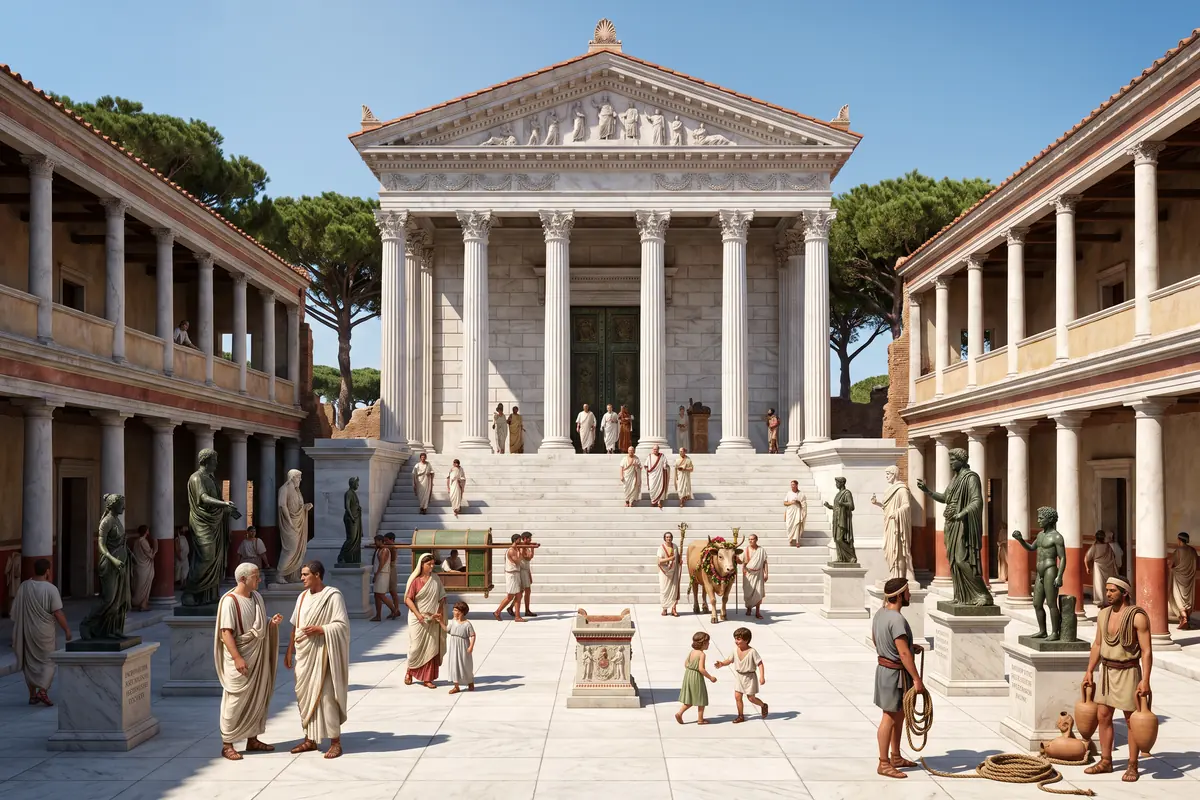
AI vision: the forum of Ostia around AD 150, the Capitolium in white marble with six columns and pediment, colonnades on both sides, statues on bases, men in togas, merchants, sailors, a litter, a priest with a bull on the steps
AI vision: the forum of Ostia on an autumn evening in 387, the temple still with marble and columns but weathered, grass between the slabs, empty statue bases, in the evening light an elderly woman in a dark cloak and a younger man in conversation
AI vision: the brick core of the Capitolium around 1804, buried to the podium in earth and reeds, marsh with pools of water, buffalo, workmen with picks in a trench, a gentleman in a top hat, a mule cart
AI vision: the excavation of the forum of Ostia around 1940, the Capitolium uncovered, the steps half out of the earth, narrow-gauge rails with tipping wagons, spoil heaps, scaffolding, dozens of workmen with picks and wheelbarrows, a man in a light suit with a notebook
The Capitolium of Ostia Antica today from the forum: the flight of steps, the brick core of the temple without columns, on the left the column of the basilica, blue sky (photo)
Documented Capitolium with six columns and marble cladding: plan, podium and marble remains documented, built around 120 under HadrianDocumented Flight of steps: surviving, marble steps documentedAssumed Colonnades of the forum: excavated, height and roofs assumedAssumed Travertine paving and statue bases: remains documented, distribution guessedInvented People, bull, litter, sailors
Documented Capitolium with marble: temple still standing in the 4th century, cult extinctDocumented Flight of steps: survivingAssumed Empty statue bases, grass in the paving: decline of the town from the 3rd century documented, condition guessedInvented The woman and the man: Augustine and Monica were at Ostia in 387, this evening is invented
Documented Brick core of the Capitolium without marble: the state of the photograph, marble robbing documentedDocumented Steps buried: the town lay under earth and reeds into the 19th centuryAssumed Marsh, buffalo, pines: silting and malaria documented, the picture guessedInvented Petrini’s excavation with the gentleman in the top hat: digging from 1801 to 1805 documented, the scene invented
Documented Capitolium uncovered: the state of the photograph, excavation of the forum completed by 1942Documented Steps half uncovered: Calza’s campaign of 1938 to 1942 documented, the state in 1940 guessedAssumed Narrow-gauge railway and wagons: usual on excavations of the time, not attested hereInvented Scaffolding, car, the men, the man with the notebook
Documented Capitolium: built around 120 under Hadrian, brick core surviving, marble robbed in the Middle AgesDocumented Flight of steps with marble treads: surviving, uncovered 1938 to 1942Documented Column of the basilica: forum excavated, porticoes and basilica surviving in remains

AI vision · artistic licence

The window of Ostia: one view, 1,900 years

You stand in a single spot, on the forum of Ostia, looking at the steps of the Capitolium. Time runs, you don’t. Scroll from a morning in the grain year 150 through the evening when Augustine stands at the window with his mother, the marsh and the pope’s excavation and Calza’s race for a world fair to the view that awaits you today.

I’m Ada Falk. I have spent my life sifting sand for traces of times gone by. This town did not die in a day; it took eight hundred years. I’ll show you how that works. I’ll guide you.

Ada is an invented narrator. The history is real: every fact and quotation is sourced, and the sources are listed at the end. The images are AI visions, not scientific reconstructions. The button “What is the evidence?” shows what is documented.

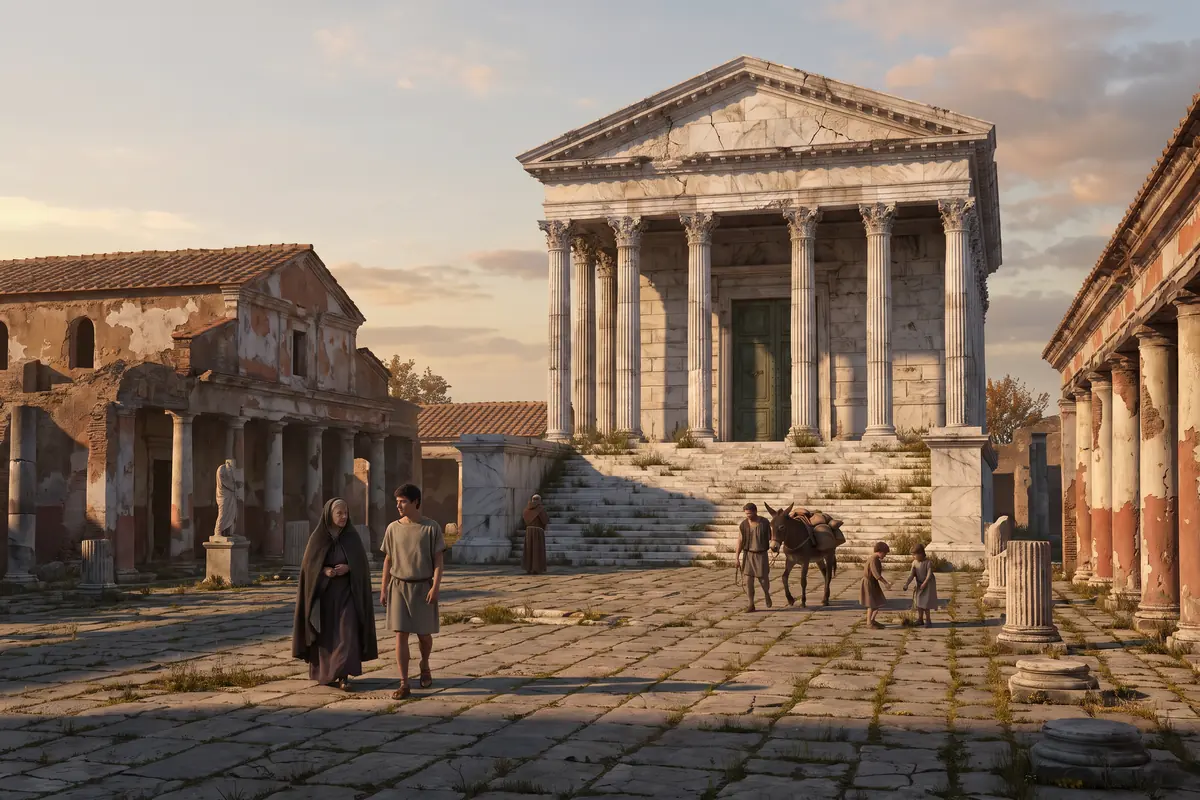
AI vision: the forum of Ostia around AD 150, the Capitolium in white marble with six columns and pediment, colonnades on both sides, statues on bases, men in togas, merchants, sailors, a litter, a priest with a bull on the steps

Diary 1 / 5 · around 150 · a morning in the season of the grain fleet

The forum of Ostia around AD 150: The town that keeps Rome fed

Stand here, on the forum, and look north. What you see is not a ruin but the heart of a town of perhaps fifty thousand people: the Capitolium, built thirty years ago under Hadrian, in white marble, six columns, a pediment, bronze doors. Right and left the colonnades, behind them the warehouses where the grain of Egypt waits before it goes up the Tiber to Rome. In the harbour lie the ships from Alexandria and Carthage; their owners have paved their offices behind the theatre with mosaics.

The temple and the steps stand where they stand in the photograph; their marble is documented, the columns are inferred from the plan and the foundations. The colonnades of the forum are excavated, their height guessed. The people, the bull, the litter: invented, from what a forum needed on a morning. Minucius Felix, a lawyer from Rome, came here a few decades later at the vintage to bathe in the sea. He called Ostia a very pleasant city.

A lawyer from Rome, around 200

„We agreed to go to that very pleasant city Ostia, that my body might have a soothing and appropriate remedy for drying its humours from the marine bathing, especially as the holidays of the courts at the vintage-time had released me from my cares.“

Minucius Felix, Octavius, chapter 2. Translation by Robert Ernest Wallis.

Image: AI vision based on a photo by Nicholas Hartmann (CC BY-SA 4.0), not a scientific reconstruction.

AI vision: the forum of Ostia on an autumn evening in 387, the temple still with marble and columns but weathered, grass between the slabs, empty statue bases, in the evening light an elderly woman in a dark cloak and a younger man in conversation

Diary 2 / 5 · autumn 387 · an evening

Ostia in the autumn of 387, Augustine and Monica: The window of Ostia

Two hundred and forty years later the forum is emptier. The harbour is now at Portus, three kilometres to the north; the warehouses are half empty, the statues of the emperors have gaps. The temple still stands, its cult does not: for seven years Christianity has been the state religion. In this town, in the autumn of 387, a man from North Africa waits with his mother for a ship to Carthage. His name is Augustine, he is 33 and newly baptised. Her name is Monica.

At the window of a house with a garden, he later writes, they talked about eternal life, alone, “removed from the din of men”. A few days later she fell ill with fever. She died at Ostia, aged 56, and was buried here. Which house it was, nobody knows; Ostia then had hundreds of houses with gardens, and nobody will ever find the window. The two figures in the evening light are my invention; the weathered temple, the grass, the empty bases follow the evidence of the 4th century.

The son, thirty years later

„It came to pass that she and I stood alone, leaning in a certain window, which looked into the garden of the house where we now lay, at Ostia; where removed from the din of men, we were recruiting from the fatigues of a long journey, for the voyage.“

Augustine, Confessions IX 10. Translation by Edward Bouverie Pusey (Project Gutenberg).

Image: AI vision based on a photo by Nicholas Hartmann (CC BY-SA 4.0), not a scientific reconstruction.

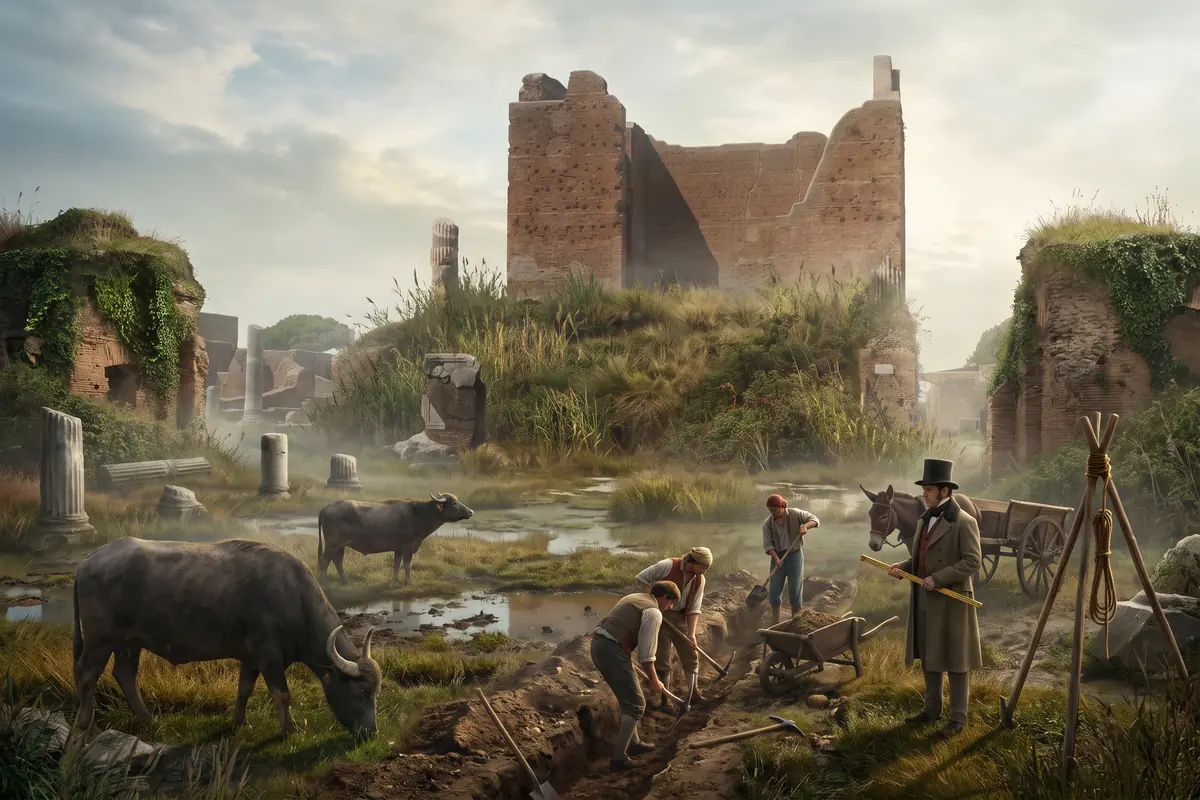
AI vision: the brick core of the Capitolium around 1804, buried to the podium in earth and reeds, marsh with pools of water, buffalo, workmen with picks in a trench, a gentleman in a top hat, a mule cart

Diary 3 / 5 · around 1804 · a misty morning

The ruins of Ostia in the marsh around 1804: The pope digs for statues

Fourteen centuries of silence. In 1557 a flood gave the Tiber a new bed, the sea has moved three kilometres away, and what remained between is marsh. The marble of the temple went into lime kilns and to Pisa; its brick core stands as a landmark in a sea of reeds, among buffalo, herdsmen and malaria. Nobody lives here; the borgo with the castle lies a kilometre to the east.

In 1801 Pope Pius VII has digging begun. Not for the town, for statues for the Vatican: Giuseppe Petrini directs men who cut trenches wherever the ground promises marble. The excavation in the picture, the gentleman in the top hat, the cart: invented from what is known of these campaigns. The state of the temple, the burial up to the podium, the reeds: that is how the travellers of the time describe it. And the shore where Minucius Felix once walked can no longer be seen.

The mother, in her fever, 387

„Lay this body any where; let not the care for that any way disquiet you: this only I request, that you would remember me at the Lord’s altar, wherever you be.“

Monica’s words as recorded by Augustine, Confessions IX 11, translation by Pusey. Her epitaph was found in 1945 beside the church of Sant’Aurea in the borgo.

Image: AI vision based on a photo by Nicholas Hartmann (CC BY-SA 4.0), not a scientific reconstruction.

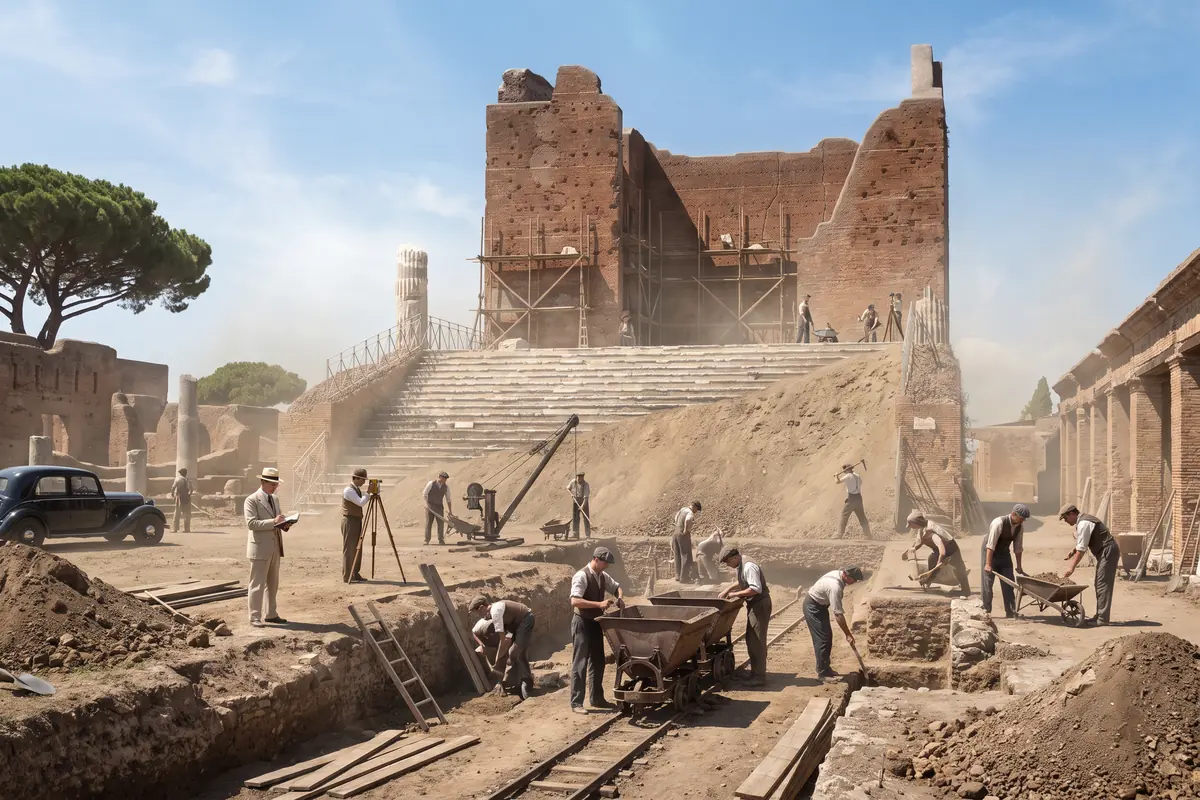
AI vision: the excavation of the forum of Ostia around 1940, the Capitolium uncovered, the steps half out of the earth, narrow-gauge rails with tipping wagons, spoil heaps, scaffolding, dozens of workmen with picks and wheelbarrows, a man in a light suit with a notebook

Diary 4 / 5 · around 1940 · midday

Guido Calza’s excavation at Ostia around 1940: A town for the world fair

In 1938 Italy wants to show the world something. A world fair is planned for Rome in 1942, the E42, with a new district halfway to Ostia, and the visitors are to see the harbour town of ancient Rome, not a few walls in the grass. Guido Calza, director of the excavation since 1924, gets money and men as never before: in four years he uncovers more than everyone before him together, whole streets, warehouses, baths, houses. Half the town you see today came to light then.

The world fair never takes place; in 1940 Italy enters the war, and by 1942 guests are unthinkable. The excavation continues, more slowly. After the war the half-finished exhibition district becomes a business quarter and still bears the abbreviation of the Esposizione Universale di Roma as its name: EUR, like the metro station EUR Magliana on the way to Ostia. The narrow-gauge railway and the wagons are likely for Calza’s excavation; the scaffolding, the car and the men in the picture are invented. What remained was a problem the park still has: what was uncovered so fast has had to be protected ever since.

The son, about his mother, 387

„On the ninth day then of her sickness, and the fifty-sixth year of her age, and the three-and-thirtieth of mine, was that religious and holy soul freed from the body.“

Augustine, Confessions IX 11, translation by Pusey. In 1945, five years after this scene, two boys in the borgo found a fragment of Monica’s epitaph.

Image: AI vision based on a photo by Nicholas Hartmann (CC BY-SA 4.0), not a scientific reconstruction.

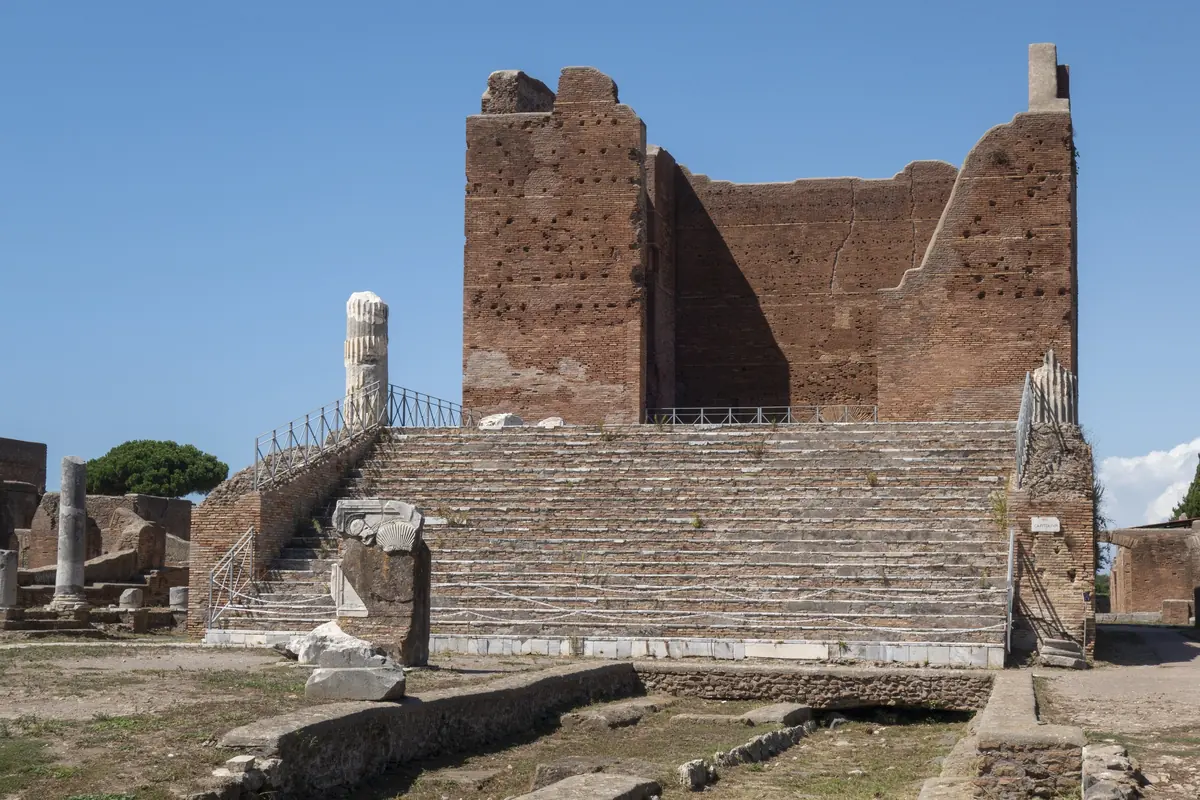
The Capitolium of Ostia Antica today from the forum: the flight of steps, the brick core of the temple without columns, on the left the column of the basilica, blue sky (photo)

Diary 5 / 5 · Today

Ostia Antica today: And now you

This is real. Exactly this view awaits you when you have walked twenty minutes along the decumanus from the entrance at the Porta Romana and step onto the forum: the steps, the brick core that once carried marble, on the left the column of the basilica, and all around a town that did not die in a day but was abandoned over centuries. Two thirds of it still lie under the fields; since 2019 it has carried the European Heritage Label.

The sea is three kilometres away, the Tiber flows one bend further north. Stand on the forum, half close your eyes, and the temple is white, and somewhere behind you, at a window onto a garden, a woman and her son sit talking about eternity.

The lawyer from Rome, on the beach

„We were now walking on the broad and open shore. There the gently rippling wave was smoothing the outside sands as if it would level them for a promenade.“

Minucius Felix, Octavius, chapter 3, translation by Wallis. The shore today lies three kilometres further west.

Real photo: Nicholas Hartmann, CC BY-SA 4.0, via Wikimedia Commons.

Your expedition

Visit the forum of Ostia Antica: Stand exactly here

“The rest you have to see for yourself. And when you stand on the forum, turn once on the spot. Everything you see, somebody built, lived in, left. Nobody destroyed it.” Ada Falk

  1. From the entrance along the decumanus. Behind the ticket office on Viale dei Romagnoli walk through the Porta Romana and straight on, past the Baths of Neptune and the theatre, a good twenty minutes, until the forum opens on your right: that is the place of this time journey, with the Capitolium at its north end.
  2. Onto the steps. You may climb the flight of steps; at the top you stand inside the brick core of the temple and look across the forum to the temple of Roma and Augustus. Next door the Forum Baths with their latrine.
  3. Then to the window. No house is known as Augustine’s; the House of Cupid and Psyche, ten minutes further west, is a house with a garden from exactly those decades. Last the Museo Ostiense, before the park closes.
  • At 8.30 am: The forum is empty at opening time; the groups from Rome need until 10 am to reach it.
  • Tuesday to Sunday: The park is closed on Mondays. The Decorated Houses with wall paintings open only at set times; ask at the ticket office.
  • Check first: Prices, opening hours and how to get there are in our guide to Ostia Antica tickets and admission; all highlights are on our map.

At a glance

Ostia in facts

Foundation
tufa fort, mid-4th century BCE; by legend founded by King Ancus Marcius
Height
2nd century CE under Hadrian: Capitolium around 120, apartment blocks, warehouses, baths; up to 50,000 inhabitants
Harbour
artificial harbour of Portus from 42 CE (Claudius), hexagonal basin around 110 (Trajan), three kilometres north
Augustine
autumn 387: the window of Ostia, death of Monica in her 56th year; epitaph found in 1945
Abandoned
from the 5th century; Tiber flood 1557, marsh, malaria; the sea today three kilometres away
Excavation
1801 Pius VII, 1855 Pius IX, from 1907 Vaglieri, 1938 to 1942 Calza for the E42; about a third of the 150 hectares uncovered

Frequently asked questions about Ostia Antica and the window of Ostia

What is the window of Ostia?

A scene from Augustine’s Confessions: in the autumn of 387 he stood with his mother Monica at a window onto the garden of a house in Ostia, where both were waiting for a ship to Africa, and talked with her about eternal life. A few days later she died. The house has not been identified; the scene is among the most famous in late antique literature.

Where is Monica buried?

She was buried at Ostia in 387; in 1945 two boys found a fragment of her epitaph beside the church of Sant’Aurea in the borgo. Her bones had already been moved to the church of Sant’Agostino in Rome in 1430, where they lie today.

Why was Ostia abandoned?

Because the harbour moved to Portus, the mouth of the Tiber silted up and from the 5th century Goths, Vandals and Saracens came. A Tiber flood moved the river in 1557, the sea retreated, the marshes brought malaria. There was no catastrophe, only time; that is why whole streets stand to the first floor.

Who excavated Ostia?

Popes first: Pius VII from 1801 and Pius IX from 1855, mostly in search of statues. Dante Vaglieri excavated systematically from 1907, and Guido Calza uncovered half the town in four years from 1938 to 1942 for the planned world fair E42. The fair fell victim to the war; the excavation remained.

What did the Capitolium look like?

A temple on a high podium with a flight of steps, built around 120 under Hadrian: a brick core faced with marble, six columns across the front, pediment and tiled roof, inside the cult statues of Jupiter, Juno and Minerva. The marble was stripped in the Middle Ages; today the brick core stands with the steps, as the photograph shows.

How many people lived in Ostia?

Estimates for the 2nd century range from under 30,000 to 75,000; the classic figure is 50,000, from the area and the height of the apartment blocks. No ancient source gives a number. What is certain is that Ostia was one of the largest towns in Italy after Rome.

What did Ostia look like?

A town of red and yellow brick with apartment blocks of four storeys, balconies, shops, colonnades, warehouses and baths, on a river with quays and close to the sea. The images on this page are AI visions meant to convey a feeling; people, colours and scenes are interpretation, and the buildings follow the evidence only in broad strokes.

When is the best time for this view?

At 8.30 am when the park opens and the forum is empty, or in summer in the late afternoon when the light falls low on the brick. The park is closed on Mondays. Prices, opening hours and how to get there are in our guide to Ostia Antica tickets and admission.

About these images

The images of stages 1 to 4 are AI visions generated with Nano Banana Pro (Google Gemini) via fal.ai; the starting point was a photograph of the Capitolium taken from the forum (Nicholas Hartmann, CC BY-SA 4.0). As adaptations of that photo the visions are published under the same licence. They are meant to convey a feeling and are not scientific reconstructions: people, clothing, colours and scenes are invented, and the buildings follow the evidence only in broad strokes. The image files are labelled as AI-generated (IPTC). The last image is the unaltered photograph.

Sources and status

Text: Daniela Pieper, Back in Time Travel editorial team. Updated 26 September 2026. Specialist review is still pending. Translations are our own, abridged.

  1. Ostia-antica.org: Introduction to Ostia (Jan Theo Bakker)
  2. Ostia-antica.org: topographical dictionary, Capitolium and forum
  3. Augustine: Confessions, Book IX (Pusey translation, Project Gutenberg)
  4. Minucius Felix: Octavius, chapters 2 and 3 (Wallis translation, New Advent)
  5. European Commission: European Heritage Label, Archaeological Area of Ostia Antica (2019)
  6. Parco archeologico di Ostia antica: visitor information
  7. CoopCulture: ticket for the archaeological area (prices, opening hours)
  8. R. Meiggs: Roman Ostia. 2nd ed., Oxford 1973.
  9. C. Pavolini: Ostia (Guide archeologiche Laterza). Rome 2006.
  10. G. Calza et al.: Scavi di Ostia I. Topografia generale. Rome 1953.
  11. S. Keay, L. Paroli (eds.): Portus and its Hinterland. London 2011.
Image credits

Forum today and source image of the AI visions: Nicholas Hartmann, Wikimedia Commons, CC BY-SA 4.0. Resized.

AI visions: Back in Time Travel, generated with Nano Banana Pro via fal.ai, adaptations of the photo by Nicholas Hartmann, CC BY-SA 4.0. Not a scientific reconstruction.

Barlow Condensed / Manrope · SIL Open Font License. Barlow OFL · Manrope OFL