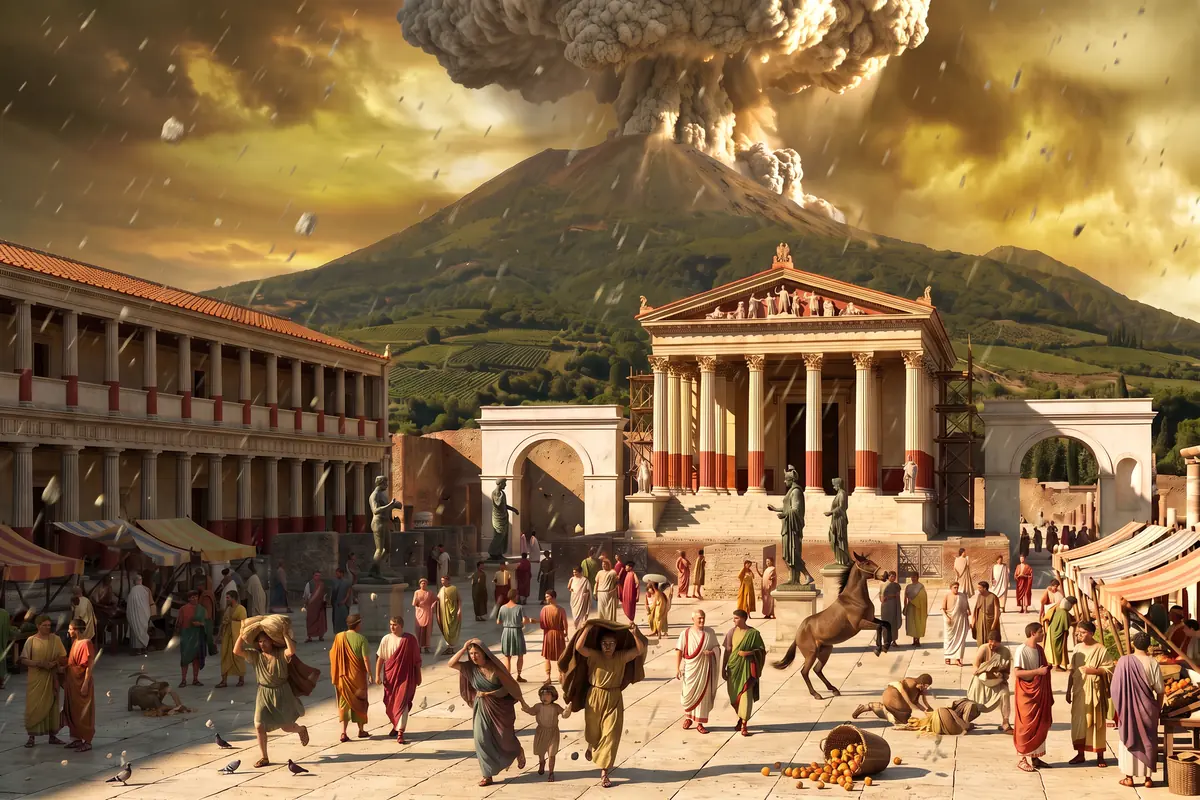
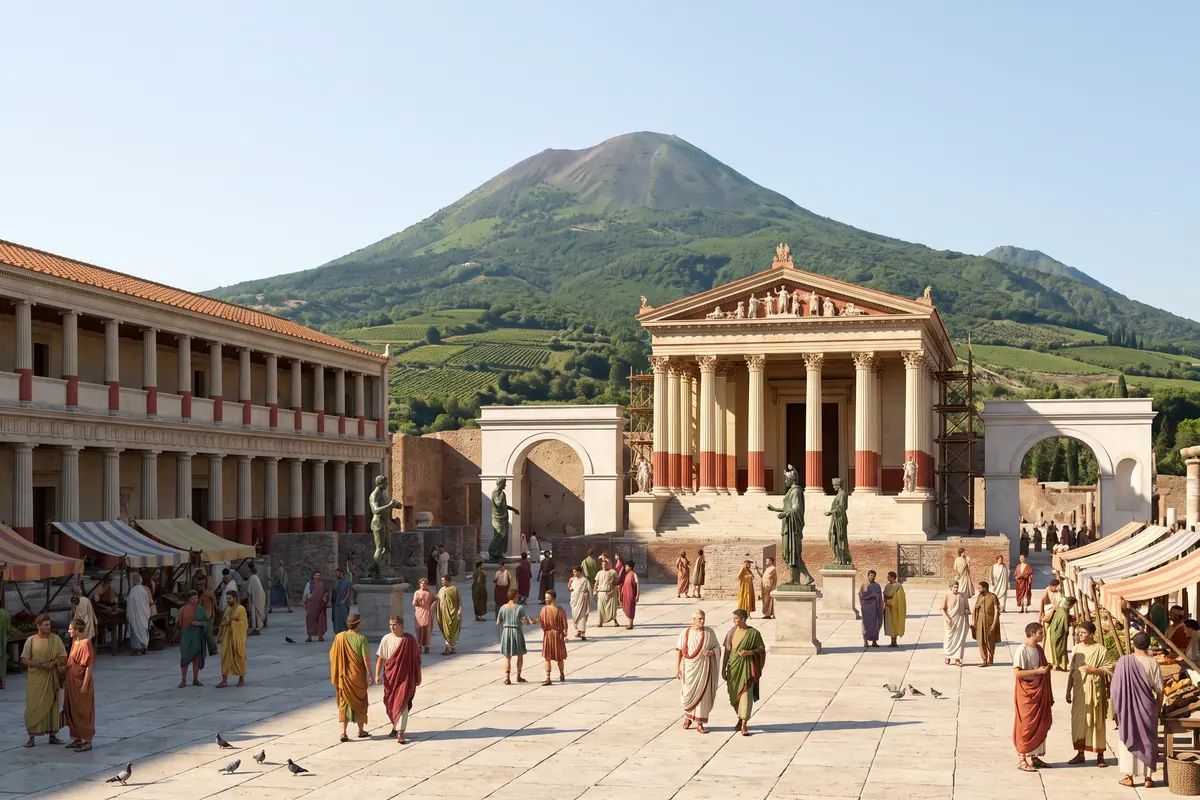
AI vision: what the Forum of Pompeii may have looked like before the eruption of 79 AD, with the painted Temple of Jupiter, a two-storey colonnade, market stalls and people, green Mount Vesuvius behind
AI vision: the eruption of Mount Vesuvius in 79 AD over Pompeii, a huge eruption column above the volcano, a sulphur-yellow sky, people fleeing across the Forum
AI vision: Pompeii after the eruption, the Forum buried under a grey plain of pumice and ash, only the temple roof and the tops of buildings sticking out, tiny figures digging
AI vision: vineyards, olive trees and a farmhouse above buried Pompeii around 1600, wooded Mount Vesuvius behind
AI vision: the excavation of Pompeii in the 19th century, workers with baskets among spoil heaps, a man in a top hat, half-excavated ruins of the Forum, a plume of smoke above Vesuvius
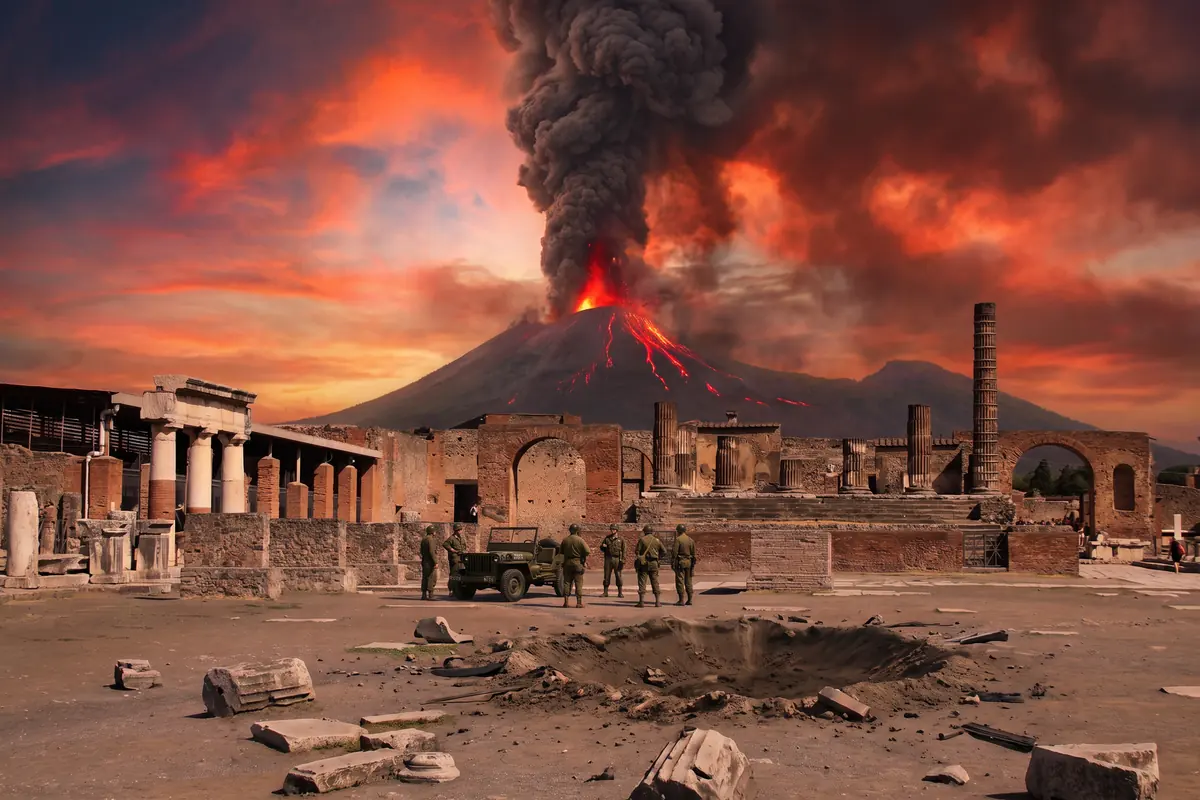
AI vision: the last eruption of Mount Vesuvius in March 1944 above the ruins of Pompeii, lava on its flank, soldiers and a jeep next to a bomb crater on the Forum
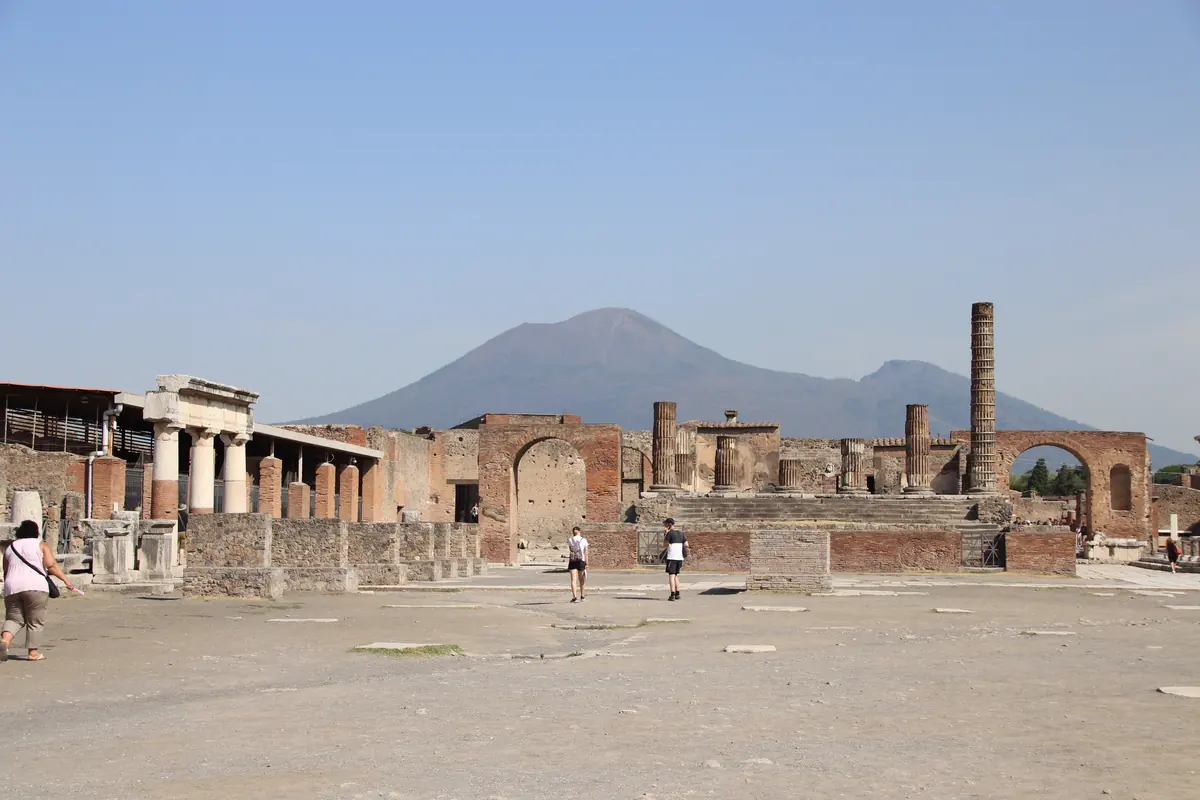
Pompeii today: the Forum with column stumps, the remains of the Temple of Jupiter, the arches and Mount Vesuvius, Monte Somma on the right, a few visitors (photo)
Evidence Temple of Jupiter on its high podium at the north end of the ForumEvidence Two-storey colonnade on the west sideLikely Scaffolding: repairs after the earthquake of 62/63 ADLikely Shape of Vesuvius before 79: probably a single, higher peakInvented People, clothing, market stalls, colours
Evidence Eruption column, described by Pliny as a pine treeEvidence Hours of pumice falling on PompeiiLikely Light and colour of the skyInvented Individual scenes of flight, animals, people
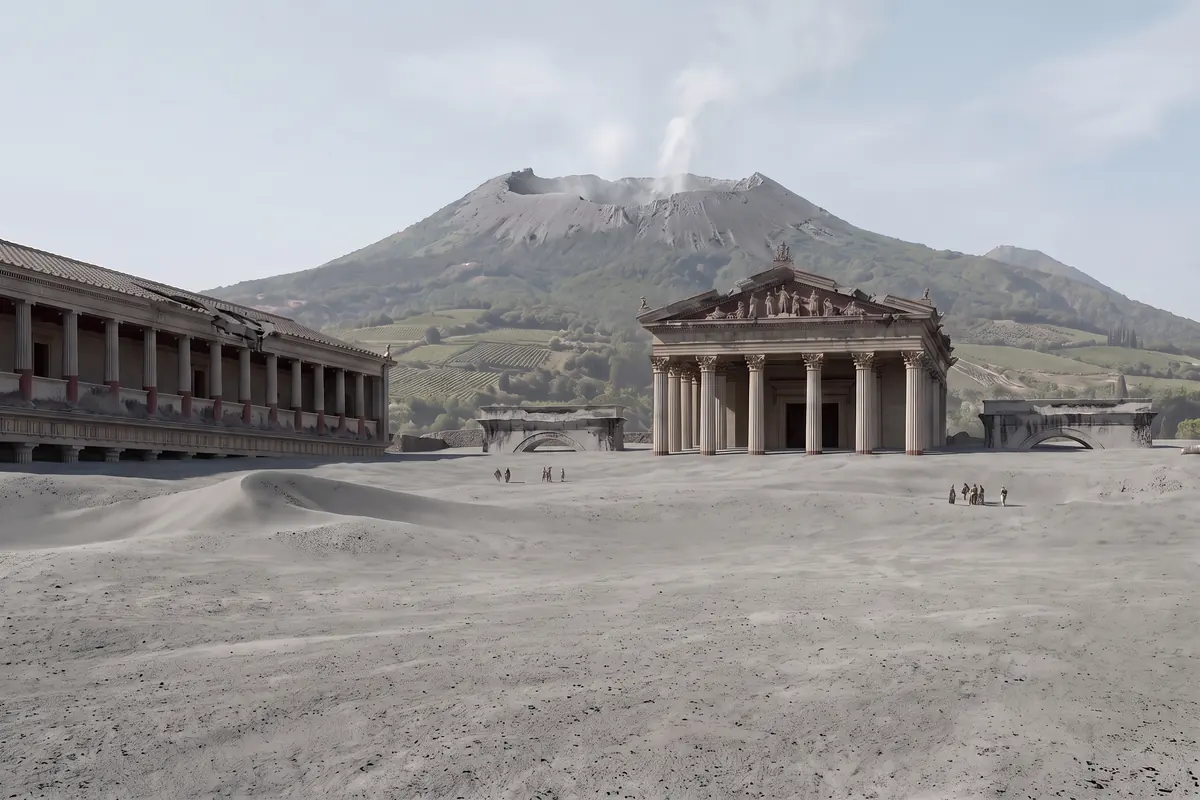
Evidence Four to six metres of pumice and ashEvidence Ancient search tunnels and later, poor inhabitants of the ruinsLikely Summit collapsed after the eruptionInvented How far the temple and colonnades actually stuck out
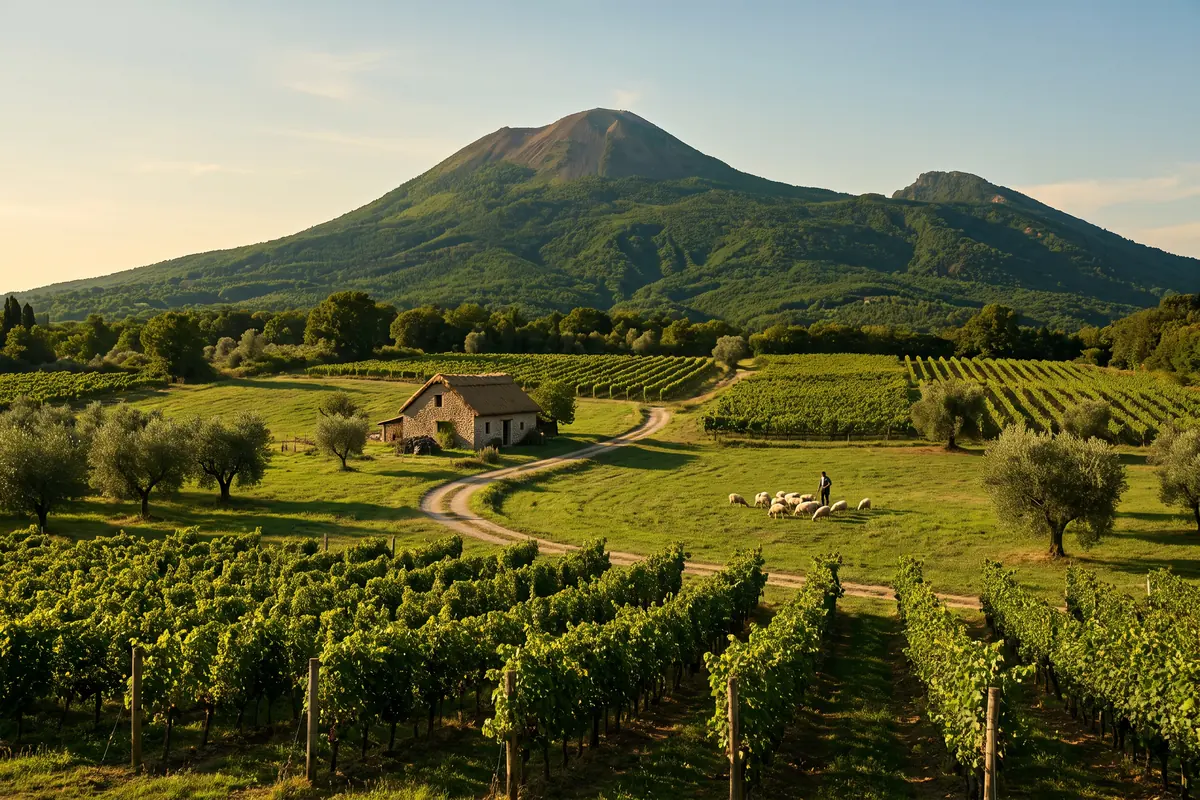
Evidence Vineyards on top of the buried cityEvidence Fontana’s canal runs beneath Pompeii, from 1594Likely Wooded Vesuvius before the eruption of 1631Invented Farmhouse, shepherd, exact landscape
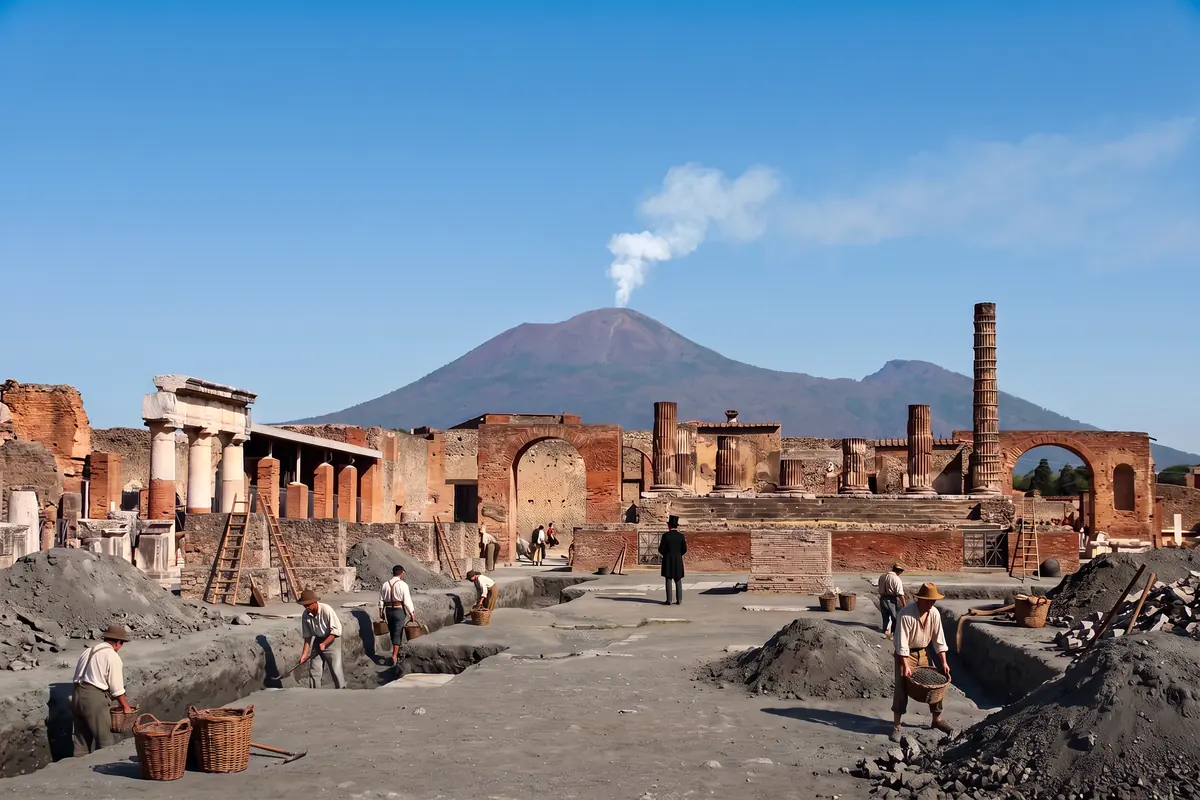
Evidence Forum uncovered in the early 19th centuryEvidence Vesuvius often active in the 19th centuryInvented Workers, clothing, top hat, exact trenches
Evidence Eruption of March 1944, the most recent so farEvidence Bomb damage in Pompeii in 1943Invented Crater at this exact spot, soldiers, jeep
Evidence Temple of Jupiter: surviving podium and column stumpsEvidence Monte Somma, remains of the old volcano summitEvidence Arch on the north side of the Forum

AI vision · artistic licence

The eruption of Pompeii: one view, two thousand years

You stand in a single spot, on the Forum of Pompeii. Time moves, you don’t. Scroll through what happened to Pompeii: from a market day before the eruption of Mount Vesuvius in 79 AD, through ash, meadows and treasure hunters, to the place where you can stand yourself today.

I’m Ada Falk. I have spent my life digging through dirt in search of other lives, and Pompeii is the place I keep coming back to. Let me take you there.

Ada is a fictional narrator. The story is real: every fact and quote is sourced, and the sources are listed at the end. The images are AI visions, not scientific reconstructions. Tap “What is the evidence?” to see what is known, what is likely and what is invented.

AI vision: what the Forum of Pompeii may have looked like before the eruption of 79 AD, with the painted Temple of Jupiter, a two-storey colonnade, market stalls and people, green Mount Vesuvius behind

Diary 1 / 7 · 79 AD · one morning

Pompeii before the eruption: The heart of the city

Stand here, at the southern end of the Forum, and look north. In front of you the Temple of Jupiter on its high podium, the two-storey colonnade to the left, honorary arches on either side. People trade, vote, argue and gossip here. And on the walls of the Basilica next door they scribble whatever is on their minds: election slogans, love notes, insults. This is roughly what Pompeii may have looked like before the eruption: brightly plastered, full of statues, stalls and voices.

See the scaffolding on the temple? An earthquake badly damaged the town in 62 or 63 AD, and the repairs are still not finished. To the people of Pompeii the green mountain behind is a vineyard. Only the geographer Strabo had noticed that the rock near its summit looked as if it had once been on fire.

A voice from the time

“I am amazed, wall, that you have not collapsed under the tedious scribbles of so many writers.”

Wall inscription from Pompeii, CIL IV 1904 (found in the Basilica on the Forum, among other places). Our translation.

Image: AI vision, not a scientific reconstruction.
AI vision: the eruption of Mount Vesuvius in 79 AD over Pompeii, a huge eruption column above the volcano, a sulphur-yellow sky, people fleeing across the Forum

Diary 2 / 7 · 79 AD · around noon

The eruption of Mount Vesuvius in 79 AD: The mountain that became a pine tree

Around noon the mountain bursts open. A column of gas, ash and pumice shoots about 30 kilometres into the sky, and the wind drives it south-east, straight over Pompeii. For hours pumice rains down, until roofs collapse under the weight.

The cruel and yet comforting part: most people flee in these first hours, and it saves them. Those who stay die the next morning, when avalanches of hot gas and ash, known as pyroclastic surges, race through the streets. Even the date is uncertain. The famous 24 August comes from the manuscripts of Pliny’s letters, and they do not all agree. A charcoal inscription found in 2018 points to October instead.

An eyewitness

“Its shape resembled no tree more than a pine: it rose high as if on a very tall trunk and then spread out into branches.”

Pliny the Younger, Letters 6.16, describing the cloud he saw from Misenum. Our translation.

Image: AI vision, not a scientific reconstruction.

AI vision: Pompeii after the eruption, the Forum buried under a grey plain of pumice and ash, only the temple roof and the tops of buildings sticking out, tiny figures digging

Diary 3 / 7 · 79 AD · days later

Pompeii buried under ash: A city sinks

Two days later Pompeii lies under four to six metres of pumice and ash. What still sticks out looks like a stranded ship. Then the first people come back: survivors and looters dig tunnels to their houses, to statues, to money chests. Archaeologists still come across these ancient search tunnels today.

Emperor Titus sends senators to organise the rebuilding of Campania. A city like the old one never rises here again. Yet the place is not entirely abandoned: recent excavations show that people lived poorly among the protruding ruins for a long time, probably into late antiquity. The mountain has changed too. Its summit has collapsed, and over the following centuries a new cone grows inside the crater: the one you see today.

A poet, nine years later

“Here is Vesuvius, green only yesterday with the shade of vines. Now everything lies sunk in flames and grim ash.”

Martial, Epigrams 4.44, around 88 AD. Our translation.

Image: AI vision, not a scientific reconstruction.

AI vision: vineyards, olive trees and a farmhouse above buried Pompeii around 1600, wooded Mount Vesuvius behind

Diary 4 / 7 · around 1600

The forgotten city: Meadows over the rooftops

The city is forgotten. Farmers call the hill simply “la Civita”, the city, without knowing which one. Vines grow in the fertile volcanic soil.

Now for my favourite story. From 1594 the architect Domenico Fontana has a canal dug to carry water from the river Sarno to mills near the coast, right through buried Pompeii. His workers hit walls, wall paintings and inscriptions. And Fontana? He just keeps digging. The canal still runs beneath the city today. Then, in 1631, Vesuvius wakes with a violent eruption that kills thousands in the towns on its slopes.

A find

“Canale Conte di Sarno, built from 1594. A water channel running straight through a Roman city whose name nobody knows.”

Summary based on information from the Archaeological Park of Pompeii.

Image: AI vision, not a scientific reconstruction.

AI vision: the excavation of Pompeii in the 19th century, workers with baskets among spoil heaps, a man in a top hat, half-excavated ruins of the Forum, a plume of smoke above Vesuvius

Diary 5 / 7 · 1748 to 1863

Rediscovery and the Pompeii casts: The treasure hunters

In 1748 excavations begin on behalf of the Bourbon king of Naples. They are after statues and treasure for the royal collection, not history. Which city they are digging up only becomes clear in 1763, when an inscription names the “res publica Pompeianorum”. The Forum is uncovered in the early 19th century. Pompeii becomes a must on the Grand Tour, and Vesuvius smokes on cue.

In 1863 the excavator Giuseppe Fiorelli has a brilliant and macabre idea. He pours plaster into the hollows that the victims’ bodies had left in the hardened ash. Suddenly the disaster has faces. These Pompeii bodies are not petrified, by the way, even if you often read that: many of the casts still contain the bones, wrapped in plaster.

A visitor

“Many disasters have befallen the world, but few have given posterity so much delight.”

Johann Wolfgang von Goethe, Italian Journey, Naples, March 1787. Our translation.
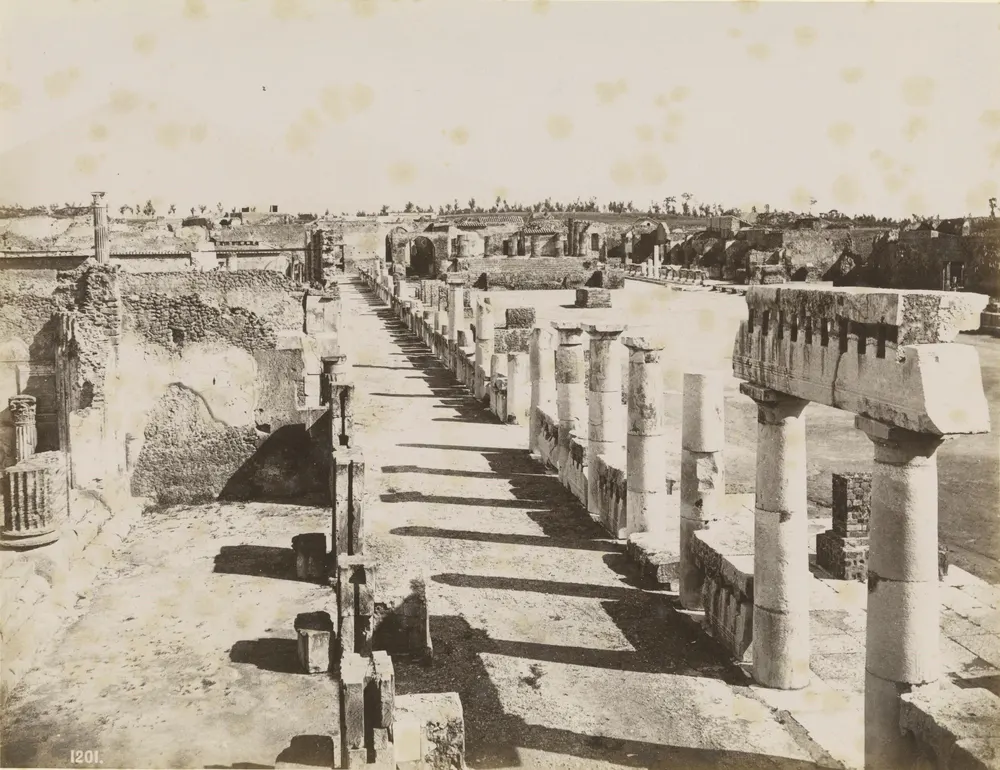
Historic black-and-white photograph: colonnade on the Forum of Pompeii looking north
Not an AI image: a real photograph from around 1875 to 1900 showing the colonnade on the Forum. Rijksmuseum Amsterdam, CC0.

Image: AI vision, not a scientific reconstruction.

AI vision: the last eruption of Mount Vesuvius in March 1944 above the ruins of Pompeii, lava on its flank, soldiers and a jeep next to a bomb crater on the Forum

Diary 6 / 7 · 1943 and 1944

Vesuvius’ last eruption in 1944: Bombs and lava

In August and September 1943 Allied bombs fall on Pompeii, well over a hundred of them. They hit houses, streets and the small site museum. Much was rebuilt after the war; some things are lost.

Half a year later, in March 1944, Vesuvius erupts, to this day for the last time. Lava destroys the villages of San Sebastiano and Massa di Somma. At a US air base near Terzigno, ash and glowing rocks destroy around 80 bombers. Soldiers photograph and film the eruption, and their footage goes around the world.

A find

“More than 160 bombs on the excavations, spread over several raids in late summer 1943.”

After L. García y García, Danni di guerra a Pompei, 2006.

Image: AI vision, not a scientific reconstruction.

Pompeii today: the Forum with column stumps, the remains of the Temple of Jupiter, the arches and Mount Vesuvius, Monte Somma on the right, a few visitors (photo)

Diary 7 / 7 · Today

Pompeii today: And now: you

This one is real. Exactly this view is waiting for you: a wide square of stone and dust, the stumps of the temple, the arches and Vesuvius, with the ridge of Monte Somma on its right, the remains of the old summit.

Pompeii is not a closed story. About a third of the city is still underground, and excavations continue in Regio V. That is where the charcoal inscription that shook the eruption date was found in 2018. And Vesuvius? It is sleeping. Hundreds of thousands of people live in the red zone on its slopes.

A find, 2018

“XVI K NOV: the sixteenth day before the Kalends of November, that is 17 October.”

Charcoal inscription from Regio V, Archaeological Park of Pompeii. It gives no year; it probably dates from autumn 79.

Real photo: Gary Todd, public domain, via Wikimedia Commons.

Your expedition

Visiting the Forum of Pompeii: Stand exactly here

“The rest you have to see for yourself. And trust me: if you stand there and half close your eyes, you’ll see the awnings.” Ada Falk

  1. Porta Marina entrance. It is the closest to the Forum. Behind it the Via Marina climbs uphill, with the Basilica on your right and the Temple of Apollo on your left.
  2. Onto the Forum and head south. After a few minutes the square opens up. Walk a little way into its southern half.
  3. Turn around and look north. Temple, arches and Vesuvius now line up, just like in the last picture.
  • Quiet and beautiful: right at opening time or in the late afternoon. The temple faces south and gets light almost all day.
  • Hardly any shade: there is almost none on the Forum. Bring water; there are drinking fountains on the site.
  • Check before you go: prices, opening hours and which ticket is worth it are in our guide to Pompeii tickets. Paths can change.

At a glance

Pompeii eruption facts

Eruption
79 AD, probably in October; the exact day is disputed
Buried
under 4 to 6 metres of pumice and ash
Victims found
about 1,150 people
Rediscovered
excavations from 1748, name confirmed in 1763
Excavated
about two thirds of the city
Last eruption of Vesuvius
March 1944

Frequently asked questions about the eruption of Pompeii

When did Mount Vesuvius erupt and destroy Pompeii?

In 79 AD. Strictly speaking it was Vesuvius that erupted, not Pompeii. For a long time 24 August was taken as the date, as it appears in most manuscripts of Pliny the Younger’s letters. A charcoal inscription found in 2018 and dated 17 October suggests the eruption happened in autumn, probably in October.

How long did it take for Pompeii to be destroyed?

About a day. The eruption began around noon and pumice fell on the city into the night. On the morning of the second day, pyroclastic surges of hot gas and ash reached Pompeii and killed everyone who was still there.

How many people died in Pompeii?

The remains of about 1,150 people have been found in Pompeii so far. Since about a third of the city has not been excavated, the real number was higher. The population is usually estimated at around 10,000; most of them probably managed to flee.

Did anyone survive Pompeii?

Yes, probably most of the inhabitants. Those who fled in the first hours had a good chance. Inscriptions from neighbouring cities such as Naples, Puteoli and Cumae suggest that families from Pompeii resettled there. Recent excavations also show that people later lived among the ruins again.

Are the Pompeii bodies real?

They are plaster casts, not petrified people. The victims’ bodies decomposed in the hardened ash and left hollows. From 1863 Giuseppe Fiorelli had these filled with plaster, and many casts still contain bones. DNA analyses published in 2024 showed that some traditional interpretations are wrong, for example a supposed mother with her child.

What famous person died at Pompeii?

The best-known victim of the eruption, Pliny the Elder, did not die in Pompeii but on the beach at Stabiae, a few kilometres south, while trying to rescue people by ship. His nephew Pliny the Younger described the disaster in two letters.

When was Pompeii discovered?

Workers digging a canal cut through the city’s walls from 1594 without recognising it. Proper excavations began in 1748 under the Bourbon kings of Naples, and an inscription found in 1763 proved that the site was Pompeii.

How much of Pompeii is still buried?

About a third. Roughly two thirds of the ancient city have been excavated. The Archaeological Park keeps digging, for example in Regio V, where the charcoal inscription about the eruption date was found in 2018.

What did Pompeii look like before the eruption?

Far more colourful than today. Buildings were plastered and painted, statues stood on the Forum, and there were shops, snack bars and workshops, with walls covered in writing. The images on this page are AI visions meant to convey a feeling. How a single house was laid out is shown in our tour of the House of the Tragic Poet.

Could Vesuvius erupt again?

Yes. Vesuvius last erupted in March 1944 and is considered one of the most dangerous volcanoes in the world because hundreds of thousands of people live on its slopes. The Vesuvius Observatory, founded in 1841 as the world’s first volcano observatory, monitors it around the clock.

About these images

The images of time steps 1 to 6 are AI visions; the moving scenes in the first two steps are AI videos based on them. They were created with Nano Banana Pro (Google Gemini) and Kling via fal.ai, starting from a public-domain photo of today’s Forum. They are meant to convey a feeling, not to be a scientific reconstruction: people, clothing, colours and scenes are invented, and the buildings only broadly follow the archaeological evidence. The image files are labelled as AI-generated (IPTC). The last image is a real photograph, as is the historic photo in “The treasure hunters”.

Sources and date

Text: Daniela Pieper, Back in Time Travel. Updated 25 September 2026. Fact-checked by Dr. Heike-Doreen Klein, history teacher (Oberstudienrätin), Berlin. Translations of ancient texts are our own, abridged.

  1. Pliny the Younger, Epistulae 6.16 and 6.20 (Latin text)
  2. Martial, Epigrams book 4, no. 44 (Latin text)
  3. Suetonius, Titus 8: aid for Campania after the eruption (Latin text)
  4. Parco Archeologico di Pompei: history of the excavations and current research
  5. GEO (German): Pompeii was resettled after the disaster
  6. wissenschaft.de (German): DNA reveals errors in identifying the Pompeii dead (2024)
  7. GEO (German): what the Pompeii plaster casts tell us
  8. INGV Osservatorio Vesuviano: Vesuvius and the eruption of 1944
  9. UNESCO World Heritage: Archaeological Areas of Pompei, Herculaneum and Torre Annunziata
  10. Wall inscription CIL IV 1904 (Corpus Inscriptionum Latinarum, vol. IV).
  11. Strabo, Geography 5.4.8, on the appearance of the summit of Vesuvius.
  12. J. W. von Goethe, Italian Journey, Naples, March 1787.
  13. L. García y García: Danni di guerra a Pompei. Rome 2006.
Image credits

Today’s Forum and starting image for the AI visions: Gary Todd, Wikimedia Commons, public domain. Resized.

Historic photograph: colonnade on the Forum, around 1875 to 1900, Rijksmuseum Amsterdam (RP-F-00-4206), Wikimedia Commons, CC0. Cropped.

AI visions: Back in Time Travel, created with Nano Banana Pro and Kling via fal.ai, 25 September 2026. Not a scientific reconstruction.

Barlow Condensed / Manrope · SIL Open Font License. Barlow OFL · Manrope OFL