Pompeii map: the ruins with 20 highlights
Our own plan of the ancient city with 20 highlights, the three entrances and the train station. Tap a number for details, pick a walking route or print the map for your visit.
Interactive map of the Pompeii ruins
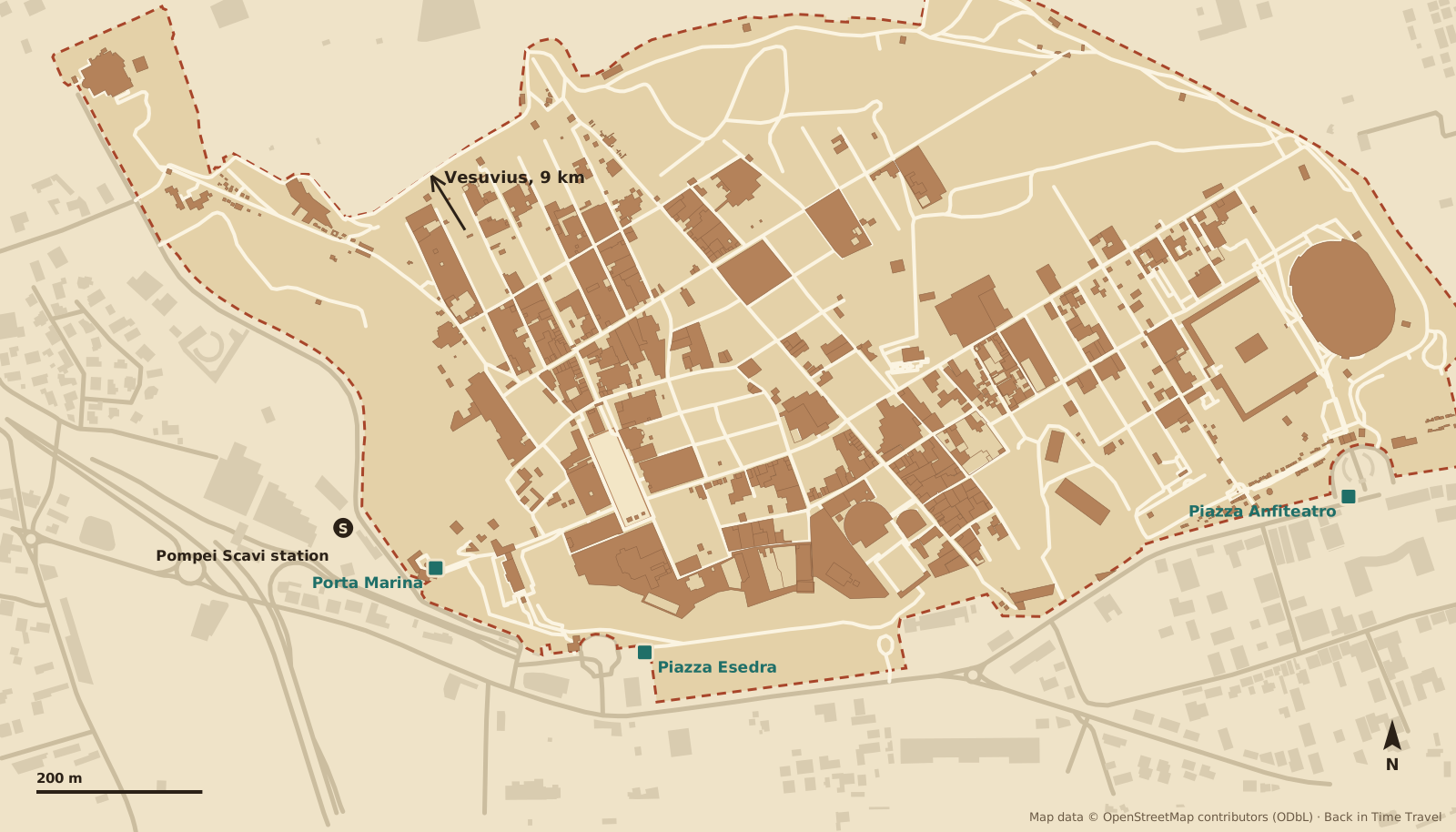
Map data © OpenStreetMap contributors, ODbL. Drawn by Back in Time Travel, data as of 25 September 2026. The map is a guide; paths and open houses can change.
20 highlights on the Pompeii map
The numbers match the map. In brackets is the ancient address: region, block and entrance, as shown on the houses.
Porta Marina Entrance
The western city gate and main entrance, a few steps from Pompei Scavi station. A steep path leads up into the city.
Basilica VIII 1,1
Law court and business hall on the Forum. Its walls were covered in graffiti, including the joke about the wall that has to bear so much scribbling.
Temple of Apollo VII 7,32
One of the oldest sanctuaries in the city. The bronze statues of Apollo and Diana are copies; the originals are in the National Archaeological Museum of Naples.
Forum VII 8
The centre of public life, with temples, a market hall and civic buildings. From its southern end, the Temple of Jupiter and Vesuvius line up.
More →Temple of Jupiter VII 8,1
The main temple on a high podium on the north side of the Forum, flanked by two honorary arches.
More →Forum granary VII 7,29
A store full of amphorae and finds, including plaster casts of victims. Easy to see through the railings.
Forum Baths VII 5,2
Small, well-preserved baths with a stucco vault; in the warm room, terracotta figures support the cornice.
House of the Tragic Poet VI 8,5
Famous for the “Cave canem” (beware of the dog) mosaic at the entrance. Our house tour explains every room.
More →House of the Faun VI 12,2
One of the largest houses in the city. The dancing faun and the Alexander Mosaic are copies here; the originals are in Naples.
House of the Vettii VI 15,1
The house of two wealthy freedmen, with magnificent wall paintings, reopened after a long restoration.
Lupanar VII 12,18
Pompeii’s best-known brothel, with stone beds and erotic wall paintings. There is usually a queue.
Stabian Baths VII 1,8
The oldest baths in the city, with separate sections for men and women and an exercise yard.
Large Theatre VIII 7,20
The theatre for around 5,000 people, next to the small roofed Odeon and the gladiators’ barracks.
House of the Menander I 10,4
A sprawling house where a silver treasure of more than a hundred pieces was found in the cellar in 1930.
Garden of the Fugitives I 21,6
Thirteen people died here while trying to flee. Their plaster casts lie where they were found.
More →Great Palaestra II 7,1
Sports ground with a swimming pool, surrounded by colonnades and plane trees, right next to the amphitheatre.
Amphitheatre II 6,1
The oldest surviving stone amphitheatre, built around 70 BC. In 1971 Pink Floyd filmed a concert here without an audience.
Street of Tombs outside Porta Ercolano Necropolis
Outside the north-west gate, tombs line the road. This is where the path to the suburban villas begins.
Villa of the Mysteries Suburban villa
Outside the walls, with its famous fresco cycle in Pompeian red. Included in the Pompeii+ ticket.
More →Antiquarium Museum
The museum at the Porta Marina entrance shows finds and plaster casts and tells the story of the city.
Walking routes through Pompeii
Three suggestions, all starting from the Porta Marina entrance. Pick a route to highlight its stops on the map.
2 hours: the classics
From the Porta Marina entrance via the Basilica and Forum to the most famous houses and back.
4 hours: across the city
The classics, then along the Via dell’Abbondanza to the theatres, gardens and amphitheatre. Exit at Piazza Anfiteatro.
Full day with Pompeii+
Everything from the long route, plus the House of the Vettii, the Street of Tombs and the Villa of the Mysteries.
- 1 Porta Marina
- 2 Basilica
- 4 Forum
- 5 Temple of Jupiter
- 8 House of the Tragic Poet
- 9 House of the Faun
- 10 House of the Vettii
- 18 Street of Tombs outside Porta Ercolano
- 19 Villa of the Mysteries
- 11 Lupanar
- 12 Stabian Baths
- 13 Large Theatre
- 14 House of the Menander
- 15 Garden of the Fugitives
- 16 Great Palaestra
- 17 Amphitheatre
Entrances and train stations
- Porta Marina
- In the west, close to the Forum and Pompei Scavi station on the Circumvesuviana line.
- Piazza Esedra
- Just south of it, with a ticket office and bookshop.
- Piazza Anfiteatro
- In the east by the amphitheatre, closer to the modern town and the Trenitalia station Pompei.
Prices, opening hours and which ticket to choose are in our guide to Pompeii tickets.
Where is Pompeii?
Pompeii is in southern Italy, in the region of Campania, on the Bay of Naples at the foot of Mount Vesuvius. The ruins border the modern town of Pompei. Distances from the ruins, as the crow flies:
- Naples
- 22 km
- Vesuvius (crater)
- 9 km
- Sorrento
- 16 km
- Rome
- 210 km
- Salerno
- 25 km
Pompeii map: frequently asked questions
Where is Pompeii?
Pompeii is in southern Italy, in the region of Campania, on the Bay of Naples at the foot of Mount Vesuvius. The ruins lie about 22 kilometres south-east of Naples and 9 kilometres from the crater of Vesuvius, as the crow flies.
Which city in Italy is closest to Pompeii?
The modern town of Pompei is right next to the ruins. The nearest big city is Naples, about 22 kilometres away; Sorrento is about 16 kilometres to the south-west, as the crow flies.
Is 2 hours enough to see Pompeii?
Two hours are enough for the classic route on this map: the Forum, a few famous houses and the baths near the Porta Marina entrance. To reach the theatres and the amphitheatre, plan about four hours; with the Villa of the Mysteries, a full day.
Can you walk around Pompeii without a tour?
Yes. With a normal ticket you can explore freely, and this map with its routes is designed for that. Not every house is open every day, so check the park’s list of open buildings or ask at the entrance.
How big is Pompeii?
The ancient city is enclosed by a wall about three kilometres long and covers around 66 hectares. Walking directly from the Porta Marina entrance to the amphitheatre takes about 20 to 25 minutes.
How much of Pompeii is still buried?
About a third. Roughly two thirds of the ancient city have been excavated, and excavations continue.
Is there a printable Pompeii map?
Yes: use the “Print map or save as PDF” button on this page. It prints the map, the 20 highlights and the routes. The Archaeological Park also has an official plan at the entrances and on its website.
How do addresses work in Pompeii?
The city is divided into nine regions (Regio I to IX), each region into blocks (insulae), and each door has a number. “VI 8,5” means region VI, block 8, entrance 5. The system goes back to the excavator Giuseppe Fiorelli in the 19th century and appears on signs at the houses.