Angkor Wat Tickets and Angkor Pass 2026
How much is the Angkor Pass, is one day enough, and where do you get the ticket that is scanned at every temple? Prices, hours and rules come from Angkor Enterprise, the state ticket office for the Angkor Archaeological Park, last checked on 25 September 2026.
The essentials in 30 seconds
- The Angkor Pass costs US$37 for one day (about €32.50), US$62 for three days (about €54.50) and US$72 for seven days (about €63). It covers every temple in the Angkor Archaeological Park.
- The three days of the 3-day pass can be spread over seven days, the seven days of the 7-day pass over 30. Children under 12 do not need a pass but may be asked for a passport as proof of age.
- Sold only by Angkor Enterprise: online by card or KHQR, in the Angkor Pass app, at self-service kiosks or at the ticket office on Road 60, four kilometres from the centre of Siem Reap. Tickets bought anywhere else are not valid.
- Buy the pass after 4:45 pm for the next day and you may enter the park that same evening for sunset.
- The park opens at 5 am; Angkor Wat closes at 5:30 pm, Phnom Bakheng at 7 pm after sunset. Shoulders and knees must be covered, or you get neither pass nor entry.
The second link is an affiliate link: we may earn a commission if you book, at no extra cost to you.
Angkor Pass prices 2026
Prices in US dollars for foreign visitors, with rough euro equivalents in brackets; Cambodians pay no admission. The Angkor Pass covers every temple in the Archaeological Park; Koh Ker has its own ticket.
| Ticket | Included | Price | Children under 12* | Validity |
|---|---|---|---|---|
| Angkor Pass, 1 day | Every temple in the Angkor Archaeological Park; one day covers the Small Circuit from Angkor Wat via the Bayon to Ta Prohm | US$37 (about €32.50) | free | 1 day |
| Angkor Pass, 3 days | Every temple, Small and Grand Circuit, Banteay Srei; any three days, photo taken for the 3- and 7-day pass, none for the 1-day pass | US$62 (about €54.50) | free | 3 days within 7 days |
| Angkor Pass, 7 days | Every temple, with time for the Roluos group, Beng Mealea and Kbal Spean | US$72 (about €63) | free | 7 days within 30 days |
| Koh Ker | Separate temple park about 120 kilometres north-east with its own ticket, not in the Angkor Pass | US$15 (about €13) | n/a | 1 day |
| Beng Mealea | Jungle temple about 60 kilometres east; single ticket for visitors without an Angkor Pass | US$10 (about €9) | n/a | 1 day |
| Kbal Spean | Carved riverbed on Phnom Kulen; single ticket for visitors without an Angkor Pass | US$5 (about €4.50) | n/a | 1 day |
* Children under 12 do not need an Angkor Pass but must prove their age with a passport; full price from age 12, no student or senior discounts. Prices in US dollars according to Angkor Enterprise ticket shop, as of 25 September 2026; euro figures are rough conversions (rate of 25 September 2026). Opening hours and rules according to Angkor Enterprise.
Sunrise and the Bakan: when do you need to be where?
- Sunrise over the five towers is the reason the park opens at 5 am. The classic spot is the northern reflecting pool to the left of the western causeway; for the reflection, be there by 5:15 am, and depending on the season the sun clears the towers between 5:45 and 6:30. From November to February the sky is clearest, in the rainy season often more dramatic. Afterwards the crowd moves into the galleries; go to breakfast instead and come back around 8.
- Buy the pass the day before. Sunrise visitors queue at the ticket office from 4:30 am, and the check at the western causeway scans every ticket, photo on the 3- and 7-day pass included. If you buy the pass after 4:45 pm, you can use it that evening for sunset and the next day for sunrise.
- The Bakan, the third and highest level of Angkor Wat with the five towers, is reached only by a steep wooden stair with a queue, and only a limited number of people are allowed up at a time. Children under 12 are not admitted, shoulders and knees must be covered, and on Buddhist holy days the stair stays closed. The queue is shortest after 7:30 in the morning and in the late afternoon.
Angkor Wat opening hours
| Place | Opens | Closes |
|---|---|---|
| Archaeological Park (Angkor Pass) | 5:00 am | 6:30 pm |
| Angkor Wat | 5:00 am | 5:30 pm |
| Phnom Bakheng (sunset) | 5:00 am | 7:00 pm |
| Pre Rup, Srah Srang (sunrise and sunset) | 5:00 am | 7:00 pm |
| Bayon, Ta Prohm and most other temples | 7:30 am | 5:30 pm |
The park is open every day of the year. Angkor Wat opens at 5 am for sunrise, most other temples not until 7:30 am; Phnom Bakheng and Pre Rup stay open until 7 pm because that is where sunset is watched. The upper level of Angkor Wat, the Bakan, opens later than the temple itself, admits only a limited number of visitors at a time and stays closed on Buddhist holy days. Angkor Wat is quietest between 7:30 and 9 am, while the sunrise groups are at breakfast, and after 3 pm.
Buying the Angkor Pass: official or through a provider?
Just the pass? Buy it from angkorenterprise.gov.kh, the ticket platform of Angkor Enterprise: pass type, date, number, nationality, payment by credit or debit card or KHQR, and the e-ticket with QR code arrives by email straight away, valid on your phone or printed. For the 3- and 7-day pass a photo of you is taken and printed on the ticket; the 1-day pass needs no photo. On site, buy at the Angkor Ticket Office on Road 60 (cash in US dollars or card), at the kiosks in the Heritage Walk Mall and at the Angkor Parvis opposite Angkor Wat (1-day pass only), or in the Angkor Pass app.
With a guide or driver? Then book a package, but check whether the Angkor Pass is included: most tours on GetYourGuide exclude it, because the pass is personal, and stop at the ticket office before sunrise. A licensed guide makes sense of the reliefs and the kings they depict; a tuk-tuk driver only gets you there. For the Bayon, Ta Prohm and Banteay Srei a guide is worth it; for sunrise a driver will do.
Note: Only Angkor Enterprise sells the Angkor Pass; tickets from hotels, drivers or websites unconnected to the ticket office are not valid. The pass is non-transferable, non-refundable and scanned at every temple; anyone found without a valid pass pays a fine far above the price of the pass. Without covered shoulders and knees the ticket office will not sell you a pass.
Free admission and discounts
- Children under 12: free; bring a passport as proof of age. Full price from the 12th birthday.
- Students, seniors, groups: no discount; the Angkor Pass has a fixed price.
- Cambodians: free admission with ID. Foreign residents holding a visa of two years or more apply for the free Special Pass from Angkor Enterprise.
- Spread the days: The three days of the 3-day pass need not be consecutive, only within seven days; for the 7-day pass it is 30 days. A rest day between temple days costs nothing.
- Kantha Bopha: Two dollars of every pass go to the Kantha Bopha children’s hospitals in Siem Reap and Phnom Penh.
Angkor with a guide: sunrise, Small Circuit, tuk-tuk
The Archaeological Park covers 400 square kilometres and the temples lie kilometres apart; you cannot do it without a vehicle. Tours leave from Siem Reap with hotel pick-up, by tuk-tuk, minivan or bicycle. Licensed guides carry the Ministry of Tourism badge and belong to the Khmer Angkor Tour Guide Association; choose the language when booking. The Angkor Pass is not included in most offers.
Affiliate links to GetYourGuide: we may earn a commission if you book, at no extra cost to you. Prices, languages and availability change; the provider’s listing prevails. Selection checked on 25 September 2026.
Getting there: from Siem Reap, the airport or Phnom Penh
Angkor Wat lies about seven kilometres north of Siem Reap, 15 to 20 minutes by tuk-tuk. The ticket office on Road 60 is on the way into the park, and every driver knows it. A tuk-tuk for the day costs roughly US$15 to 20 for the Small Circuit and 20 to 25 for the Grand Circuit, with a few dollars more for sunrise or Banteay Srei; the Grab and PassApp apps quote the price in advance. A taxi or air-conditioned minivan costs about twice as much. Bicycles and e-bikes are hired in Siem Reap from a few dollars a day; the road to Angkor Wat is flat and paved, and Angkor Wat, Angkor Thom and Ta Prohm can be done in a day. Angkor Enterprise confirms that visitors may ride scooters themselves.
Siem Reap-Angkor International Airport (SAI) replaced the old city airport in 2023 and lies about 40 kilometres east of town, 45 to 60 minutes by road; taxis and minibuses wait at the terminal, and many hotels collect guests. From Phnom Penh it is 320 kilometres, six to seven hours by bus or about an hour by plane; buses from Bangkok cross the border at Poipet and take eight to nine hours.
Ticket office, western causeway and checkpoints
- Angkor Ticket Office (Road 60)
- Four kilometres from the centre, on the way into the park. Besides the website, app and kiosks the only place of sale; photo for the 3- and 7-day pass, payment in US dollars or by card.
- Western causeway of Angkor Wat
- The main entrance across the 190-metre-wide moat, with the view of the five towers. Here are the reflecting pool for sunrise and the ticket check for Angkor Wat.
- East entrance
- Behind the temple on the east side: hardly anyone, tuk-tuks wait there, and if you walk in from the back after sunrise you have the galleries almost to yourself.
- Checkpoints
- The pass is scanned on the road into the park and at every temple; without a pass, or with someone else’s, you are turned away and fined.
- South Gate of Angkor Thom
- The bridge with 54 gods and 54 demons pulling the naga, 1.5 kilometres north of Angkor Wat. The way to the Bayon; tuk-tuks drop you before the gate, and you walk through it.
The western causeway, east entrance, ticket office, South Gate and the temples of the Small Circuit are on our Angkor map. To find out why the temple faces west and who had it built, read our history of Angkor Wat.
Around Angkor Wat: Angkor National Museum, Banteay Srei, Ta Prohm, Bayon
The Angkor National Museum on the road from the centre to the park shows the Gallery of a Thousand Buddhas, statues from Angkor Wat and the Bayon, and explains the kings from Jayavarman II to Jayavarman VII; admission about US$12, not in the Angkor Pass, best in the afternoon heat. Banteay Srei, 25 kilometres north-east, is the temple with the finest carvings of the empire, in pink sandstone and consecrated in 967; it is included in the Angkor Pass but takes half a day with the drive, well combined with Kbal Spean or the Landmine Museum.
Ta Prohm, the temple with strangler figs on its walls, and the Bayon with its more than 200 stone faces both lie on the Small Circuit and both in the pass; Jayavarman VII built them at the end of the 12th century, Ta Prohm for his mother, the Bayon as the state temple of his capital Angkor Thom. Ta Prohm is quietest around 7:30 am and after 4 pm, the Bayon in the early afternoon.
Tips for your visit
- Dress code: Shoulders and knees covered, in every temple and for every visitor; at the Bakan it is checked strictly. A light shirt and long, loose trousers are more comfortable than a scarf you keep adjusting.
- Code of conduct: The APSARA Authority’s code bans touching the reliefs, smoking anywhere in the park, noise and entering closed areas. Ask monks before photographing them; women do not touch monks. Do not buy from children.
- Drones: Flying is allowed only with a permit from the APSARA Authority, which tourists practically never get. Leave the drone at home.
- Heat: 30 to 38 degrees, shaded in the galleries, not on the causeways and stairs. Two litres of water, a hat, sunscreen; a midday break in Siem Reap or in the shade of Ta Prohm.
- Cash: US dollars in small notes for drivers, food and tips; riel comes back as change. The pass itself can be paid by card.
- How many days: One day covers Angkor Wat, the Bayon and Ta Prohm; three days add the Grand Circuit, Banteay Srei and a second sunrise. More than three temples in a morning wears you out.
Frequently asked questions about Angkor Wat tickets and the Angkor Pass
How much is the Angkor Wat entrance fee?
The Angkor Pass costs US$37 for one day, US$62 for three days and US$72 for seven days, about €32.50, €54.50 and €63 (as of 2026). It covers every temple in the Angkor Archaeological Park, including the Bayon, Ta Prohm and Banteay Srei. Children under 12 go free; there are no other discounts.
Where can I buy the Angkor Pass?
Only from Angkor Enterprise, the state ticket office: online at angkorenterprise.gov.kh by card or KHQR, in the Angkor Pass app, at the kiosks in the Heritage Walk Mall and at the Angkor Parvis (1-day pass only), or at the ticket office on Road 60, four kilometres from the centre of Siem Reap, with US dollars or card. Tickets from anywhere else are not valid.
Should I buy Angkor Wat tickets in advance?
Ideally the day before, online or at the ticket office. If you buy after 4:45 pm for the next day, you may enter the park that same evening for sunset. Before sunrise the queues at the ticket office are longest at 4:30 am; the e-ticket on your phone spares you them.
How many days do you need for Angkor Wat?
One day is enough for the Small Circuit with Angkor Wat, the Bayon and Ta Prohm. Three days add the Grand Circuit with Preah Khan and Pre Rup, Banteay Srei and a second sunrise without rushing between temples. Seven days are worth it for Roluos, Beng Mealea, Koh Ker and rest days; the days need not be consecutive.
What time does Angkor Wat open?
At 5 am, for sunrise; it closes at 5:30 pm. Phnom Bakheng and Pre Rup stay open until 7 pm for sunset, and most other temples are open from 7:30 am to 5:30 pm. The park is open every day of the year.
Is the Angkor Wat sunrise worth it?
Yes, if you want the five towers against the light and mirrored in the pool; from November to February the sky is clearest. You share the spot with a thousand others, though. If you would rather have the galleries empty, come around 8 am while the sunrise groups are at breakfast, or after 3 pm.
Is there a dress code at Angkor Wat?
Yes: shoulders and knees must be covered, in every temple and for every visitor. At the Bakan, the upper level of Angkor Wat, it is checked strictly, and the ticket office will not sell you a pass without suitable clothing. Light long trousers and a shirt with sleeves are the simplest answer.
Can you visit Angkor Wat without a tour?
Yes. With the Angkor Pass you move freely, by tuk-tuk, bicycle or scooter between the temples. Little is labelled, so our map helps with the route and a licensed guide with the reliefs. For sunrise a driver is enough; for the Bayon and Banteay Srei a guide is worth it.
How much is a tuk-tuk for Angkor Wat?
About US$15 to 20 for the day on the Small Circuit and 20 to 25 on the Grand Circuit, with a few dollars extra for sunrise or Banteay Srei. The Grab and PassApp apps quote fixed prices; on GetYourGuide private tuk-tuk tours start at around US$20 per group. The driver waits at every temple.
Is Angkor Wat free for children?
Yes, up to the 12th birthday; bring a passport as proof of age. From age 12 children pay the full price. Children under 12 are not allowed up to the Bakan, the upper level of Angkor Wat.
When is the best time to visit Angkor Wat?
November to February: dry, pleasantly cool in the morning, clear skies for sunrise, but the most visitors. From March to May it gets hotter than 35 degrees. From June to October it usually rains in the afternoon, the moats are full and the temples are emptier.
How do I get from Siem Reap airport to Angkor Wat?
Siem Reap-Angkor International Airport (SAI) lies about 40 kilometres east of town, 45 to 60 minutes by taxi or minibus. Angkor Wat itself is another seven kilometres from the centre. Buy the pass on the way at the ticket office on Road 60, or online beforehand.
Can you fly a drone at Angkor Wat?
No, not without a permit from the APSARA Authority, which tourists practically never get. The code of conduct also bans touching the reliefs, smoking in the park and entering closed areas.
Sources and status
Text: Daniela Pieper, Back in Time Travel editorial team. Prices, opening hours and rules checked on 25 September 2026 with Angkor Enterprise, the state ticket office of the Angkor Archaeological Park. Details may change; the operator’s information prevails. Currency conversions are approximate.
- Angkor Enterprise: Available Tickets (Angkor Pass 1, 3, 7 days, validity, entry times)
- Angkor Enterprise: FAQs (children under 12, Bakan, photo, purchase after 4:45 pm, Small and Grand Circuit)
- Angkor Enterprise: How to buy a ticket (website, app, kiosks, ticket office, payment methods)
- Angkor Enterprise: Angkor Wat (opening hours, built under Suryavarman II)
- Angkor Enterprise: Phnom Bakheng (open until 7 pm)
- APSARA National Authority: Angkor Visitor Code of Conduct
- UNESCO: Angkor
Image credit
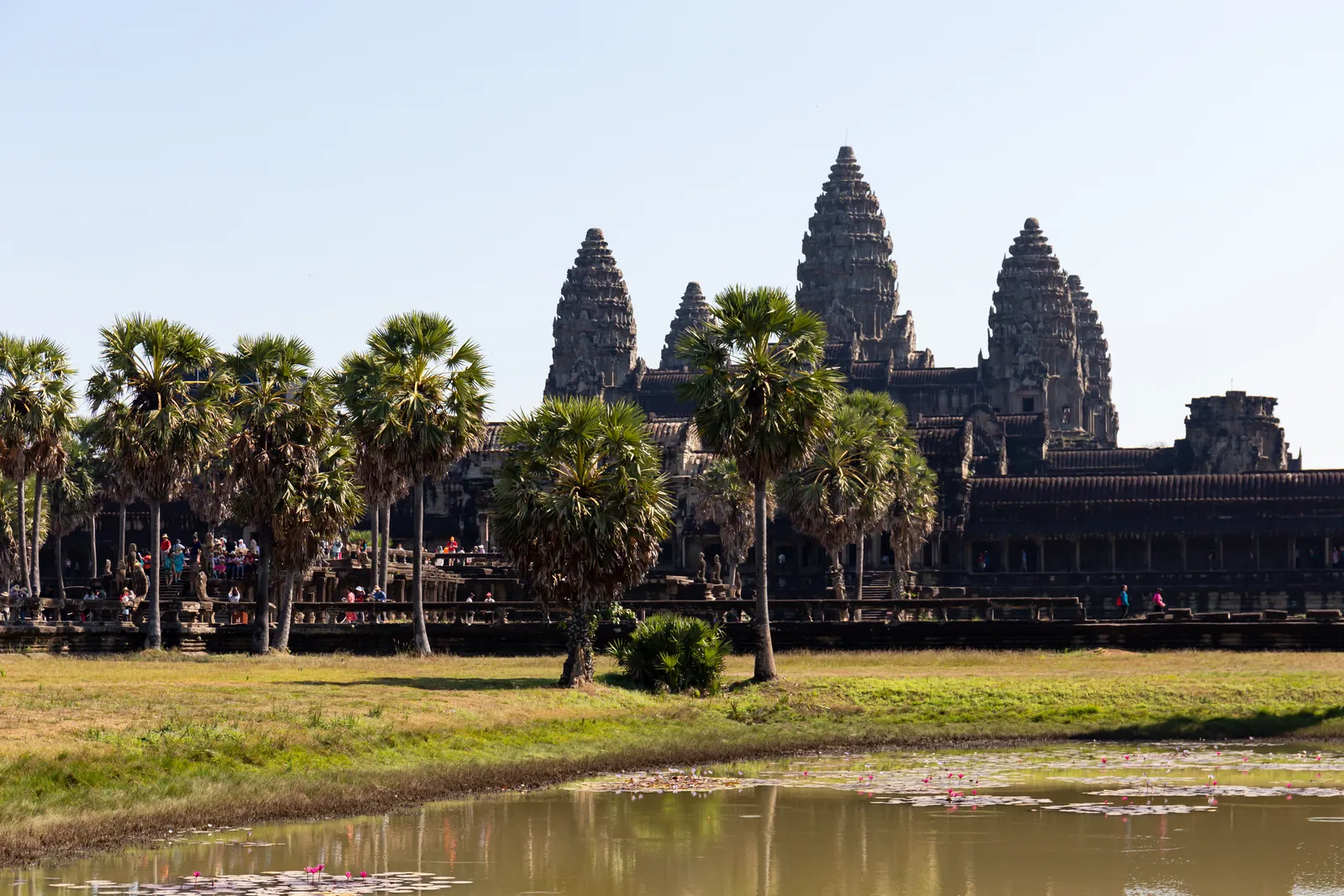
Angkor Wat from the west across the lotus pond, photographed on 10 December 2019. Photo: Balon Greyjoy, CC0 1.0, via Wikimedia Commons · Wikimedia Commons · CC0 1.0
