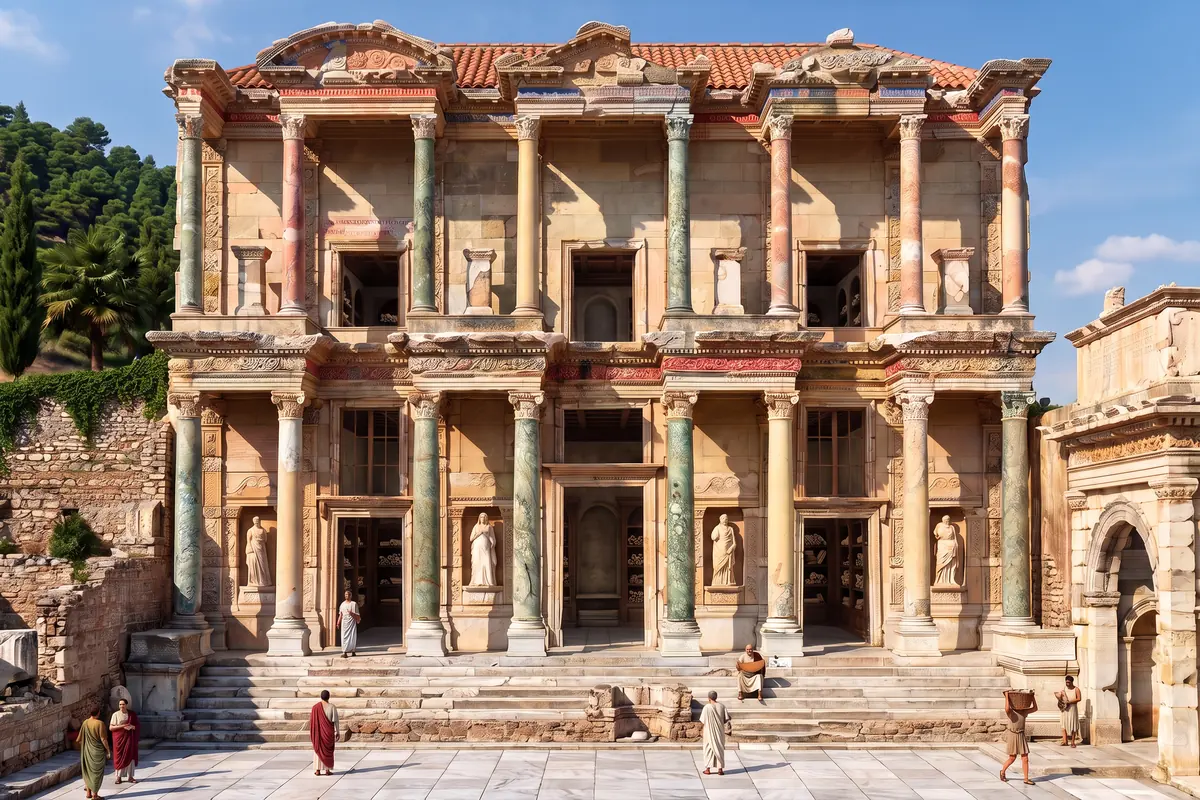
AI vision: the Library of Celsus in Ephesus around 135 AD, new, with roof, coloured marble columns, painted friezes, statues in the niches and people on the steps
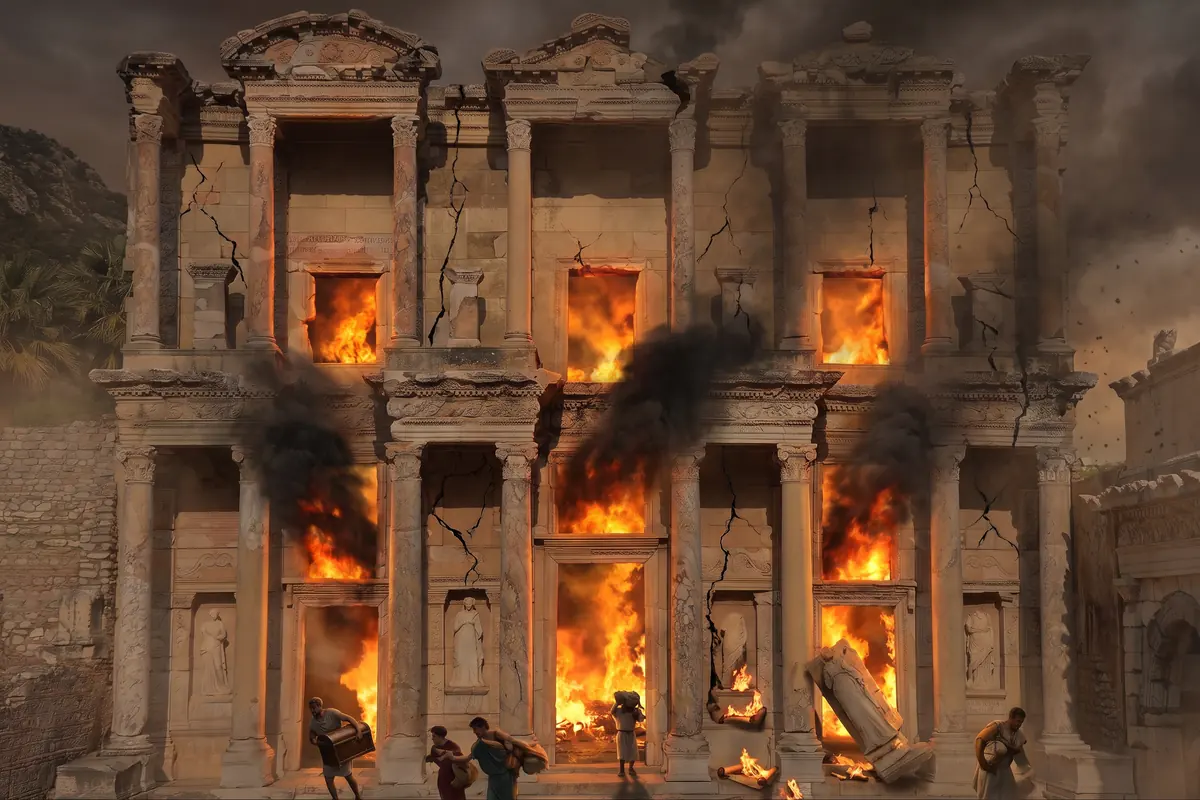
AI vision: the burning Library of Celsus after the earthquake of 262 AD, flames and smoke from portals and windows, cracks in the facade, people fleeing
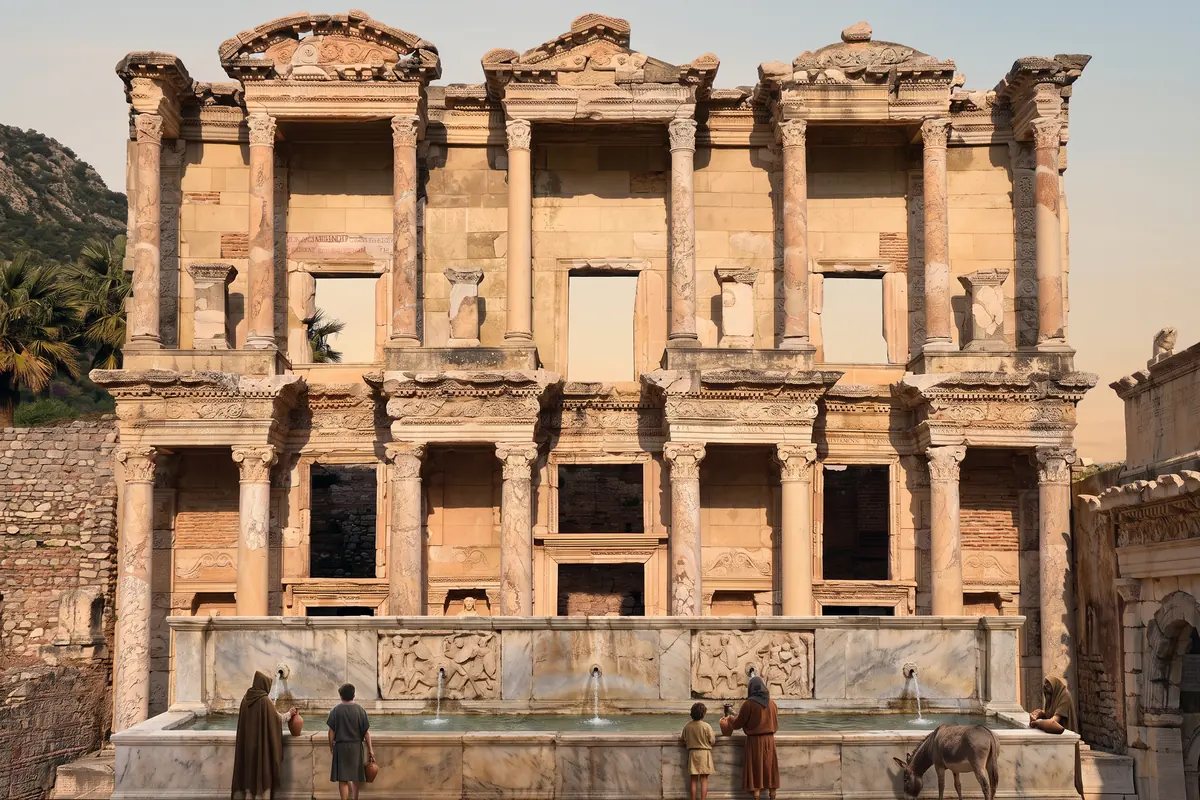
AI vision: the facade of the Library of Celsus around 400 AD as a fountain, a long water basin with relief slabs in front, people with jugs
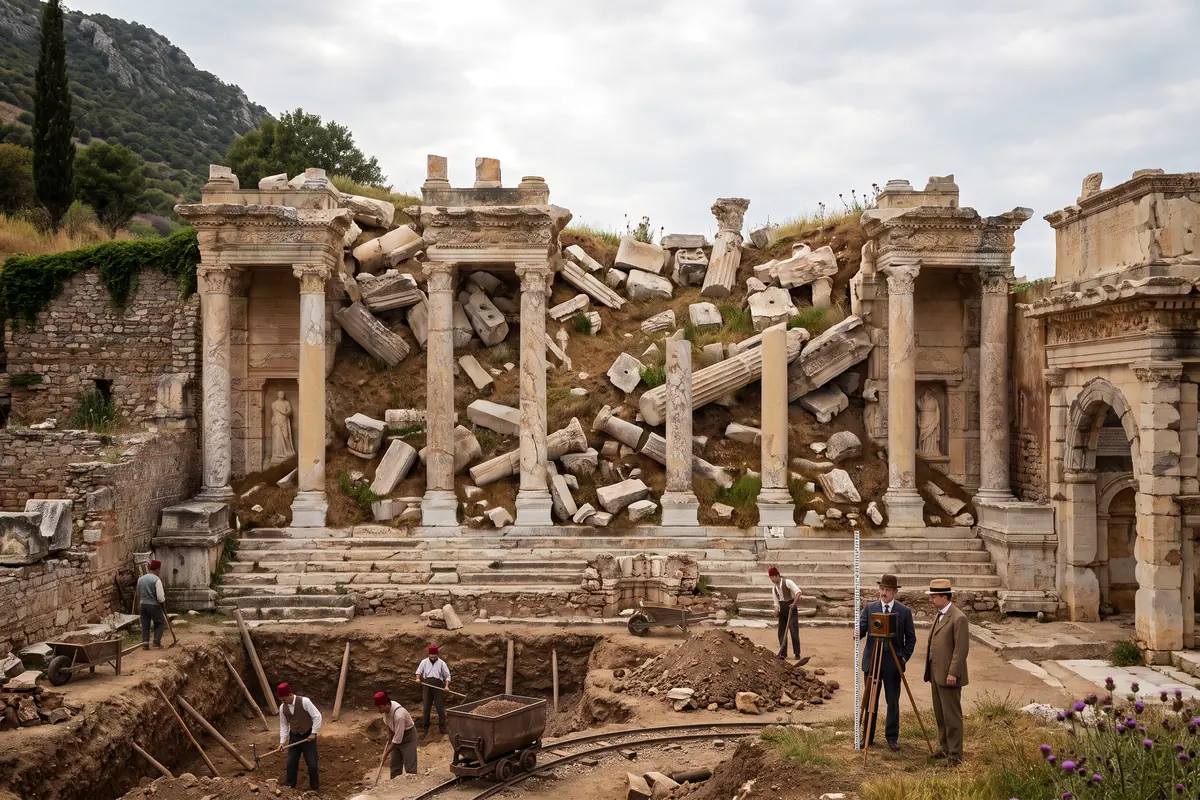
AI vision: the excavation of the Library of Celsus in 1904, a heap of collapsed marble blocks and columns in a trench, workers with wheelbarrows, archaeologists with a camera
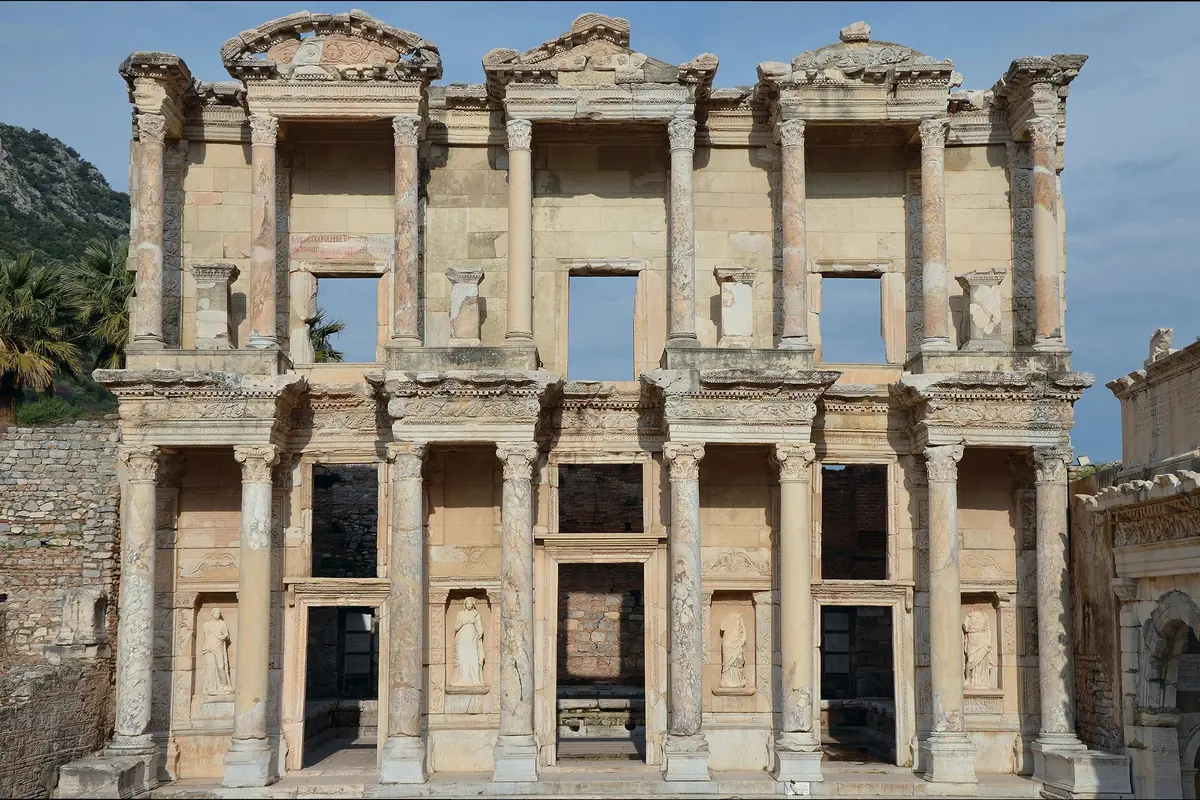
The facade of the Library of Celsus in Ephesus, photographed on 8 April 2015
Documented Two-storey facade, built 110 to about 135 ADDocumented Statues of Sophia, Arete, Ennoia and Episteme in the niches (originals in Vienna)Assumed Roof and interior: inferred from building remainsAssumed Colours: certainly painted, exact colours unknownInvented People, clothing, scrolls
Documented Interior destroyed by fire around 262, facade left standingAssumed Cause: earthquake or Gothic raid, both documented in the same decadeAssumed Extent of damage to the facadeInvented Fleeing people, scenes
Documented Fountain basin with the reliefs of the Parthian Monument in front of the facade, around 400 (reliefs now in Vienna)Documented Facade without roof after the fire, still in useAssumed Condition of windows, niches and statues around 400Invented People, animals, everyday life
Documented Collapse of the facade in the Middle Ages, uncovered 1903 to 1904 by the Austrian Archaeological InstituteDocumented Light railway, wheelbarrows, trenches: standard technique around 1904Assumed Date and cause of the collapseInvented Persons, faces, clothing in detail
Documented Facade re-erected 1970 to 1978 from original blocksDocumented Statues in the niches: copies, originals in the Ephesos Museum in ViennaDocumented Gate of Mazaeus and Mithridates, 4/3 BC, leading to the Tetragonos Agora

AI vision · artistic licence

Library of Celsus: one facade, 1,900 years

You stand in a single spot, on the square in front of the Library of Celsus in Ephesus. Time runs, you don’t. Scroll from the new library around 135 AD through the fire, the fountain and the heap of rubble of 1904 to the facade that awaits you today.

I’m Ada Falk. I have spent my life digging through dirt in search of other lives. This facade was put back together from a heap of marble, and I’ll show you what came before. I’ll guide you.

Ada is an invented narrator. The history is real: every fact and quotation is sourced, and the sources are listed at the end. The images are AI visions, not scientific reconstructions. The button “What is the evidence?” shows what is documented.

AI vision: the Library of Celsus in Ephesus around 135 AD, new, with roof, coloured marble columns, painted friezes, statues in the niches and people on the steps

Diary 1 / 5 · around 135 AD · one morning

The Library of Celsus around 135 AD: A tomb full of books

Stand here on the square in front of the steps and look up. What you see is no ordinary library but a tomb: beneath the reading room lies Tiberius Julius Celsus Polemaeanus, governor of the province of Asia, in a marble sarcophagus. His son built him this house, with 12,000 scrolls in the wall niches, and left money so that new ones could be bought every year.

The facade is a stage set: two storeys, the upper columns narrower than the lower to make the building look taller, and four women in the niches announcing what counts here: wisdom, virtue, insight, knowledge. The colours are invented, but that the facade was painted is certain. Antiquity was never grey.

The inscription on the building

„For Tiberius Julius Celsus Polemaeanus, consul, proconsul of Asia, Tiberius Julius Aquila Polemaeanus, his son, built the library.“

Dedicatory inscription of the Library of Celsus, Ephesus, around 117 AD. Our abridged translation.

Image: AI vision based on a photo by Carole Raddato (CC BY-SA 2.0), not a scientific reconstruction.

AI vision: the burning Library of Celsus after the earthquake of 262 AD, flames and smoke from portals and windows, cracks in the facade, people fleeing

Diary 2 / 5 · 262 AD · evening

The earthquake of 262: The day the books burned

The library stands for a hundred and fifty years, then comes the year 262. A severe earthquake strikes the west coast of Asia Minor, and in the same years Gothic raiders plunder the cities on the Aegean. Which of the two hit the library we do not know exactly; what is certain is that its interior burnt out. The scrolls, the shelves, the roof: gone. The facade remained standing, cracked and sooty.

Nobody rebuilt the library. The empire had other worries in these decades: emperors who died after a few months, frontiers that did not hold, a plague. Ephesus remained a great city, but the glory of Hadrian’s time was over.

A chronicler, 1,000 years later

„At the same time Ephesus, the most famous city of Asia, was shaken to its foundations by an earthquake, and the Temple of Artemis went up in flames.“

After Jordanes, Getica 20, and Zosimus, Historia nova 1.28, on the earthquake and Gothic raid around 262. Paraphrased.

Image: AI vision based on a photo by Carole Raddato (CC BY-SA 2.0), not a scientific reconstruction.

AI vision: the facade of the Library of Celsus around 400 AD as a fountain, a long water basin with relief slabs in front, people with jugs

Diary 3 / 5 · around 400 AD

The library as a fountain: Water instead of knowledge

Around 400 the facade has a new job. Someone has placed a long marble basin in front of the steps and faced its front with relief slabs taken from an older monument: scenes from the Parthian war of Emperor Lucius Verus, two hundred years old. The burnt-out library has become a fountain. The Ephesians fetch water here where their great-grandparents read books.

This is typical of late antiquity: nothing is demolished, everything is reused. Ephesus is by now a Christian city; in 431, in the Church of Mary by the harbour, a council will argue about the nature of Christ. The harbour itself is slowly silting up, the river Cayster pushing more mud into the bay year by year.

A bishop, at the time of the council

„The whole city waited from early morning until evening and then escorted us to the church with torches and incense.“

Cyril of Alexandria in a letter from Ephesus, June 431, on the opening of the council. Our abridged translation.

Image: AI vision based on a photo by Carole Raddato (CC BY-SA 2.0), not a scientific reconstruction.

AI vision: the excavation of the Library of Celsus in 1904, a heap of collapsed marble blocks and columns in a trench, workers with wheelbarrows, archaeologists with a camera

Diary 4 / 5 · 1904

The excavation of 1904: A heap of marble

Sometime in the 10th or 11th century the facade falls. An earthquake, probably; by then Ephesus is a village on the hill by the Basilica of St John, and the harbour is a marsh. The blocks stay where they fall, and the mud of the Cayster covers them. For nine hundred years nobody knows that a library stood here.

In 1863 the Englishman John Turtle Wood begins digging at Ephesus in search of the Temple of Artemis. From 1895 Austria takes over, and in 1903 Rudolf Heberdey and his workers hit the mound of rubble at the end of Curetes Street. They clear it block by block, number every stone and read from the finds what the facade once looked like. The statues of the four virtues go to Vienna, where they stand to this day.

The excavator

„The library, whose remains lay before us in a heap of piled-up marble blocks, proved to be one of the most important buildings of the city.“

After Rudolf Heberdey, preliminary report on the excavations at Ephesus 1904, Jahreshefte of the Austrian Archaeological Institute. Paraphrased.

Image: AI vision based on a photo by Carole Raddato (CC BY-SA 2.0), not a scientific reconstruction.

The facade of the Library of Celsus in Ephesus, photographed on 8 April 2015

Diary 5 / 5 · Today

The Library of Celsus today: And now you

This is real. Exactly this facade awaits you at the lower end of Curetes Street, and it is the work of eight years of puzzle: from 1970 to 1978 Austrian archaeologists under Volker Michael Strocka put the blocks numbered in 1904 back on top of each other, filled the gaps in lighter stone and placed copies of the four women in the niches. About two thirds of what you see is ancient.

The sarcophagus of Celsus still lies beneath the floor of the reading room. The sea, which once began 500 metres behind the theatre, is now six kilometres away. If you stand in front of the steps and half close your eyes, you can see the roof.

The Austrian Archaeological Institute, today

„The re-erection of the facade is regarded as one of the most accurate reconstructions in classical archaeology; since 2023 it is being conserved again.“

Austrian Academy of Sciences, announcement on the conservation of the Library of Celsus. Paraphrased.

Real photo: Carole Raddato, CC BY-SA 2.0, via Wikimedia Commons.

Your expedition

Visit the Library of Celsus: Stand exactly here

“The rest you have to see for yourself. And when you stand in front of the steps, look for the lighter stones: those are the ones that were missing in 1904.” Ada Falk

  1. Start at the top. From the upper gate, Curetes Street leads downhill; after 20 minutes the square with the facade opens up.
  2. Onto the square. Stand between the steps and the Gate of Mazaeus and Mithridates, about 25 metres from the facade. That is the view of this time journey.
  3. Then inside. Through the central portal into the reading room; beneath you still lies the sarcophagus of Celsus.
  • Morning light: The facade faces east and is in the sun only in the morning. At 8 am the square is almost empty.
  • Crowded at midday: Between 10 am and 2 pm the cruise groups stand here. Walk downhill and you arrive before them.
  • Check first: Prices, opening hours and gates are in our guide Ephesus tickets and admission; all 16 highlights are on our map.

At a glance

The Library of Celsus in facts

Built
110 to about 135 AD, donated by Tiberius Julius Aquila for his father Celsus
Holdings
about 12,000 scrolls
Fire
around 262 AD, earthquake and Gothic raid
Fountain
around 400 AD, basin with the reliefs of the Parthian Monument
Collapse
10th or 11th century, earthquake
Re-erection
1970 to 1978, Austrian Archaeological Institute

Frequently asked questions about the Library of Celsus

What was the Library of Celsus?

A library and at the same time a tomb: Tiberius Julius Aquila had it built from 110 AD for his father Celsus, the former governor of the province of Asia. Beneath the reading room lies the sarcophagus of Celsus. With about 12,000 scrolls it was one of the largest libraries of the Roman Empire.

Why is the Library of Celsus in ruins?

Around 262 AD its interior burnt out, after an earthquake and a Gothic raid in the same decade. The facade remained standing and later served as a fountain wall, until it collapsed in an earthquake in the 10th or 11th century.

Is the Library of Celsus real?

Yes and no. The facade was re-erected in 1970 to 1978 from the ancient blocks found in the heap of rubble in 1903/04; missing parts were filled in lighter stone. About two thirds is original. The statues in the niches are copies; the originals are in the Ephesos Museum in Vienna.

What did the Library of Celsus look like inside?

A single large hall, about 17 by 11 metres, with wall niches for the scrolls on three levels reached by galleries. In the middle of the back wall a large niche for a statue. Today only the foundations of the interior survive.

Who were the four women in the niches?

Personifications of the qualities of Celsus: Sophia (wisdom), Arete (virtue), Ennoia (insight) and Episteme (knowledge). The original statues went to Vienna after the excavation.

Why is Ephesus no longer by the sea?

The river Cayster filled the bay with sediment over centuries. In Roman times the harbour lay directly behind the theatre; today the coast is about six kilometres away. The silting was one reason for the city’s decline.

Can you go inside the Library of Celsus?

Yes, you can walk through the portals into the interior, which today lies open to the sky. The facade itself has been under conservation again since 2023, so scaffolding may be present.

When is the best light for the library?

The facade faces east. In the morning it is in the sun, from midday in shade. At 8 am it is also still almost empty; the images on this page show it in morning light.

About these images

The images of stages 1 to 4 are AI visions generated with Nano Banana Pro (Google Gemini) via fal.ai; the starting point was a photograph of the facade today (Carole Raddato, CC BY-SA 2.0). As adaptations of that photo the visions are published under the same licence. They are meant to convey a feeling and are not scientific reconstructions: people, clothing, colours and scenes are invented, and the buildings follow the evidence only in broad strokes. The image files are labelled as AI-generated (IPTC). The last image is the unaltered photograph.

Sources and status

Text: Daniela Pieper, Back in Time Travel editorial team. Updated 25 September 2026. Specialist review is still pending. Translations are our own, abridged.

  1. Austrian Academy of Sciences: conservation of the Library of Celsus
  2. Austrian Archaeological Institute: Ephesos bio-geo-archive (silting of the harbour)
  3. World History Encyclopedia: Library of Celsus
  4. Turkish Ministry of Culture: Efes Örenyeri
  5. UNESCO World Heritage: Ephesus
  6. V. M. Strocka: Zur Datierung der Celsusbibliothek. In: Proceedings of the Xth International Congress of Classical Archaeology, Ankara 1978.
  7. R. Heberdey: Vorläufiger Bericht über die Grabungen in Ephesos 1904. Jahreshefte des ÖAI 8, 1905.
  8. Cyril of Alexandria, Letter 20 (to the clergy of Alexandria), June 431.
  9. Jordanes, Getica 20; Zosimus, Historia nova 1.28.
Image credits

Facade today and source image of the AI visions: Carole Raddato, Wikimedia Commons, CC BY-SA 2.0. Cropped, resized.

AI visions: Back in Time Travel, generated with Nano Banana Pro via fal.ai, adaptations of the photo by Carole Raddato, CC BY-SA 2.0. Not a scientific reconstruction.

Barlow Condensed / Manrope · SIL Open Font License. Barlow OFL · Manrope OFL