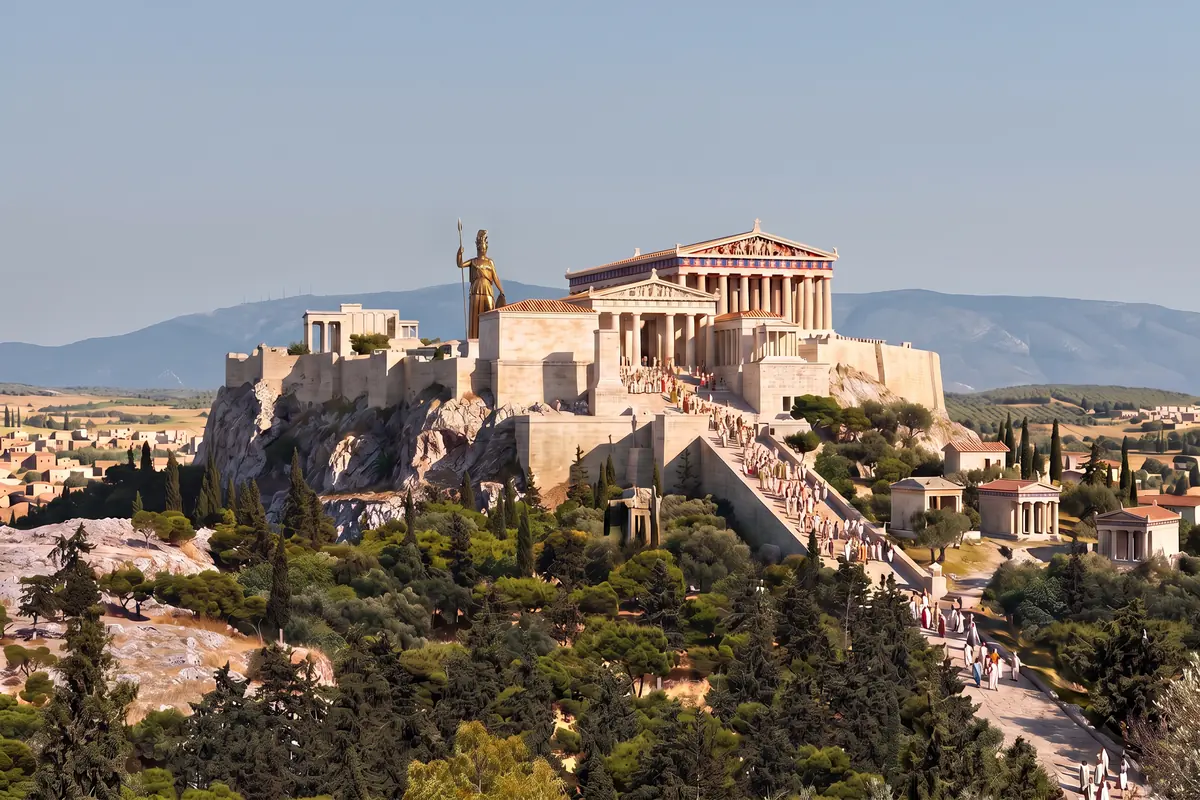
AI vision: the Acropolis of Athens around 432 BC seen from the Pnyx, with the complete Parthenon and its roof, the Propylaea, the bronze statue of Athena Promachos and a procession on the ramp
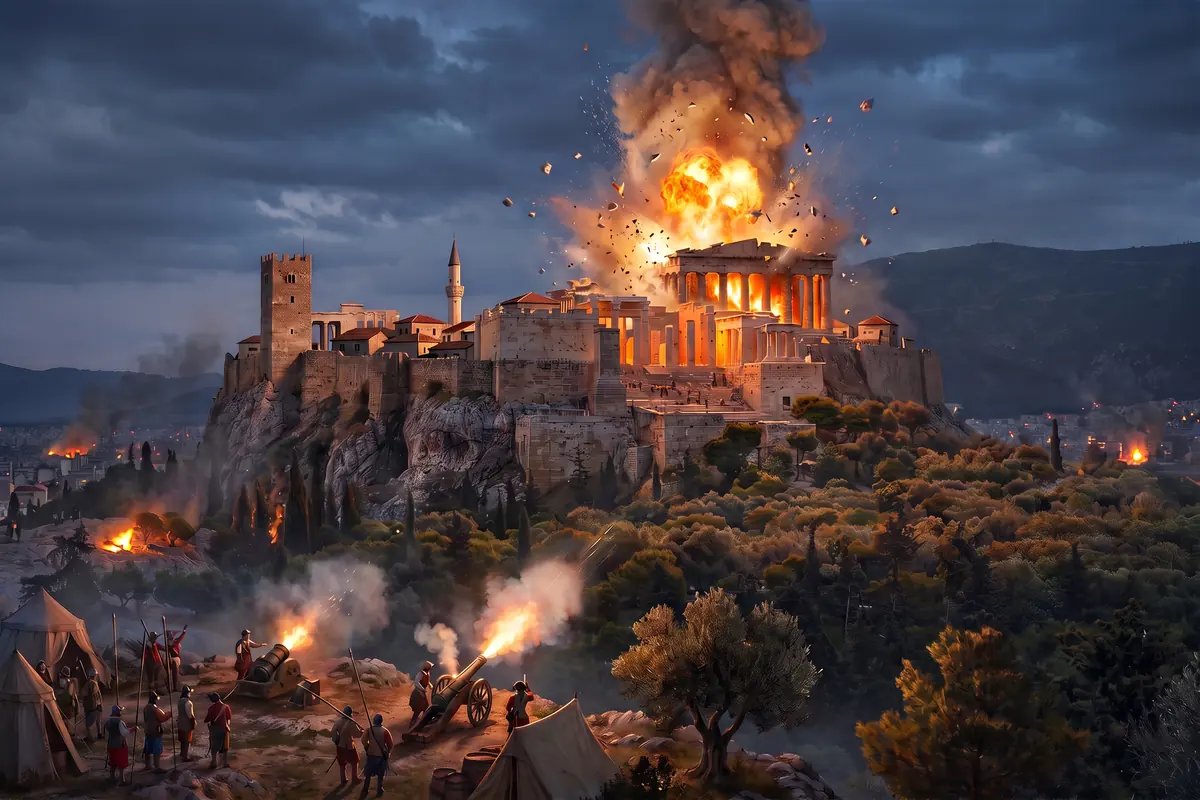
AI vision: the explosion of the Parthenon on 26 September 1687 seen from the Pnyx, a fireball and column of smoke above the Ottoman fortress on the Acropolis, Venetian mortars in the foreground
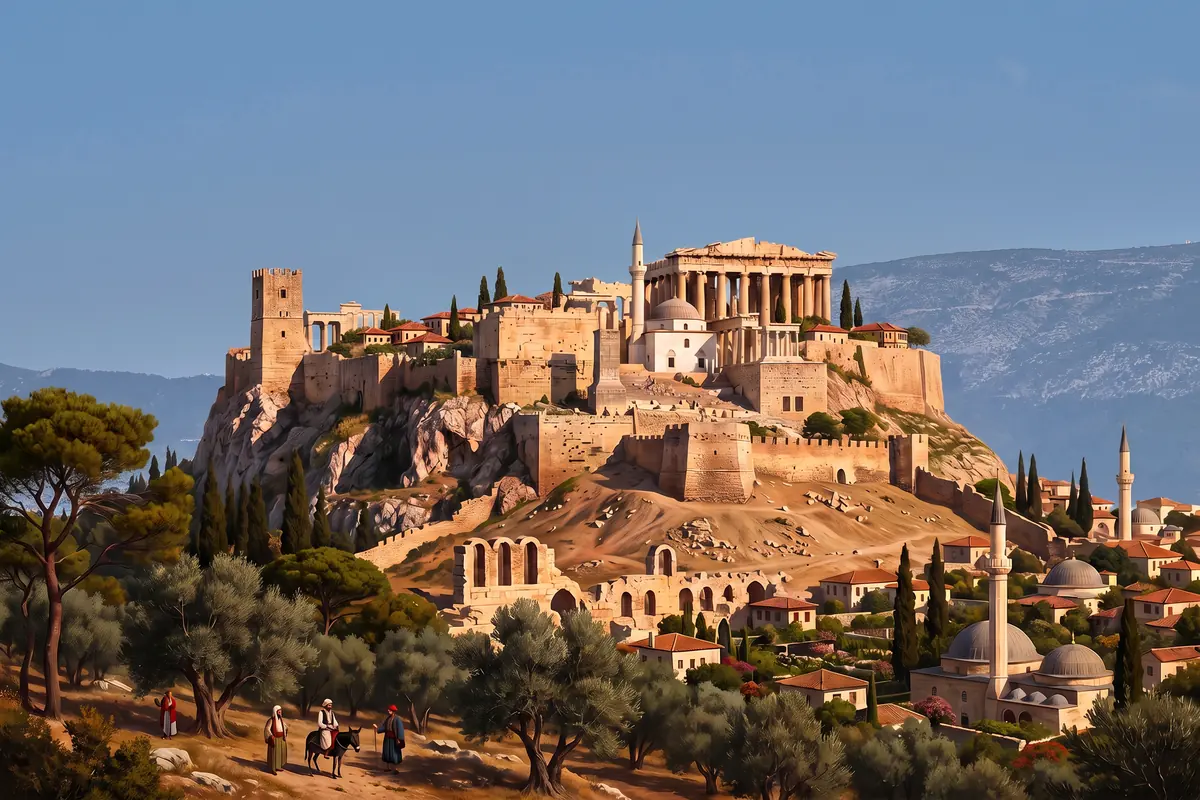
AI vision: the Acropolis around 1750 seen from the Pnyx, the Parthenon as a ruin with a small mosque in the middle, houses and a medieval tower on the rock, the Ottoman town below
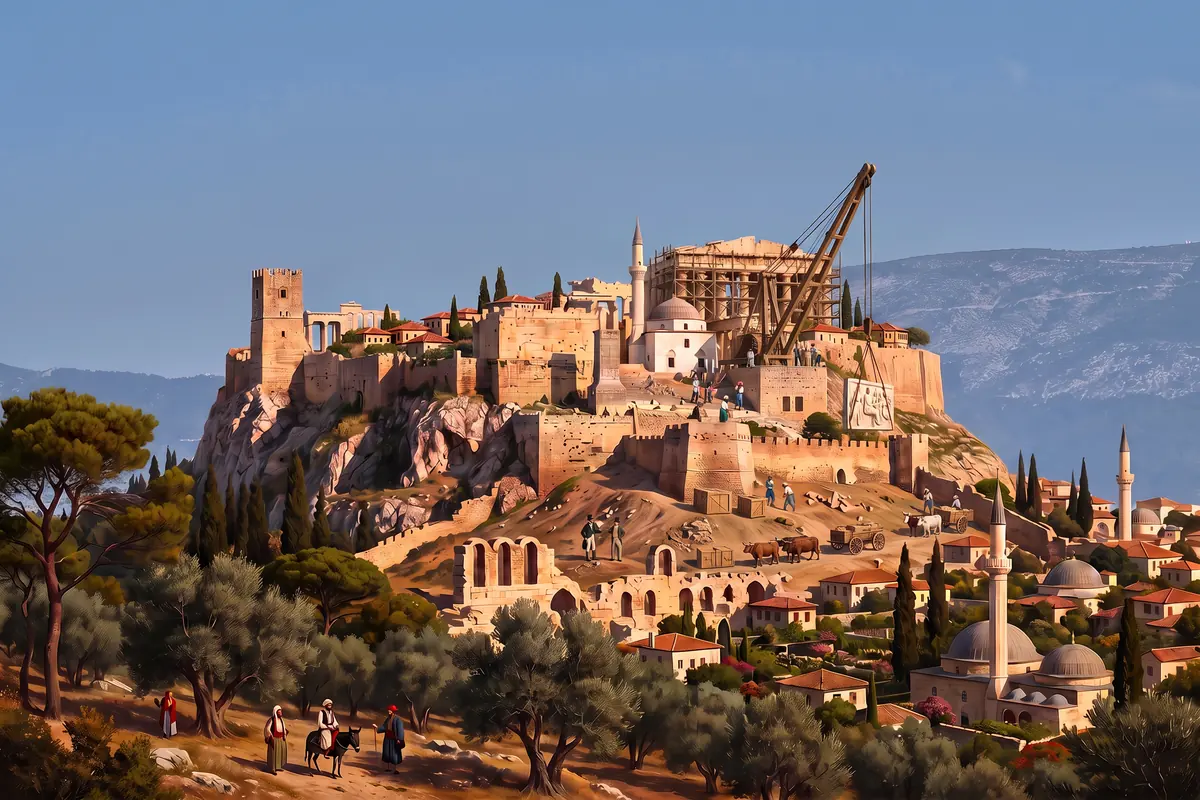
AI vision: the removal of the Parthenon sculptures around 1802 seen from the Pnyx, scaffolding and pulleys on the Parthenon, a relief slab being lowered to ox carts on the slope
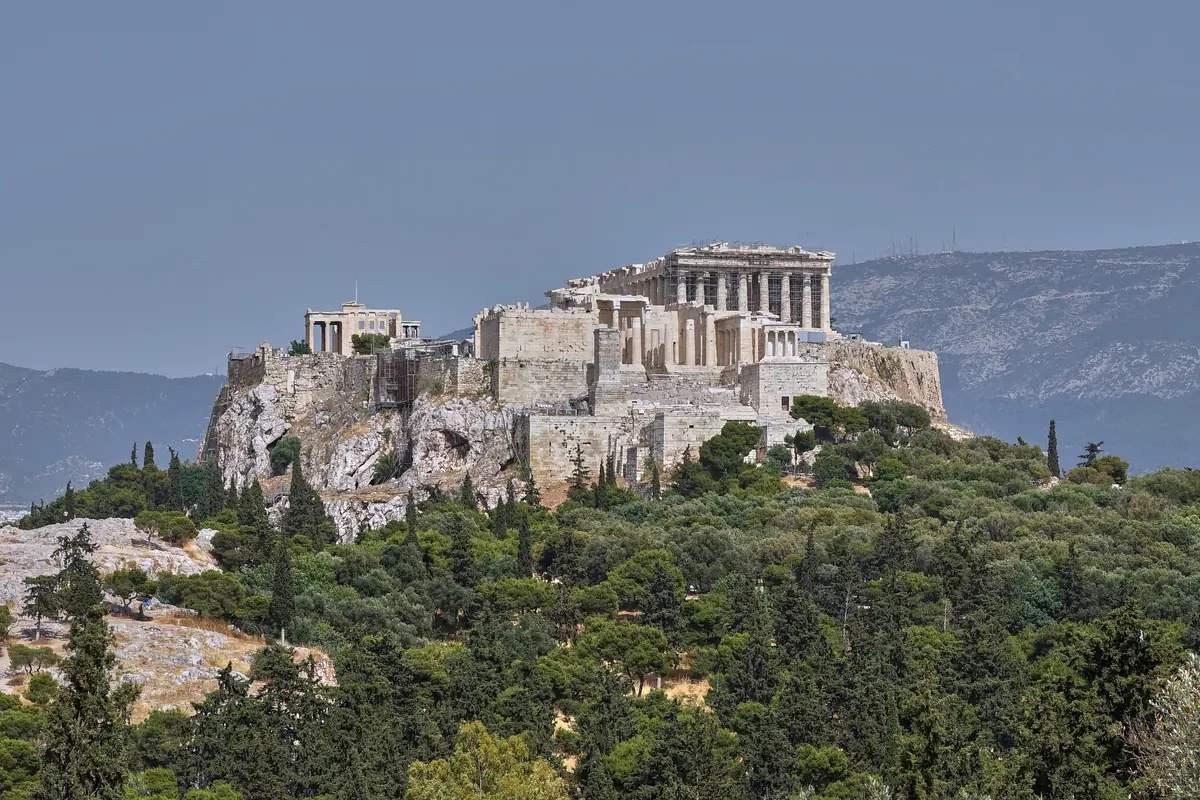
View from the Pnyx of the Acropolis of Athens with the Parthenon, photographed on 20 May 2020
Documented Parthenon, completed 447 to 432 BC, with roof and sculptureDocumented Propylaea, 437 to 432 BC, never finishedDocumented Athena Promachos, bronze statue by Phidias, about nine metres tallAssumed Painted colours of the temple: red, blue, gold on marbleInvented Procession, clothing, facesInvented Houses and gardens of the city around 432 BC
Documented Explosion of the gunpowder store in the Parthenon on 26 September 1687Documented Frankish tower at the Propylaea, demolished only in 1875Documented Venetian mortar positions on the hills to the westAssumed Extent of fireball and smokeInvented Soldiers, tents and guns in detail
Assumed State of the Parthenon: in reality the centre was blown out, only the ends stoodDocumented Frankish tower at the PropylaeaDocumented Small mosque in the ruin, built in the early 18th century, removed around 1840Assumed Odeon of Herodes Atticus, buried at the timeInvented Houses, people and animals in detail
Documented Scaffolding and removal of the sculptures 1801 to 1805Documented Relief slabs in crates, shipped to EnglandAssumed Ox carts on the slope: transport to the port of PiraeusInvented Workers and overseers in detail
Documented Parthenon with restoration scaffolding, work since 1975Documented Propylaea, restoredDocumented Odeon of Herodes Atticus, uncovered in the 19th century

AI vision · artistic licence

The Parthenon explosion of 1687: one view, 2,500 years

You stand in a single spot, on the Pnyx opposite the Acropolis. Time runs, you don’t. Scroll from a festival morning in 432 BC through the explosion of 1687, the village on the rock and Lord Elgin’s crates to the view that awaits you today.

I’m Ada Falk. I have spent my life digging through dirt in search of other lives. On this rock everything lies on top of everything else: temple, church, mosque, fortress, ruin. I’ll guide you.

Ada is an invented narrator. The history is real: every fact and quotation is sourced, and the sources are listed at the end. The images are AI visions, not scientific reconstructions. The button “What is the evidence?” shows what is documented.

AI vision: the Acropolis of Athens around 432 BC seen from the Pnyx, with the complete Parthenon and its roof, the Propylaea, the bronze statue of Athena Promachos and a procession on the ramp

Diary 1 / 5 · 432 BC · a festival morning

The Acropolis around 432 BC: The marble shines

Stand here on the Pnyx, where the Athenians hold their assembly, and look across. Up there, something has just been finished that never existed before: a temple entirely of marble, with a roof, pediment figures and a frieze running all the way round. The Parthenon. Its colours would surprise you: red, blue and gold on the marble, not the white we picture today. On the left the gateway, the Propylaea, still under construction. And between them, nine metres tall, the bronze Athena by Phidias, whose spear tip sailors can see from Cape Sounion.

Every four years the city climbs up for the Great Panathenaia: with oxen, music and a new robe for the goddess. This is roughly how the rock may have looked when Pericles completed his building programme. Nobody can yet see the war against Sparta that begins this year.

A biographer, 500 years later

„In beauty each work was at once ancient, and in freshness it is to this day new and young, as if an ever-young spirit lived within it.“

Plutarch, Life of Pericles 13, on the buildings of the Acropolis. Our abridged translation.

Image: AI vision based on a photo by George E. Koronaios (CC BY-SA 4.0), not a scientific reconstruction.

AI vision: the explosion of the Parthenon on 26 September 1687 seen from the Pnyx, a fireball and column of smoke above the Ottoman fortress on the Acropolis, Venetian mortars in the foreground

Diary 2 / 5 · 26 September 1687 · evening

The Parthenon explosion of 1687: One shot, one temple

The temple stands for two thousand years, then one evening is enough. Athens has belonged to the Ottomans since 1456, the Acropolis is their fortress, and the Parthenon, long since a mosque, now serves as a gunpowder store. In September 1687 a Venetian army under Francesco Morosini advances on the city and sets up its mortars on the hills here in the west. For five days they fire at the rock.

On the evening of 26 September a shell hits the powder. The explosion blows the roof, the centre and a large part of the columns of the Parthenon into the air; debris flies as far as the town, and the fire burns for days. The Ottomans surrender, but the Venetians stay only until spring. Trying to remove the horses of Poseidon from the west pediment, they drop the sculptures. A year earlier the Ottomans had already dismantled the small temple of Athena Nike to build a gun emplacement.

An eyewitness in the Venetian camp

„How it dismayed His Excellency to destroy the beautiful temple which had existed three thousand years!“

Anna Åkerhjelm, lady-in-waiting in the entourage of the Swedish commander Königsmarck, in a letter from Athens, October 1687. Our translation.

Image: AI vision based on a photo by George E. Koronaios (CC BY-SA 4.0), not a scientific reconstruction.

AI vision: the Acropolis around 1750 seen from the Pnyx, the Parthenon as a ruin with a small mosque in the middle, houses and a medieval tower on the rock, the Ottoman town below

Diary 3 / 5 · around 1750

The Acropolis as an Ottoman village: A mosque in the ruin

Sixty years later the rock is a village. In the gap the explosion tore into the Parthenon stands a small domed mosque. At the Propylaea rises a tower from the Middle Ages, between them the houses of the garrison, gardens, a well. This is the Acropolis that the first travellers from the West get to see, and they now come more often.

Two Englishmen, James Stuart and Nicholas Revett, measure every column around 1751 and publish their drawings. That is how the Parthenon enters the architecture of Europe, from London to Berlin, as a ruin. What the temple looked like before the explosion we know above all from drawings a Frenchman had made in 1674, thirteen years before the shell struck.

A traveller, eleven years before the explosion

„The finest mosque in the world, without comparison.“

George Wheler, A Journey into Greece, London 1682, on the Parthenon, which he saw intact as a mosque in 1676.

Image: AI vision based on a photo by George E. Koronaios (CC BY-SA 4.0), not a scientific reconstruction.

AI vision: the removal of the Parthenon sculptures around 1802 seen from the Pnyx, scaffolding and pulleys on the Parthenon, a relief slab being lowered to ox carts on the slope

Diary 4 / 5 · 1801 to 1805

Lord Elgin and the Parthenon sculptures: The crates

Now it grows quieter on the rock, and that is the sad part. From 1801 the agents of the British ambassador Lord Elgin have scaffolding put up against the Parthenon. With saws and pulleys they remove pediment figures, metopes and about half of the surviving frieze, pack everything into crates and ship it to England. In 1816 the British Parliament buys the collection for the British Museum.

Whether Elgin had valid permission from the Ottoman authorities is disputed to this day; the original document is lost. Greece has demanded the sculptures back since the 1980s, and in the Acropolis Museum empty places in the frieze have been waiting for them since 2009.

A poet, 1812

„Dull is the eye that will not weep to see / Thy walls defaced, thy mouldering shrines removed / By British hands.“

Lord Byron, Childe Harold’s Pilgrimage, Canto II, stanza 15, London 1812.

Image: AI vision based on a photo by George E. Koronaios (CC BY-SA 4.0), not a scientific reconstruction.

View from the Pnyx of the Acropolis of Athens with the Parthenon, photographed on 20 May 2020

Diary 5 / 5 · Today

The Acropolis today: And now you

This is real. Exactly this view is waiting for you, from the Pnyx, a few minutes west of the west entrance, free and usually empty. The Parthenon is a temple again, at least half of one: from 1833 the Ottoman garrison left, the village disappeared, in 1875 the tower came down, and since 1975 the restoration service has been putting stone after stone back in place, with titanium instead of iron. The scaffolding has been part of the picture ever since.

What the explosion and the crates left behind is now in three places: on the rock, in the Acropolis Museum on the south slope, and in London. If you stand up there and half close your eyes, you can see the roof.

The restoration service, today

„The aim is to preserve the monuments, not to rebuild them: every inserted stone remains recognisable, every intervention is reversible.“

Principles of the Acropolis Restoration Service (YSMA), since 1975. Paraphrased.

Real photo: George E. Koronaios, CC BY-SA 4.0, via Wikimedia Commons.

Your expedition

See the view from the Pnyx yourself: Stand exactly here

“The rest you have to see for yourself. And when you stand up there between the columns, think of that evening in September 1687.” Ada Falk

  1. To the Pnyx. From the west entrance of the Acropolis, Apostolou Pavlou street leads west; after five minutes a path climbs left up the hill. No ticket, no opening hours.
  2. To the speaker’s platform. The rock podium, the Bema, is where the ancient assembly met. From here you look east at the Acropolis.
  3. Then up. With a timed ticket through the west entrance, through the Propylaea to the Parthenon, whose blown-out centre you now recognise.
  • Evening light: The west front of the Parthenon catches the sun in the late afternoon; the Pnyx is the best spot for sunset.
  • No closing times: The Pnyx is freely accessible, the Acropolis only with a time slot. Both together take three hours.
  • Check first: Prices, time slots and entrances are in our guide Acropolis tickets and admission; the places on the rock are on our map.

At a glance

The Parthenon explosion in facts

Built
447 to 432 BC, under Pericles
Explosion
26 September 1687, Venetian shell in the gunpowder store
Destroyed
roof, cella and most of the columns of the long sides
Sculptures
removed 1801 to 1805 by Lord Elgin’s agents, in the British Museum since 1816
End of the fortress
1833 Ottoman garrison withdraws, 1875 tower demolished
Restoration
since 1975, with titanium clamps instead of iron

Frequently asked questions about the destruction of the Parthenon

Why is the Parthenon in ruins?

Mainly because of an explosion: on 26 September 1687, during the Venetian siege of Athens, a shell hit the gunpowder store the Ottomans had set up inside the Parthenon. The roof, the interior and many columns were blown apart. Looting, the removal of the sculptures by Lord Elgin and two centuries of weather followed.

When was the Parthenon built?

447 to 438 BC, with the sculpture finished in 432 BC. It was built by Athens under Pericles; the architects were Iktinos and Kallikrates, and Phidias directed the sculpture.

Who destroyed the Parthenon in 1687?

The Venetian army under Francesco Morosini, besieging Athens during the Morean War against the Ottoman Empire. One of its shells hit the powder. Morosini took the city but gave it up again in spring 1688.

Was the Parthenon a church and a mosque?

Yes. In late antiquity the temple became a church, in the 13th century a Catholic cathedral, and after 1456 a mosque with a minaret. After the explosion the Ottomans built a small mosque inside the ruin; it was removed around 1840.

Where are the Parthenon sculptures today?

In three places: the Acropolis Museum in Athens, the British Museum in London (the parts removed by Lord Elgin in 1801 to 1805) and smaller holdings such as the Louvre. Greece is demanding the return of the London pieces.

Did Lord Elgin have permission?

Disputed. Elgin relied on a letter from the Ottoman authorities of 1801 that survives only in an Italian translation and does not clearly allow the removal of sculptures. The British Parliament bought the collection in 1816 nonetheless.

Was the Parthenon painted?

Yes. Traces of red, blue, green, yellow and gold were found on sculptures and architectural parts; the Acropolis Museum shows them. How completely the temple was painted is uncertain. The images on this page are AI visions, not reconstructions.

What did the Acropolis look like before 1687?

Quite well known, thanks to the drawings the French ambassador Nointel had made in 1674: the Parthenon still stood with its roof and almost all its pediment figures, as a mosque with a minaret, surrounded by the houses of the Ottoman garrison and the Frankish tower at the Propylaea.

Can you visit the Pnyx?

Yes, free and without a ticket. The hill lies a few minutes west of the west entrance of the Acropolis; the Athenian assembly met here in the 5th century BC. The view of the Parthenon matches the photograph this time journey starts from.

About these images

The images of stages 1 to 4 are AI visions generated with Nano Banana Pro (Google Gemini) via fal.ai; the starting point was a photograph of the Acropolis today from the Pnyx (George E. Koronaios, CC BY-SA 4.0). As adaptations of that photo the visions are published under the same licence. They are meant to convey a feeling and are not scientific reconstructions: people, clothing, colours and scenes are invented, and the buildings follow the evidence only in broad strokes. The image files are labelled as AI-generated (IPTC). The last image is the unaltered photograph.

Sources and status

Text: Daniela Pieper, Back in Time Travel editorial team. Updated 25 September 2026. Specialist review is still pending. Translations are our own, abridged.

  1. Acropolis Restoration Service (YSMA): The Parthenon, history and restoration
  2. Plutarch, Pericles 13 (Greek text with English translation, Perseus)
  3. Lord Byron, Childe Harold’s Pilgrimage, Canto II (Project Gutenberg)
  4. British Museum: The Parthenon Sculptures
  5. Acropolis Museum: The colours of the frieze
  6. UNESCO World Heritage: Acropolis, Athens
  7. Anna Åkerhjelm, letter from Athens, October 1687; quoted in Mary Beard, The Parthenon, London 2002.
  8. George Wheler, A Journey into Greece, London 1682.
  9. James Stuart, Nicholas Revett: The Antiquities of Athens, vol. 2, London 1787 (Parthenon).
  10. Jacques Carrey, drawings of the Parthenon sculptures, 1674 (Bibliothèque nationale de France).
Image credits

Acropolis today and source image of the AI visions: George E. Koronaios, Wikimedia Commons, CC BY-SA 4.0. Resized.

AI visions: Back in Time Travel, generated with Nano Banana Pro via fal.ai, adaptations of the photo by George E. Koronaios, CC BY-SA 4.0. Not a scientific reconstruction.

Barlow Condensed / Manrope · SIL Open Font License. Barlow OFL · Manrope OFL