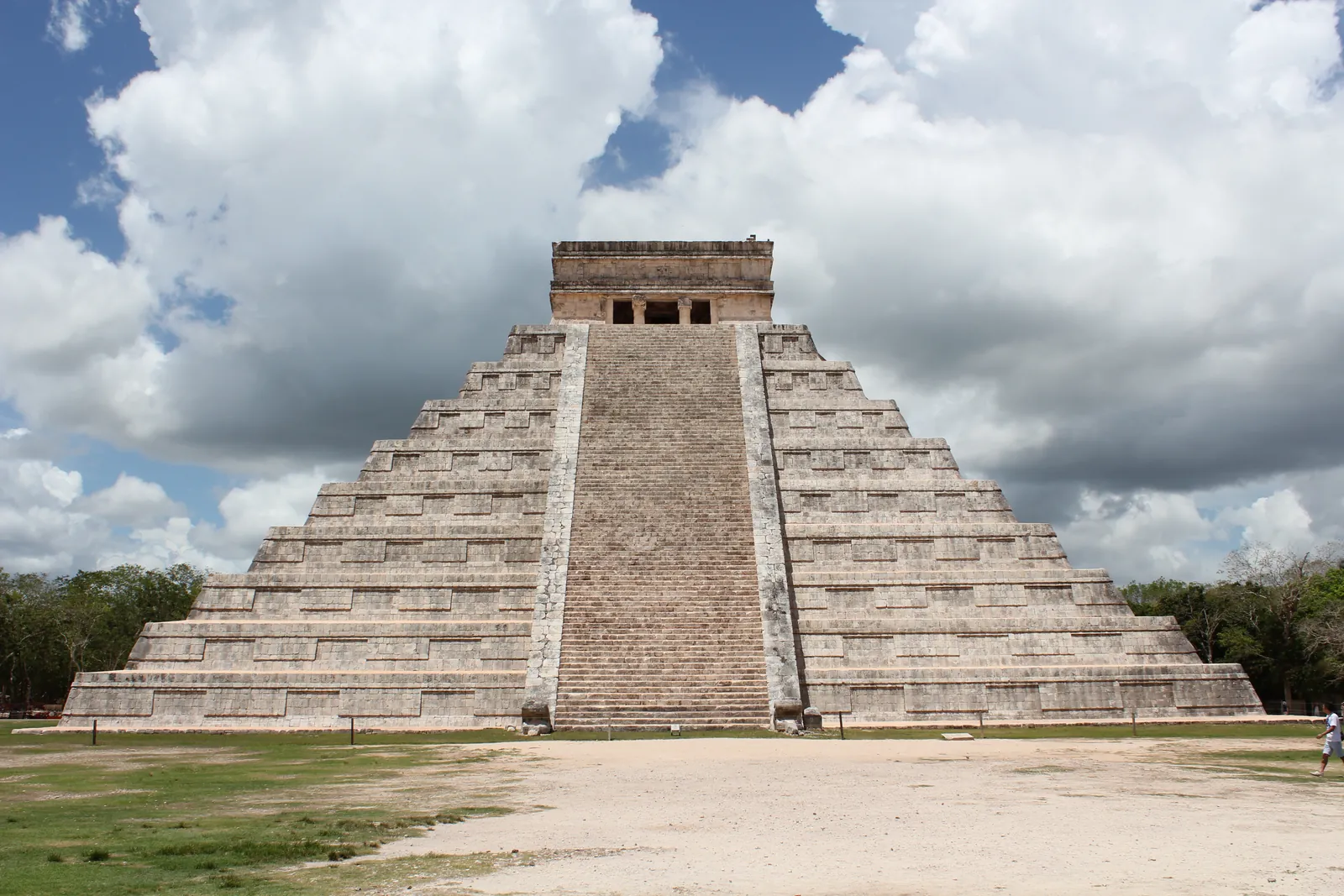
Frontal view of the nine-tiered Kukulcán pyramid with its broad north stairway and the temple on top beneath a cloudy sky.
The Kukulcán pyramid (El Castillo) at Chichén Itzá, north side with the restored stairway, seen from the Great Platform. Photograph taken on 31 May 2013. Arian Zwegers · CC BY 2.0

Mexico · Maya

Chichén Itzá.
Two cities, one place.

The pyramid stands alone on its great platform as if it had always been there. What you are looking at is the final building phase of a city that changed its shape and its connections more than once.

1000CE
Selection: 600–1250 CE8 chapters
The history
At the edge of the well of the Itzá.

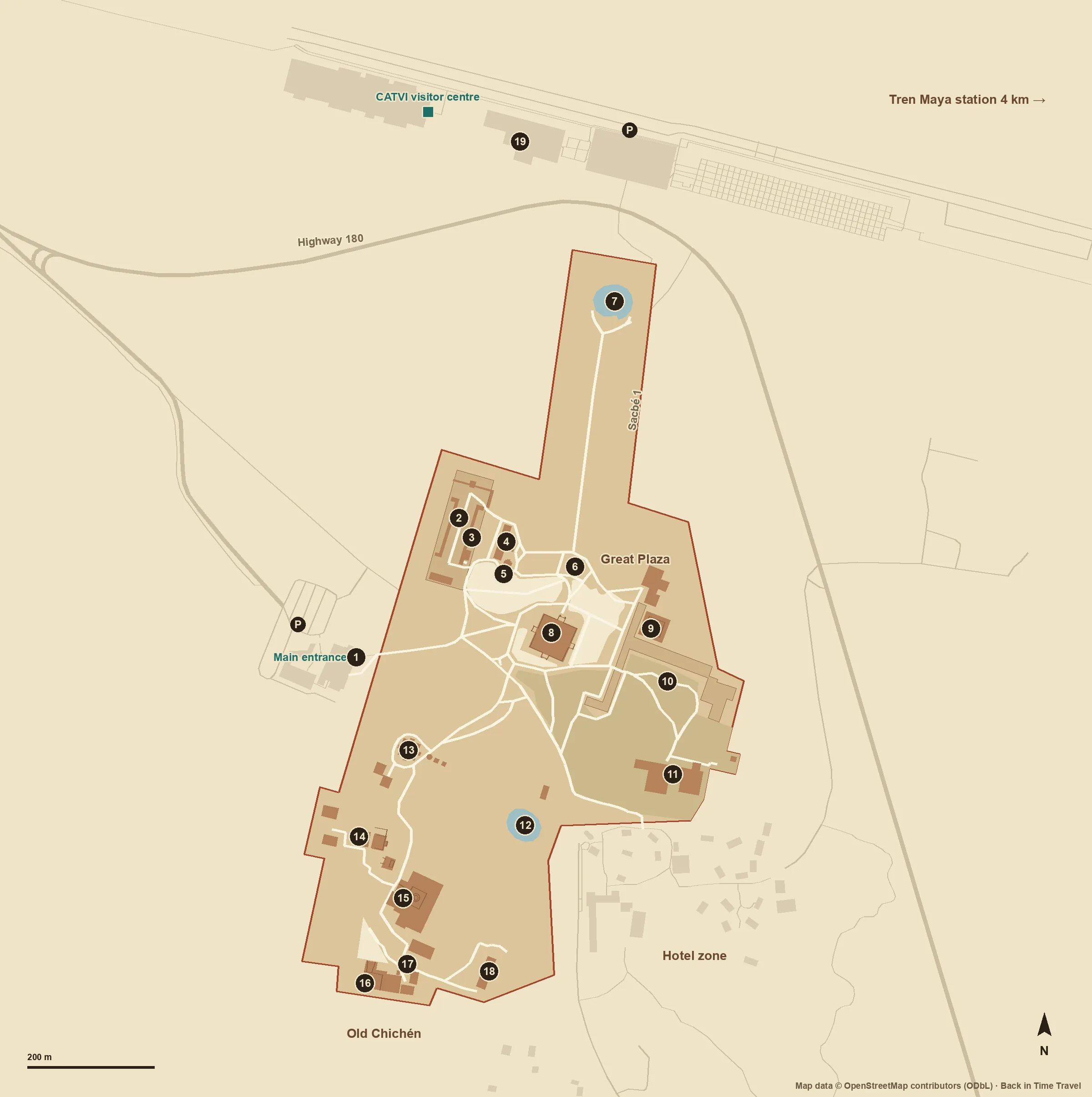
Chichén Itzá lies in the north of the Yucatán peninsula. According to INAH, the name means “the city at the edge of the well of the Itzá”, a reference to the cenotes that open access to groundwater here. The World Heritage site is far more than the Kukulcán pyramid: the ball court, the Temple of the Warriors, the Caracol and the Puuc-style buildings of Old Chichén. Source: UNESCO · Pre-Hispanic City of Chichen-Itza

Through the centuries

No place
stands still.

Choose a period. See how the story changes over time.

02c. 900–1050Florescence

New forms on the great platform.

The Kukulcán pyramid, the Great Ball Court and the Temple of the Warriors are built in a manner INAH describes as combining Maya tradition with central Mexican, Toltec-related features. Chichén Itzá becomes the capital of a wide territory. The last dated inscription in the city records the year 998.

Source: INAH · Zona Arqueológica de Chichén Itzá
0311th–13th centuriesDecline

The fall of the city and the rise of Mayapán.

In the revised chronology, Chichén Itzá ceases to be a political centre in the eleventh century, during a period of severe droughts. The chronicles speak of a league with Mayapán until about 1200; afterwards Mayapán leads northern Yucatán. After the thirteenth century no major buildings are erected at Chichén.

Source: Andrews, Andrews & Robles Castellanos · Ancient Mesoamerica 14 (2003) · The Northern Maya Collapse and its Aftermath
051841/42Rediscovery

Stephens and Catherwood reach the ruins.

On their second journey through Yucatán, John Lloyd Stephens describes the buildings of Chichén Itzá while Frederick Catherwood draws them. Their book, published in 1843, makes the site known in North America and Europe and prompts further travel and investigation.

Source: John L. Stephens · Incidents of Travel in Yucatan, Vol. II (1843)
Swipe or scroll

Look closer

Maya or Toltec? An old question asked anew.

The buildings of the florescence combine Maya techniques with forms from central Mexico: serpent columns, warrior reliefs, Chac Mool figures. The classic explanation was a conquest from Tula, dated by the chronicles to between 967 and 987. The revised chronology, however, places the final occupation of Chichén Itzá in the Terminal Classic and ends it in the eleventh century. The style then looks more like the product of contemporary contacts than the result of an invasion.

Source: Andrews, Andrews & Robles Castellanos · Ancient Mesoamerica 14 (2003) · The Northern Maya Collapse and its Aftermath
What the evidence cannot show
Similarity demonstrates connection, not its direction. Whether people, ideas or goods travelled, and who influenced whom, cannot be settled from architecture alone.
What to look for on a visit
Compare the façades: the fine stone mosaics of Las Monjas belong to Old Chichén, the serpent columns and warrior reliefs of the northern group to the later city. Two ways of building, two periods, one site.
Source: Science Advances 11 (2025) · Classic Maya response to multiyear seasonal droughts in Northwest Yucatán

Reading the place

Beneath the surface.

Buildings and finds reveal more when we consider their context. These close readings connect the evidence with questions to take on a visit.

01

A pyramid inside the pyramid.

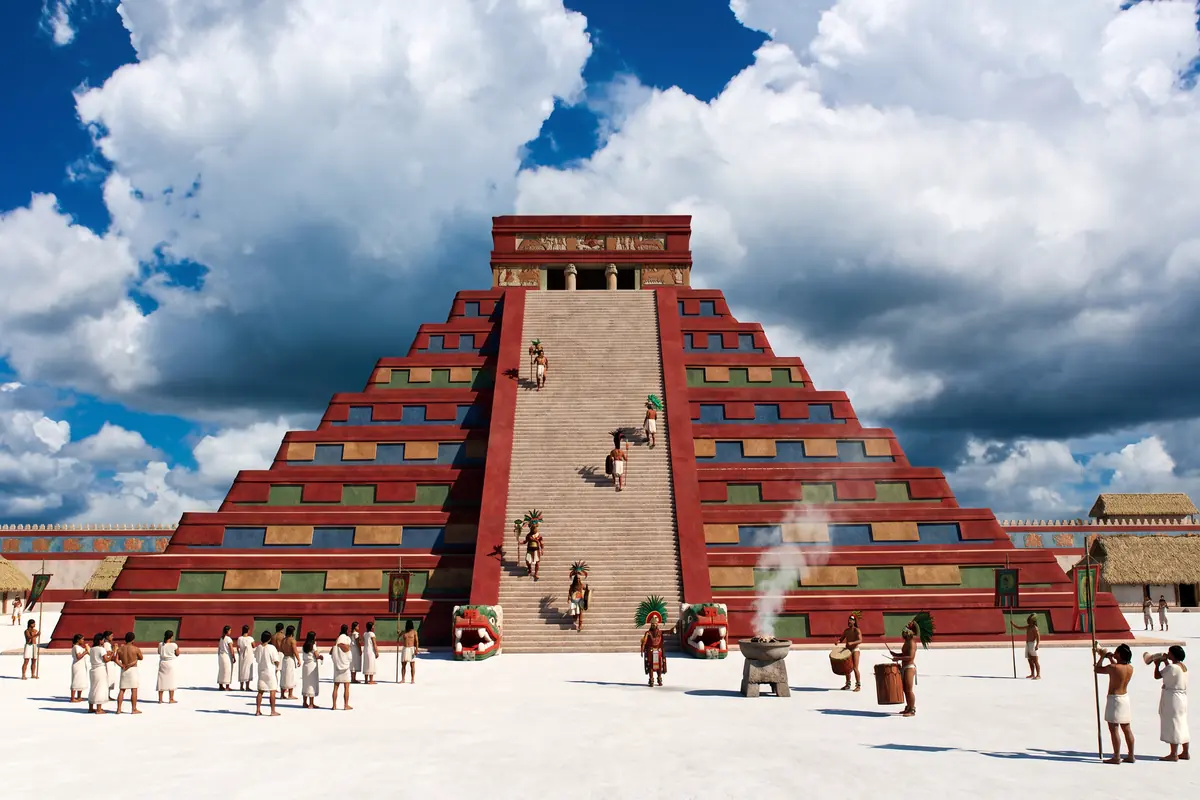
Beneath the Kukulcán pyramid lies an older pyramid with two known chambers, the Jaguar and Chac Mool chambers, reached through tunnels. Geophysical surveys indicate a second, deeper substructure. A UNAM project aims to image the interior of the 30-metre building with cosmic-ray detectors, without excavation.

Evidence / source: Gaceta UNAM · Explorarán las entrañas de la pirámide de Kukulcán en Chichén Itzá (2024)

The visible pyramid is therefore the latest of at least two, perhaps three building phases. Earlier structures were not demolished but encased. Dating El Castillo means dating its outer shell; the central Mexican-looking style belongs to the final layer. That changes how you read the photograph: you are looking at an outcome, not a beginning.

What the evidence cannot establish on its own

An anomaly in a tomographic image is not yet a dated building. Neither the size nor the age of the second substructure has been confirmed by excavation, and the surveys do not yield a calendar year for the outer pyramid.
02

What a chultún beside the cenote reveals.

In 1967, construction of an airstrip near the Sacred Cenote uncovered a repurposed chultún holding the remains of more than a hundred children. Genetic analysis of 64 of these individuals shows that all were male and several closely related, including two pairs of identical twins. Radiocarbon dates range from about 600 to about 1100.

Evidence / source: Barquera et al. · Nature 630 (2024) · Ancient genomes reveal insights into ritual life at Chichén Itzá

An old picture shifts. After the dredging of the cenote, the idea spread that mainly young women had been sacrificed; yet the bones from the water belong to both sexes, and the chultún holds only boys. Twins feature prominently in Maya mythology. The selection of the dead evidently followed rules we are only beginning to understand.

What the evidence cannot establish on its own

Genetics establishes sex and kinship, not the meaning of a ritual. The chultún is also not the cenote: two findspots, two contexts that should not be forced into a single narrative.

03

The serpent of light is a recent observation.

The play of light and shadow on the north balustrade was first described in detail by Jean Jacques Rivard in 1969. It can be seen almost unchanged for several days before and after the equinox, most strikingly about an hour before sunset. According to Šprajc and Sánchez Nava, the pyramid’s orientation fits sunrises and sunsets on calendrically significant dates, not the equinoxes.

Evidence / source: Šprajc & Sánchez Nava · Estudios de Cultura Maya 41 (2013) · Astronomía en la arquitectura de Chichén Itzá: una reevaluación

Ask, as you look at the stairway: what could the builders observe, and what do today’s crowds see? An effect that barely changes over weeks is no use as a calendar instrument. If it was intended, it was intended as an image, not a measurement. The equinox spectacle is a twentieth-century narrative that tourism has cemented.

What the evidence cannot establish on its own

No inscription tells us what the inhabitants saw in that shadow. Intention and coincidence both remain represented in the literature; even the authors of the reassessment do not rule out a symbolic purpose.

Plan a visit

Give Chichén Itzá time.

INAH provides opening hours and admission details. Expect two charges at the ticket office: the INAH admission and the additional fee levied by the state of Yucatán. Arrive early to experience the platform before the day trips from the coast.

The evening light show “Noches de Kukulcán” is a separate event run by the state. According to INAH, Old Chichén (Serie Inicial) is temporarily closed; check which areas are open before you go and whether a tour includes both fees.

Affiliate link: we may receive a commission when you book through GetYourGuide. The historical interpretation remains independent.

Visiting sources checked on 24 September 2026. Prices and availability are provided by the operator.

Keep exploring

More of
Chichén Itzá.

Sources and context

These texts combine published research with editorial explanation. Some dates are approximate. Photographs show documented surviving conditions. Specialist archaeological review is still pending.

  1. Source: UNESCO · Pre-Hispanic City of Chichen-Itza
  2. Source: Science Advances 11 (2025) · Classic Maya response to multiyear seasonal droughts in Northwest Yucatán
  3. Source: INAH · Zona Arqueológica de Chichén Itzá
  4. Source: Andrews, Andrews & Robles Castellanos · Ancient Mesoamerica 14 (2003) · The Northern Maya Collapse and its Aftermath
  5. Source: Barquera et al. · Nature 630 (2024) · Ancient genomes reveal insights into ritual life at Chichén Itzá
  6. Source: John L. Stephens · Incidents of Travel in Yucatan, Vol. II (1843)
  7. Source: Coggins & Shane · Cenote of Sacrifice. Maya Treasures from the Sacred Well at Chichén Itzá (Peabody Museum, 1984)
  8. Source: Morris, Charlot & Morris · The Temple of the Warriors at Chichen Itzá (Carnegie Institution, 1931)
  9. Source: INAH · Aspectos calendáricos y astronómicos de El Castillo de Chichén Itzá (Boletín, 2026)
  10. Source: INAH · Zona Arqueológica de Chichén Itzá
Images and usage rights

The Kukulcán pyramid (El Castillo) at Chichén Itzá, north side with the restored stairway, seen from the Great Platform. Photograph taken on 31 May 2013. Arian Zwegers / Wikimedia Commons · CC BY 2.0. Resized to 1600 pixels wide and compressed as WebP; no crop or content alterations. Framing varies by screen. Derived photograph under the same licence.

Barlow OFL · Manrope OFL