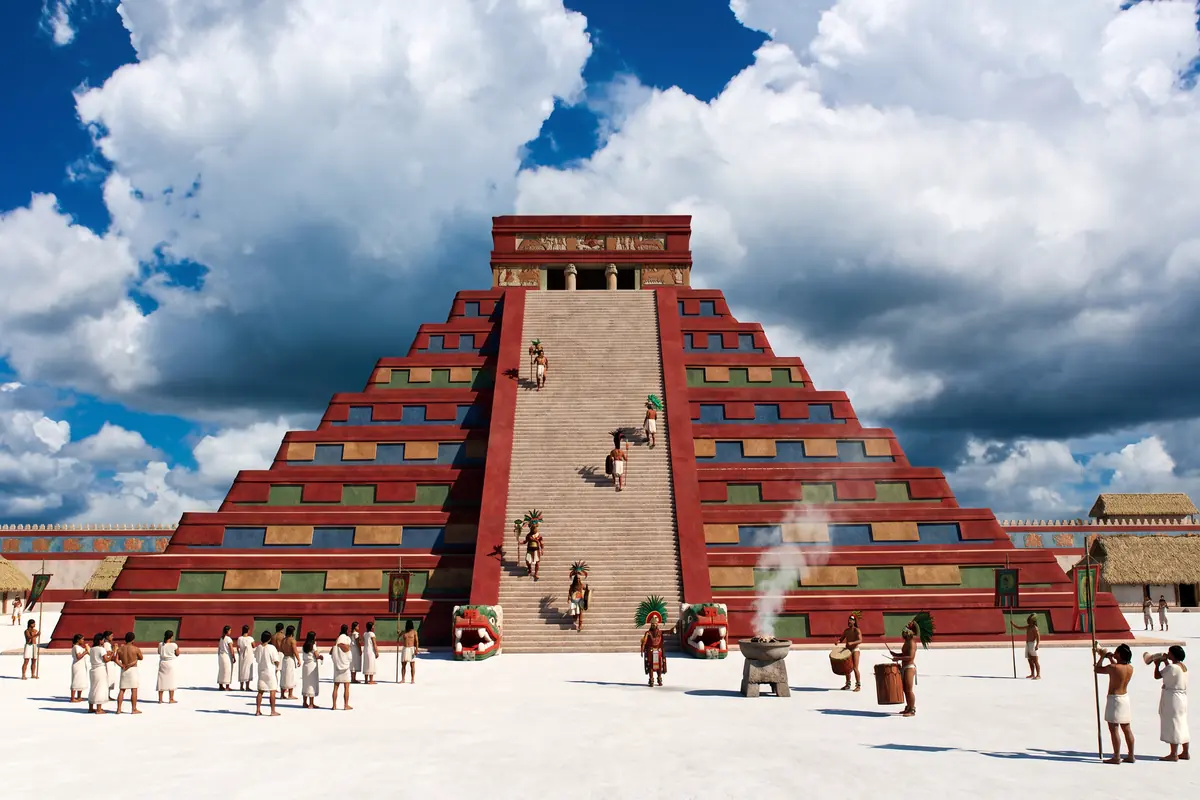
AI vision: the Kukulcán pyramid around 1000 AD, plastered red with coloured panels, painted serpent heads, white stucco floor, priests in feather headdresses on the stairway, people and copal smoke
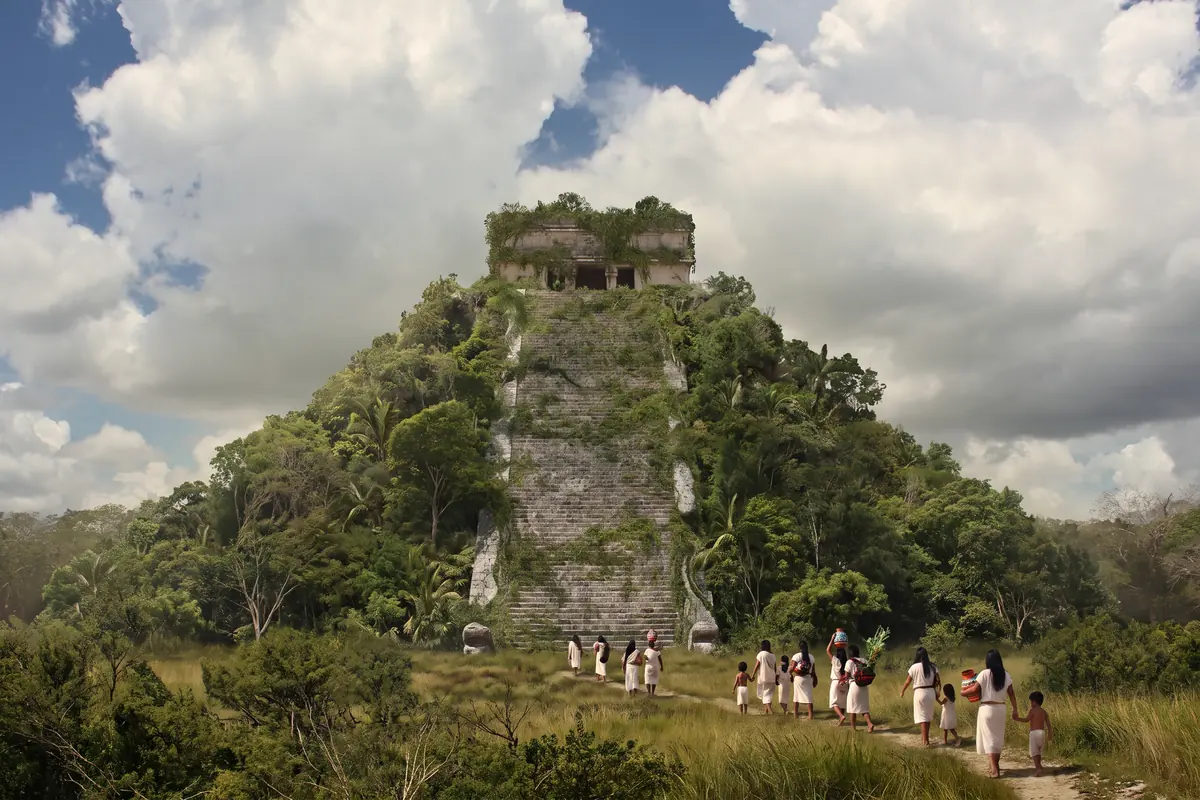
AI vision: the overgrown Kukulcán pyramid around 1550, trees on the tiers, only the stairway and the temple showing through, Maya pilgrims in white cotton with vessels on the way to the Sacred Cenote
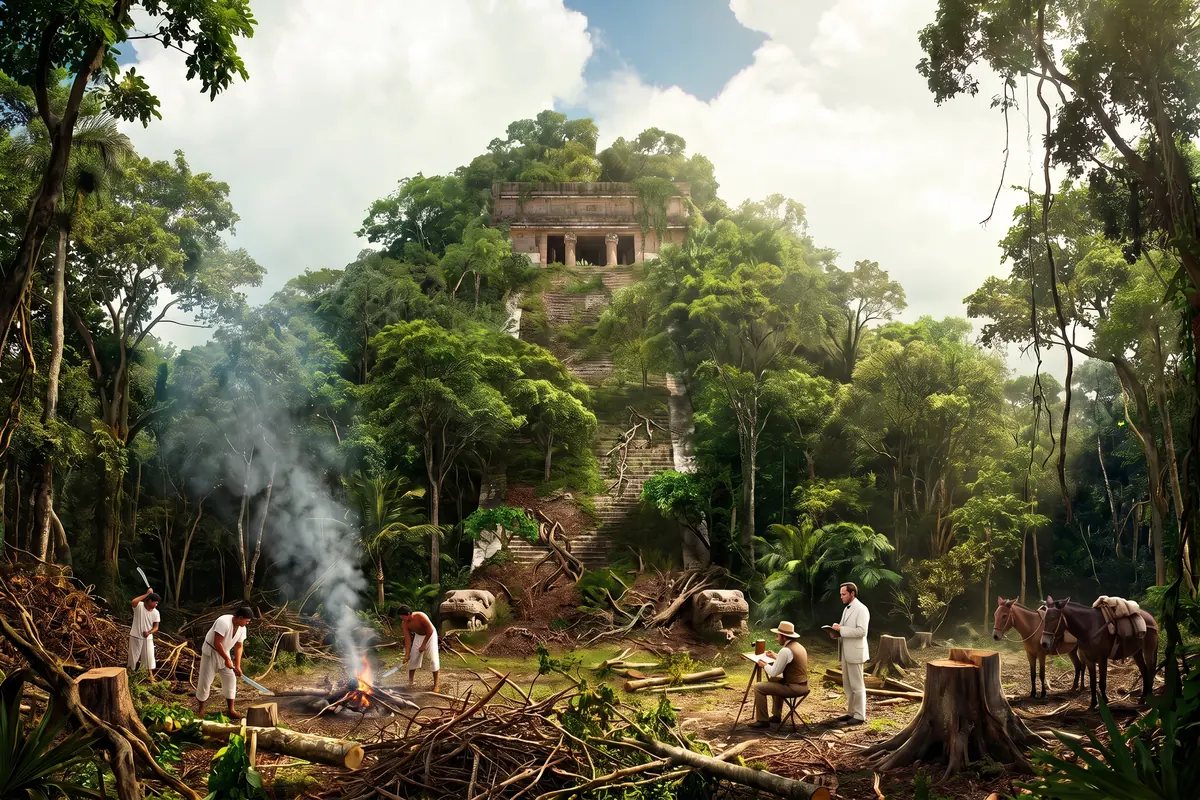
AI vision: Chichén Itzá in March 1842, the Kukulcán pyramid as a forested hill with the temple on top, a freshly cut clearing, men with machetes, an artist at the camera lucida, a man in a white suit, mules
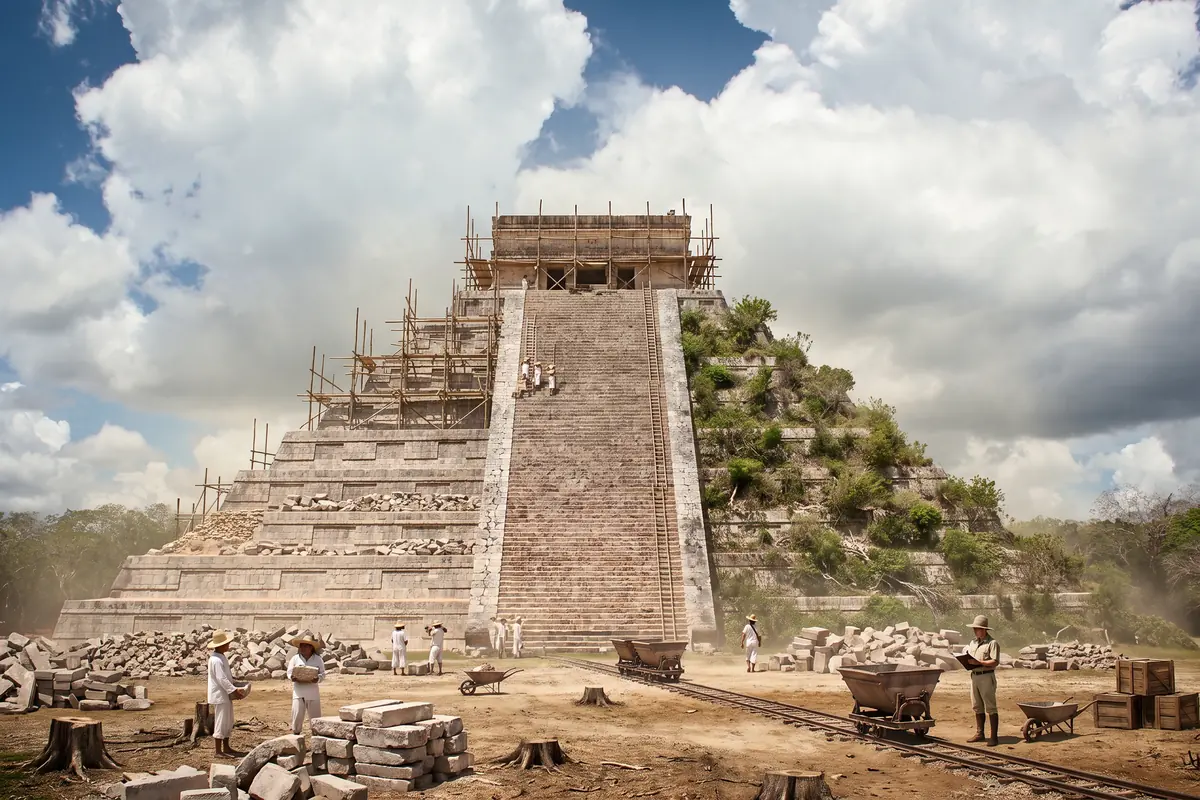
AI vision: the restoration of the Kukulcán pyramid around 1930, north side and stairway cleared with wooden scaffolding, east side still overgrown, narrow-gauge rails, tipping wagons, stacks of stone, workers in white cotton
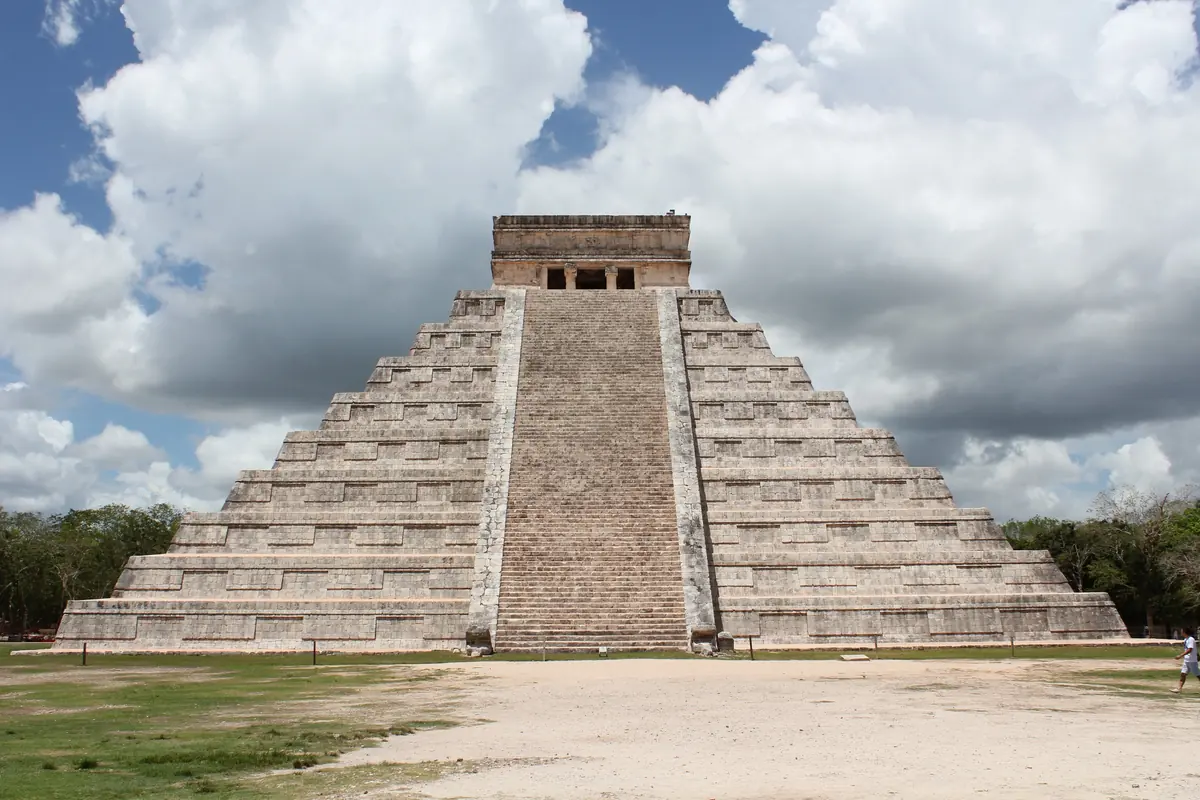
The Kukulcán pyramid (El Castillo) at Chichén Itzá today, north side with the restored stairway and temple, seen from the great platform (photo)
Documented Nine tiers, stairway with balustrades, temple on top: the surviving last building phaseDocumented Serpent heads at the foot of the stairway: surviving, paint assumedAssumed Colours: plaster and paint certain, their distribution guessedAssumed White stucco floor of the platform: documented for Maya plazas, not excavated hereInvented Feast, priests, feathers, smoke
Documented Pilgrimage to the cenote in the colonial period: Landa c. 1566, finds in the waterDocumented Stairway and temple clear, tiers overgrown: condition assumed after Stephens 1842Assumed How dense the forest on the pyramid really was around 1550Invented The pilgrims, their vessels, their faces
Documented Temple on top clear, mound forested: as Stephens describes the CastilloDocumented Artist with a camera lucida: Catherwood’s method, mentioned by StephensDocumented Serpent heads at the foot of the stairway: measured by Stephens, ten feet longAssumed Freshly cut clearing: Stephens found the platform open, not forestedInvented Mules, fire, faces
Documented North side and stairway rebuilt: seasons from 1927 to 1936Documented East side untouched: not restored until a few decades agoDocumented Temple on top scaffolded: restoration documented, form of the scaffold interpretedAssumed Narrow-gauge railway and wagons: usual on excavations of the time, not attested hereInvented Workers, foreman, crates in detail
Documented North side and stairway: restored 1927 to 1936, closed to climbing since 2006Documented Serpent head at the foot of the balustrade: described by Stephens in 1842Documented Temple on top: above two older building phases, with a cenote beneath (surveys of 2015)

AI vision · artistic licence

El Castillo at Chichén Itzá: one view, 1,000 years

You stand in a single spot, on the great platform of Chichén Itzá, looking at the north side of the Kukulcán pyramid. Time runs, you don’t. Scroll from the painted city around 1000 through the pilgrims on their way to the cenote, the travellers of 1842 and the scaffolding of the 1930s to the view that awaits you today.

I’m Ada Falk. I have spent my life digging through dirt in search of other lives. This pyramid has a pyramid in its belly, and that one may have another. I’ll show you what the shell hides. I’ll guide you.

Ada is an invented narrator. The history is real: every fact and quotation is sourced, and the sources are listed at the end. The images are AI visions, not scientific reconstructions. The button “What is the evidence?” shows what is documented.

AI vision: the Kukulcán pyramid around 1000 AD, plastered red with coloured panels, painted serpent heads, white stucco floor, priests in feather headdresses on the stairway, people and copal smoke

Diary 1 / 5 · around 1000 AD · a feast day

Chichén Itzá at its height around 1000: The painted pyramid

Stand here, on the white floor of the great platform, and look south. The pyramid in front of you is not grey. It is plastered and painted, like almost everything the Maya built; the Chac Mool found deep inside it in 1936 still carried traces of its colours, and the red jaguar throne beside it has 74 discs of jade as spots on its coat. What colour the outer skin had, nobody knows; the red and the panels in blue, green and ochre are my guess.

Around the year 1000 New Chichén is at its height: ball court, Temple of the Warriors, Thousand Columns, all new, all in a style that joins Maya tradition with forms from central Mexico. The city rules the north of Yucatán. It has fifty years left. The people, the feathers, the smoke: invented. That there were feasts here: not.

The bishop, 550 years later

„This building has four stairways facing the four directions of the world; each is thirty-three feet wide and has ninety-one steps, which it is a labour to climb.“

Diego de Landa, Relación de las cosas de Yucatán, c. 1566, on the Kukulcán pyramid. Our abridged rendering.

Image: AI vision based on a photo by Arian Zwegers (CC BY 2.0), not a scientific reconstruction.

AI vision: the overgrown Kukulcán pyramid around 1550, trees on the tiers, only the stairway and the temple showing through, Maya pilgrims in white cotton with vessels on the way to the Sacred Cenote

Diary 2 / 5 · around 1550 · a morning

Chichén Itzá as a place of pilgrimage around 1550: The city is silent, the well is not

Five hundred years after the florescence. The city lost its power in the 11th century, in a time of severe droughts; afterwards Mayapán led the north, then the Spaniards came. Nobody builds here any more. The forest stands on the tiers, and only the stairway and the temple on top keep themselves clear. But the path in front of you is not empty.

The Sacred Cenote, three hundred metres to the north, remains what it was: a place to which people from all over Yucatán make pilgrimage. Friar Diego de Landa describes it around 1566, with the eye of a missionary who wants to end it. The pilgrims with their vessels I have invented; that they came, with copal, jade and in drought years with people too, is in his account and in the finds pulled from the water from 1904 onwards.

The bishop

„Into this well they have had the custom of throwing men alive as a sacrifice to the gods in times of drought, and they believed that they did not die, though they never saw them again.“

Diego de Landa, Relación de las cosas de Yucatán, c. 1566, on the Sacred Cenote. After the Tozzer translation, abridged.

Image: AI vision based on a photo by Arian Zwegers (CC BY 2.0), not a scientific reconstruction.

AI vision: Chichén Itzá in March 1842, the Kukulcán pyramid as a forested hill with the temple on top, a freshly cut clearing, men with machetes, an artist at the camera lucida, a man in a white suit, mules

Diary 3 / 5 · March 1842

Stephens and Catherwood at Chichén Itzá in 1842: A hill with a temple

“At four o’clock we left Pisté, and very soon we saw rising high above the plain the Castillo of Chichen.” So John Lloyd Stephens begins his chapter, in March 1842, on his second journey with the artist Frederick Catherwood. The ruins are no secret: the camino real runs right through them, and every Sunday the people of Pisté stroll on the platform, the women in white with red shawls. The city was never forgotten. Now it is measured.

Stephens counts ninety steps and measures the serpent heads at the foot of the stairway, ten feet long, with open mouths. Catherwood draws with the camera lucida, a prism that throws the image onto the paper; his engravings become the first thing the world sees of Chichén. On 29 March they leave. The clearing, the fire, the mules: invented. The two men stood exactly here.

The traveller

„At four o’clock we left Pisté, and very soon we saw rising high above the plain the Castillo of Chichen. In half an hour we were among the ruins of this ancient city, with all the great buildings in full view.“

John Lloyd Stephens, Incidents of Travel in Yucatan, vol. II, New York 1843, chapter XVI.

Image: AI vision based on a photo by Arian Zwegers (CC BY 2.0), not a scientific reconstruction.

AI vision: the restoration of the Kukulcán pyramid around 1930, north side and stairway cleared with wooden scaffolding, east side still overgrown, narrow-gauge rails, tipping wagons, stacks of stone, workers in white cotton

Diary 4 / 5 · around 1930

The restoration of the pyramid around 1930: Two sides new, two sides old

On 22 February 1927 the exploration of the Castillo begins, under Eduardo Martínez Cantón, inspector of archaeological monuments in Yucatán, and José Erosa Peniche. Over nine seasons, until September 1936, they clear the north and west sides and rebuild them; the other two sides stay as they are until a few decades ago. That is why you see today a pyramid with two smooth and two rough halves.

In 1931 Erosa Peniche starts digging inside, in 1932 he drives a tunnel in from the north side, and finds the older pyramid beneath: a chamber with the Chac Mool, still carrying paint, and one with the red jaguar throne. At the same time the Carnegie Institution is working over at the Temple of the Warriors. The scaffolding and the wagons are my reading of photographs from those years; the workers from the villages existed, their faces are invented.

The excavation report

„In the first of them a monolith of the kind known as Chac Mool was found, which still showed part of the colours that once covered it entirely.“

Agustín Peña Castillo, El Castillo de Chichén Itzá, in: Arqueología Mexicana, on the finds inside the inner pyramid in 1936. Our translation.

Image: AI vision based on a photo by Arian Zwegers (CC BY 2.0), not a scientific reconstruction.

The Kukulcán pyramid (El Castillo) at Chichén Itzá today, north side with the restored stairway and temple, seen from the great platform (photo)

Diary 5 / 5 · Today

Chichén Itzá today: And now you

This is real. Exactly this view awaits you when you come from the entrance onto the great platform: the north side, smooth since the restoration of the 1930s, with the serpent heads Stephens measured. You may no longer climb; since 2006 every structure has been closed. From here you see the best of it anyway.

The light does not play here only twice a year: according to INAH the shadow of the north-west edge moves across the balustrade from 12 February to 29 October, with seven triangles around the equinox. Beneath the pyramid lie two older building phases and, according to the surveys of 2015, a cenote. Be here at 8 am, half close your eyes, and the pyramid is red.

INAH, today

„The first trace of light on the upper part of the ramp occurs on 12 February. The last gleams of light on the balustrade will be observed briefly around 29 October.“

INAH bulletin of 28 April 2026 after Casares, Montero, Galindo and Wood, Arqueología Mexicana 197 (2026). Our translation.

Real photo: Arian Zwegers, CC BY 2.0, via Wikimedia Commons.

Your expedition

Visit El Castillo: Stand exactly here

“The rest you have to see for yourself. And when you stand in front of the north stairway, clap your hands once. What comes back sounds like a bird. Whether that was intended, nobody knows. But it is there.” Ada Falk

  1. To the great platform. From the main entrance at the Parador the path leads through the forest in ten minutes; you come out at the edge of the platform, the pyramid in front of you.
  2. In front of the north stairway. Walk round the pyramid to its north side, the one with the serpent heads, and stand about forty metres from the stairway. That is the view of this time journey.
  3. Then north. Along the processional way to the Sacred Cenote, then to the ball court and the Temple of the Warriors, and last south to the Caracol and Las Monjas.
  • At 8 am: The zone opens at 8, the coaches arrive from 10. For two hours the platform is almost yours.
  • No climbing: Since 2006 every structure has been closed. The view from the platform is the one Stephens described anyway.
  • Check first: Prices, how to get there and rules are in our guide to Chichen Itza tickets and admission; all highlights are on our map.

At a glance

El Castillo in facts

Built
last building phase c. 900 to 1050; at least two older pyramids beneath
Height
about 24 metres of pyramid plus 6 metres of temple; four stairways of 91 steps each
Decline
c. 1025 to 1050, in drought years; afterwards pilgrimage to the cenote
Rediscovery
March 1842, John Lloyd Stephens and Frederick Catherwood
Restoration
1927 to 1936, north and west sides; inner pyramid found 1932 to 1936
Today
climbing banned since 2006; light effect from 12 February to 29 October

Frequently asked questions about Chichén Itzá and El Castillo

How old is the Kukulcán pyramid?

The visible pyramid belongs to the florescence of New Chichén around 900 to 1050. It encases an older pyramid with two chambers, found between 1932 and 1936, and surveys of 2015 point to an even older substructure beneath. Dating El Castillo means dating its outer shell.

How many steps does the pyramid at Chichén Itzá have?

Four stairways of 91 steps each, 364 in all, plus the temple platform as the 365th. Landa already counted the 91 steps around 1566. Whether the number was intended cannot be proved, but it fits too well to be chance.

Can you climb the Kukulcán pyramid?

No. Since 2006, after a visitor fell to her death, every structure at Chichén Itzá has been closed. Violations mean fines, and in several cases arrests. If you want to climb a Maya pyramid, go to Ek Balam or Cobá.

When can you see the serpent on the pyramid?

Not only on 21 March and 22 September. According to INAH the shadow of the north-west edge moves across the balustrade from 12 February to 29 October; around the equinoxes seven triangles of light appear, best between 3 and 5 pm. On the dates themselves more than 30,000 people come; a week before or after, the effect is almost the same.

Who discovered Chichén Itzá?

The city was never forgotten: the camino real ran through the ruins, and the people of Pisté strolled on the platform on Sundays. Landa described it around 1566. John Lloyd Stephens and Frederick Catherwood wrote it down and drew it for the world in March 1842; their book appeared in 1843.

What was found in the Sacred Cenote?

From 1904 Edward Thompson had the cenote dredged: jade, gold, copal, pottery, wood, textiles and human bones of both sexes. Landa had described around 1566 that people and precious things were thrown in during droughts. Most of the finds are in the Peabody Museum at Harvard; some have returned to Mexico.

What did Chichén Itzá look like in its heyday?

Colourful. The buildings were plastered and painted; the Chac Mool and the jaguar throne inside the pyramid still carried paint when they were found in 1936. What colours the outside had, nobody knows. The images on this page are AI visions meant to convey a feeling, not reconstructions.

When is the best time to see the pyramid?

At 8 am, when the zone opens, on a Tuesday to Thursday: then you have the platform almost to yourself for two hours before the coaches from Cancun arrive. Prices, how to get there and rules are in our guide to Chichen Itza tickets and admission.

About these images

The images of stages 1 to 4 are AI visions generated with Nano Banana Pro (Google Gemini) via fal.ai; the starting point was a photograph of the north side taken from the great platform (Arian Zwegers, CC BY 2.0). As adaptations of that photo the visions are published under the same licence. They are meant to convey a feeling and are not scientific reconstructions: people, clothing, colours and scenes are invented, and the buildings follow the evidence only in broad strokes. The image files are labelled as AI-generated (IPTC). The last image is the unaltered photograph.

Sources and status

Text: Daniela Pieper, Back in Time Travel editorial team. Updated 25 September 2026. Specialist review is still pending. Translations are our own, abridged.

  1. UNESCO World Heritage: Pre-Hispanic City of Chichen-Itza
  2. INAH: Zona Arqueológica de Chichén Itzá
  3. INAH bulletin: calendrical and astronomical aspects of El Castillo (28 April 2026)
  4. Arqueología Mexicana: El Castillo de Chichén Itzá (A. Peña Castillo; exploration 1927–1936, finds inside)
  5. John L. Stephens: Incidents of Travel in Yucatan, vol. II (1843), digitised
  6. Diego de Landa: Yucatan Before and After the Conquest (transl. W. Gates, 1937), digitised
  7. Science Advances 11 (2025): Classic Maya response to multiyear seasonal droughts in Northwest Yucatán
  8. Coggins & Shane: Cenote of Sacrifice (Peabody Museum, 1984), digitised
  9. Gaceta UNAM: Explorarán las entrañas de la pirámide de Kukulcán (2024)
  10. A. M. Tozzer (ed.): Landa’s Relación de las cosas de Yucatán. Peabody Museum Papers 18, Cambridge 1941.
  11. F. Catherwood: Views of Ancient Monuments in Central America, Chiapas and Yucatan. New York 1844.
  12. E. H. Morris, J. Charlot, A. A. Morris: The Temple of the Warriors at Chichen Itzá. Carnegie Institution, Washington 1931.
  13. Šprajc & Sánchez Nava: Astronomía en la arquitectura de Chichén Itzá. Estudios de Cultura Maya 41 (2013).
Image credits

Pyramid today and source image of the AI visions: Arian Zwegers, Wikimedia Commons, CC BY 2.0. Resized.

AI visions: Back in Time Travel, generated with Nano Banana Pro via fal.ai, adaptations of the photo by Arian Zwegers, CC BY 2.0. Not a scientific reconstruction.

Barlow Condensed / Manrope · SIL Open Font License. Barlow OFL · Manrope OFL