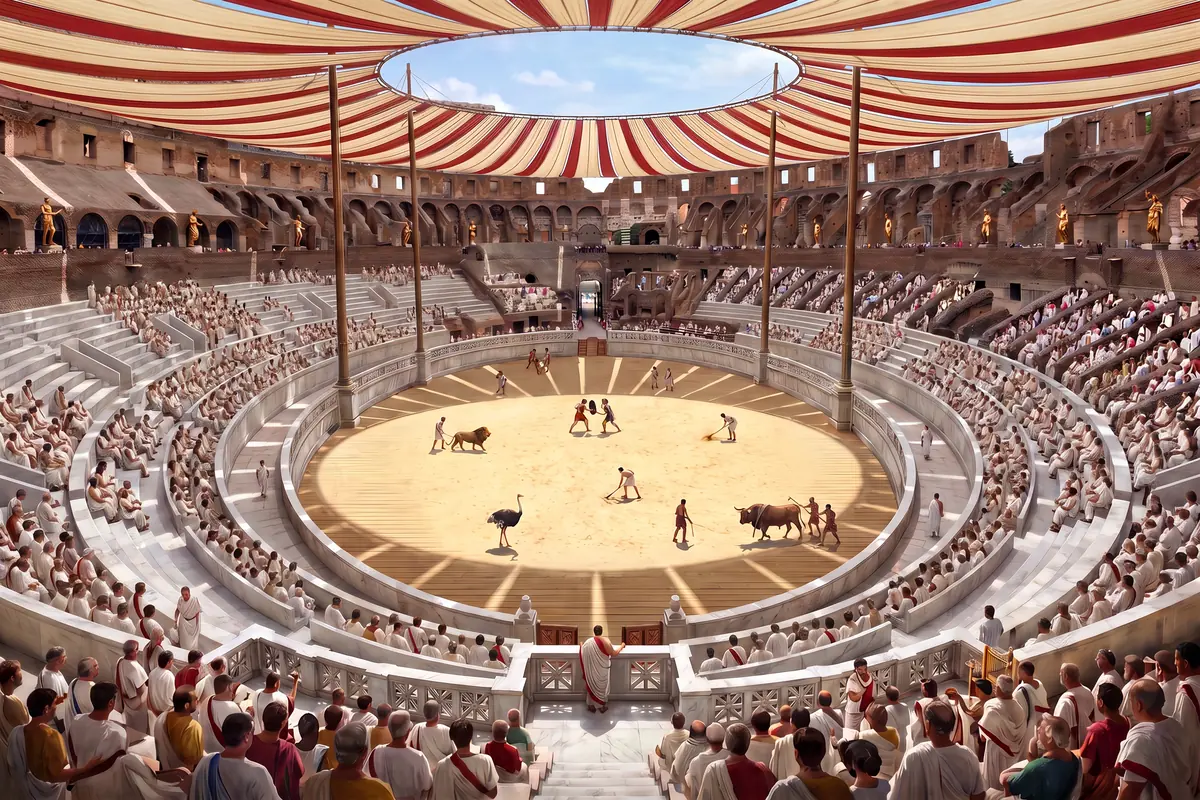
AI vision: the Colosseum during the inaugural games of AD 80, an awning in red and cream over the packed cavea, sand on the arena floor, gladiators and animals, gilded statues in the arches
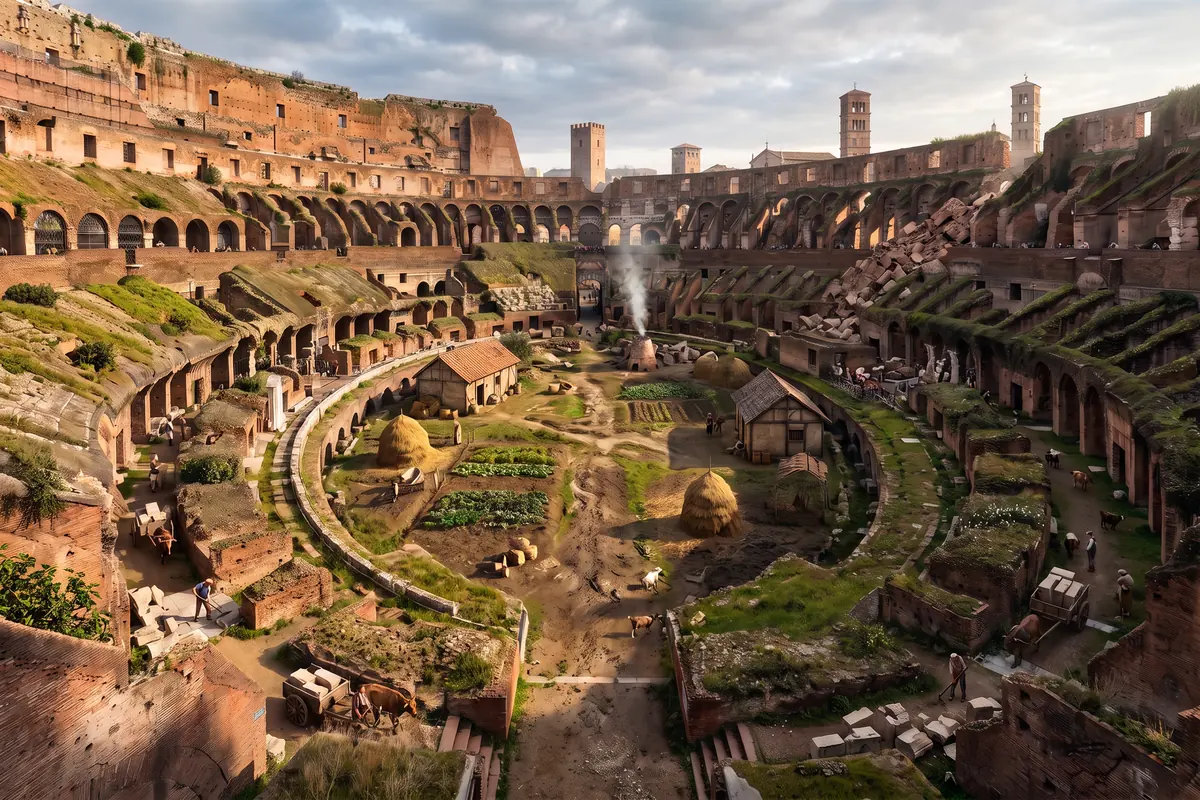
AI vision: the Colosseum around 1400 as a quarry, collapsed tiers, vegetable plots and huts in the arena, ox carts loaded with travertine blocks, a lime kiln, medieval towers beyond
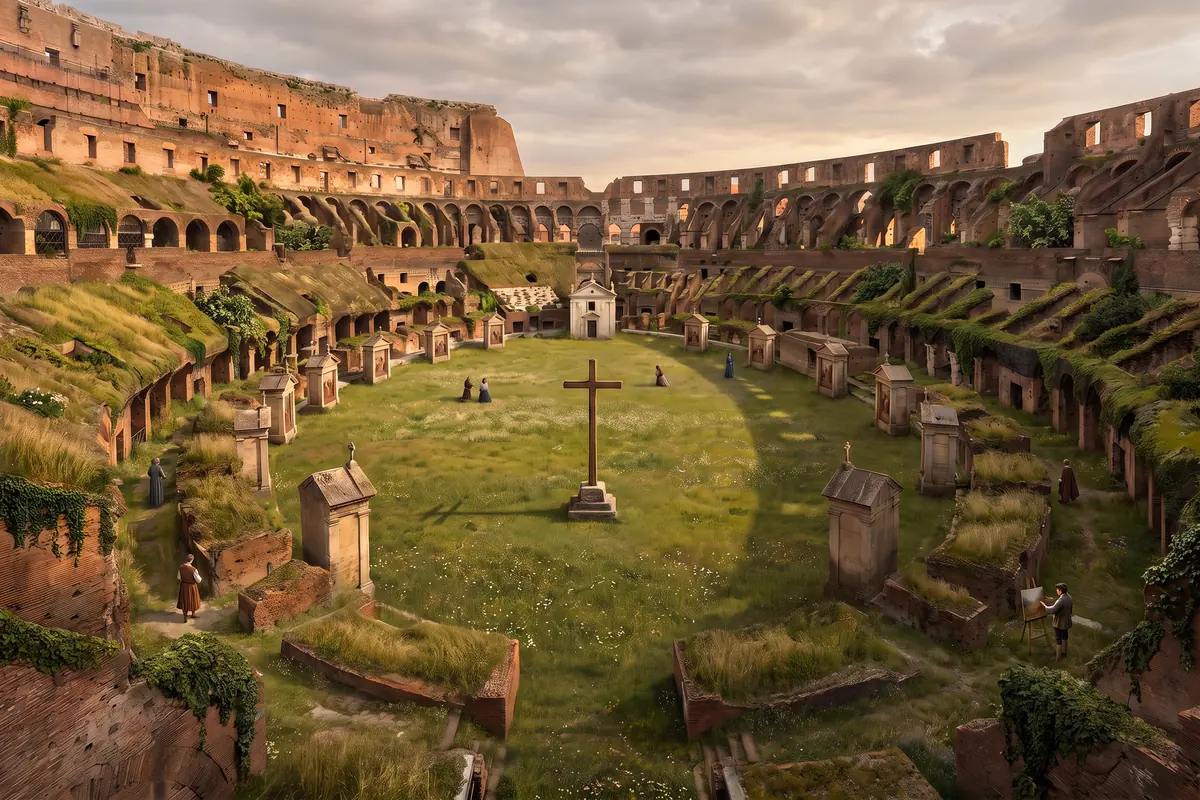
AI vision: the Colosseum around 1750 after its consecration by Benedict XIV, a wooden cross in the grassy arena, fourteen Stations of the Cross around the edge, a small chapel, friars with candles, overgrown tiers in evening light
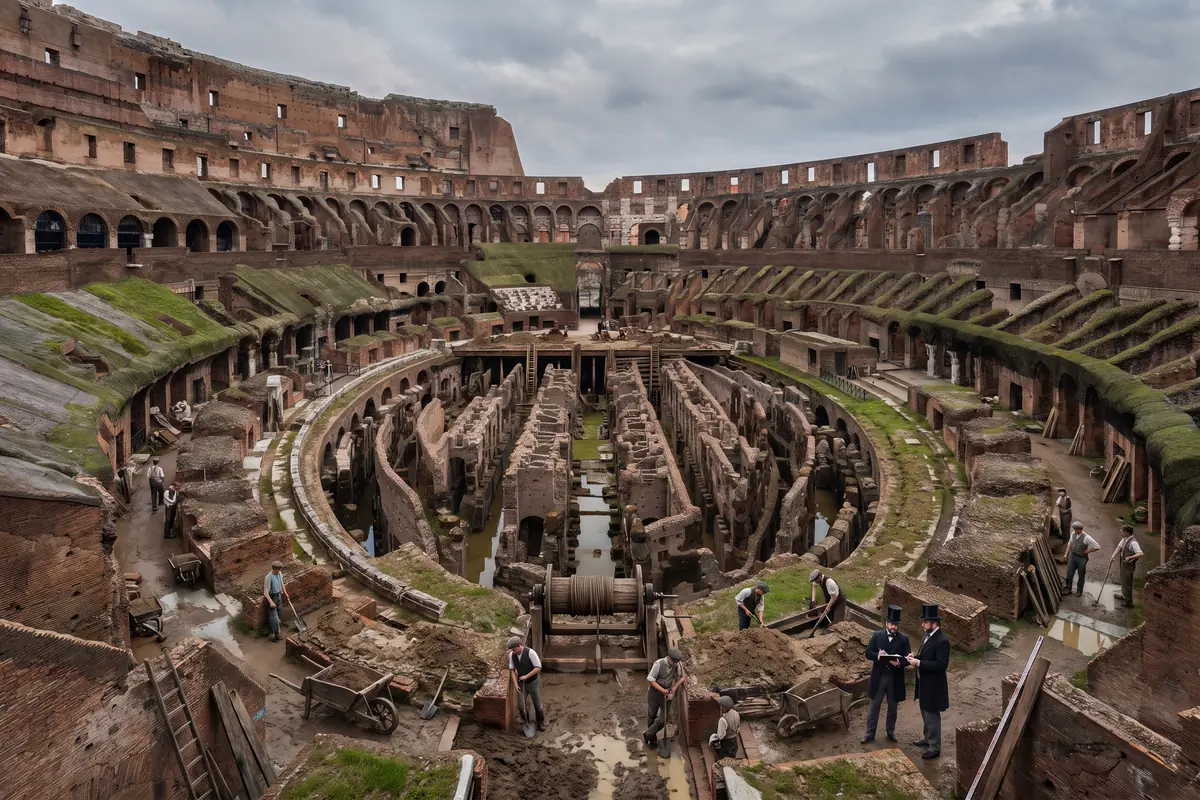
AI vision: the excavation of the Colosseum arena in 1874, exposed underground walls in muddy trenches with groundwater, wheelbarrows, ladders, a wooden winch, workmen with shovels, gentlemen in top hats
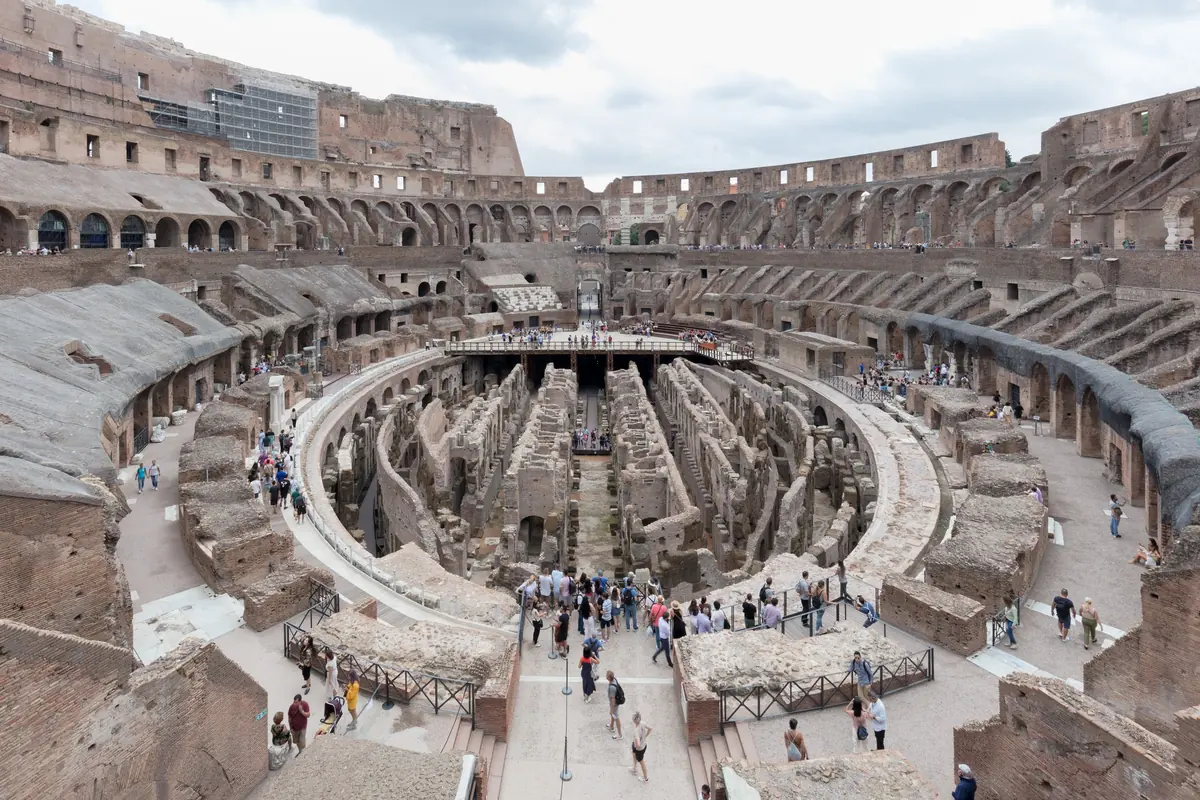
The interior of the Colosseum today, view from the seating tiers across the excavated underground corridors of the hypogeum, the platform at the end of the arena and visitors on the tiers (photo)
Documented Awning (velarium): documented, worked by sailors; colour inventedDocumented Arena floor of timber and sand, not yet the masonry underground (built under Domitian)Assumed Statues in the arches: derived from coin images, not surviving on the buildingAssumed Marble seats of the lower tiers: documented, surviving only in fragmentsInvented Pairs of gladiators, animals, attendants: scene invented, programme documented
Documented Collapse of the south side: earthquake of 1349, rubble quarried into the 18th centuryDocumented Ox carts with travertine: in 1451/52 alone 2,522 cartloads for the Vatican and the city wallsDocumented Artisans and lime burners lived in the arches (smiths, cobblers)Assumed Gardens and hay in the arena: plausible, not documented for these yearsInvented The huts and the people in detail
Documented Cross and fourteen stations: set up after the consecration by Benedict XIV in 1749Documented Chapel and hermit: documented for the 18th centuryDocumented Vegetation on the tiers: in 1855 Deakin counted 420 speciesAssumed Appearance and placement of the stations in detailInvented Procession of friars, painter: scene invented
Documented Exposed underground walls (hypogeum): excavations of 1813 and 1874, both stopped by groundwaterDocumented Flooded pit: after 1874 full of water for five yearsAssumed Wooden winch: after Beste’s reconstruction of the ancient lifting gear, not documented for 1874Invented Workmen, gentlemen in top hats, tools in detail
Documented Hypogeum: built in masonry under Domitian, cleared in the 1930s, walkable since 2021Documented Platform of 2000: suggests the arena floor above the undergroundDocumented Outer wall of the north side: surviving; the south side collapsed in 1349

AI vision · artistic licence

The inaugural games at the Colosseum: one view, 1,950 years

You sit in a single spot, high on the seating tiers, looking into the arena of the Colosseum. Time runs, you don’t. Scroll from the hundred days of games in AD 80 through the medieval quarry, the cross in the grass and the excavation of 1874 to the view that awaits you today.

I’m Ada Falk. I have spent my life digging through dirt in search of other lives. Beneath this arena lies a machine that nobody was meant to see for two thousand years. I’ll show it to you. I’ll guide you.

Ada is an invented narrator. The history is real: every fact and quotation is sourced, and the sources are listed at the end. The images are AI visions, not scientific reconstructions. The button “What is the evidence?” shows what is documented.

AI vision: the Colosseum during the inaugural games of AD 80, an awning in red and cream over the packed cavea, sand on the arena floor, gladiators and animals, gilded statues in the arches

Diary 1 / 5 · summer AD 80 · a day of games

The inaugural games of AD 80: A hundred days of games

Sit down, up here on the tier, and look down. What you see is new: Vespasian began the amphitheatre around 72 on the bed of Nero’s lake, his son Titus opens it in the year 80, and the games last a hundred days. Cassius Dio counts nine thousand animals, tame and wild, Suetonius five thousand on a single day. The arena floor is a wooden deck with sand on top; the underground corridors you see down there today do not yet exist, Domitian will have them built in masonry.

Above you the awning. Sailors of the fleet at Misenum stretched it from masts over the tiers, so the sources say; what colour it was, nobody knows, the red and cream here is my invention. The statues in the arches we know from coins, not from the building itself. And the fifty thousand people around you: invented in detail, documented as a mass. They sit by rank, senators down by the podium, women right at the top.

The historian, 150 years later

„Animals both tame and wild were slain to the number of nine thousand. These were the spectacles that were offered, and they continued for a hundred days.“

Cassius Dio, Roman History 66.25, on the dedication of the amphitheatre by Titus in AD 80. Loeb translation, abridged.

Image: AI vision based on a photo by Diego Delso (CC BY-SA 4.0), not a scientific reconstruction.

AI vision: the Colosseum around 1400 as a quarry, collapsed tiers, vegetable plots and huts in the arena, ox carts loaded with travertine blocks, a lime kiln, medieval towers beyond

Diary 2 / 5 · around 1400 · a winter morning

The Colosseum as a quarry around 1400: Rome builds from Rome

Almost a thousand years after the last gladiators, last documented in 435, and the last animal hunts of 523, the amphitheatre is a mountain of building material. The Frangipane made it a fortress in the 12th century, in 1312 it reverted to the Church, in 1349 an earthquake brought down the south side behind you. That heap of rubble, “the thigh of the Colosseum”, is an open quarry into the 18th century.

What you see is everyday life: artisans, smiths, cobblers and lime burners live in the arches, ox carts fetch travertine for palaces and churches. In 1451 and 1452 alone, 2,522 cartloads of stone leave the building, for the Vatican and the city walls. The plots and huts in the arena are my guess; gardens and hay here would fit what we know, but for these years it is not documented.

A pilgrim’s saying

„While stands the Coliseum, Rome shall stand; when falls the Coliseum, Rome shall fall; and when Rome falls, the World.“

Latin saying attributed to the Venerable Bede, recorded since the 8th century; famous in Byron’s rendering of 1818 (Childe Harold IV).

Image: AI vision based on a photo by Diego Delso (CC BY-SA 4.0), not a scientific reconstruction.

AI vision: the Colosseum around 1750 after its consecration by Benedict XIV, a wooden cross in the grassy arena, fourteen Stations of the Cross around the edge, a small chapel, friars with candles, overgrown tiers in evening light

Diary 3 / 5 · around 1750 · an evening

The Colosseum as a place of devotion around 1750: A cross in the grass

In 1749 Pope Benedict XIV declares the Colosseum a site of Christian martyrs, consecrates it to the Passion of Christ and forbids quarrying. In the arena there now stand a cross and fourteen Stations of the Cross, a small chapel, and a hermit lives here. Whether Christians really died here remains unproven to this day; the legend saved the building all the same.

And it blooms. A hundred years later the English botanist Richard Deakin counts 420 plant species on the ruins, among them exotic ones whose seeds perhaps came with the fodder of the animals from Africa. Painters and Grand Tour travellers love this wilderness of stone. The friars with candles are my invention; Way of the Cross processions did take place here, and still do, every Good Friday.

The botanist, a century later

„Flowers are perhaps the most graceful and most lovely objects of the creation but are not, at any time, more delightful than when associated with what recalls to the memory time and place.“

Richard Deakin, Flora of the Colosseum of Rome, London 1855, preface.

Image: AI vision based on a photo by Diego Delso (CC BY-SA 4.0), not a scientific reconstruction.

AI vision: the excavation of the Colosseum arena in 1874, exposed underground walls in muddy trenches with groundwater, wheelbarrows, ladders, a wooden winch, workmen with shovels, gentlemen in top hats

Diary 4 / 5 · 1874 · a grey morning

The excavation of the arena in 1874: Deeper than expected

Carlo Fea, commissioner of antiquities, was the first to dig here in 1811 and in 1813 found walls beneath the arena, which he took for later additions; groundwater stopped him. In 1874, four years after Rome became the capital of Italy, the archaeologists of the young state under Pietro Rosa dig down to the floor of the hypogeum. What they find is a maze of brick walls, channels and grooves: the underworld of the games. Then the pit fills with water and stays a swamp for five years.

The hypogeum is finally cleared only in the 1930s. Since 1996 a German-Italian team led by Heinz-Jürgen Beste has surveyed every stone and reconstructed from it the capstans, lifts and ramps that brought animals and scenery into the arena. The winch in the picture is an invention after those findings; the workmen with shovels and the gentlemen in top hats I have added.

The archaeologist, today

„A team of workmen at the capstan could raise a cage with a bear, leopard or lion inside into position just below the level of the arena.“

Heinz-Jürgen Beste, German Archaeological Institute Rome, quoted in: Secrets of the Colosseum, Smithsonian Magazine, 2011.

Image: AI vision based on a photo by Diego Delso (CC BY-SA 4.0), not a scientific reconstruction.

The interior of the Colosseum today, view from the seating tiers across the excavated underground corridors of the hypogeum, the platform at the end of the arena and visitors on the tiers (photo)

Diary 5 / 5 · Today

The Colosseum today: And now you

This is real. Exactly this view awaits you from the upper tier: the open hypogeum, the maze of brick walls where cages, lifts and scenery stood ready, and at the end the platform that has suggested a piece of the old arena floor since 2000. Since 2021 you can walk through the underground on walkways; the ticket is called Full Experience.

Fifty thousand people sat here, in marble, timber and brick, ordered by rank. What is grey today was white, red and gold. The building has survived games, earthquakes, quarrying, consecration and excavation; since 1980 it has been part of the UNESCO World Heritage Site of the historic centre of Rome. Sit down, half close your eyes, and the awning unfurls.

The Parco archeologico, today

„Built in wood for the Colosseum’s inauguration, the underground levels were transformed into solid masonry under Domitian.“

Parco archeologico del Colosseo: The underground levels of the Colosseum.

Real photo: Diego Delso, CC BY-SA 4.0, via Wikimedia Commons.

Your expedition

Visit the Colosseum: Sit exactly here

“The rest you have to see for yourself. And when you sit up on the tier, wait until the noise of the groups below dies down. Then you’ll hear how quiet fifty thousand people can be.” Ada Falk

  1. Through the entrance. With your timed ticket through security, then up the stairs to the second tier; from there you continue upwards.
  2. Up to the upper tier. Stand at the parapet above the south side, facing the north wall with its rows of windows. Below lies the open hypogeum, at the end the platform: that is the view of this time journey.
  3. Then down. With the Full Experience ticket onto the arena platform and along the walkways through the hypogeum, then across to the Forum and the Palatine.
  • Early or late: The first slot at 8.30 am and the last ones in the afternoon are the emptiest; from 10 am to 2 pm the groups are there.
  • Ticket in time: Tickets are sold only by the Parco archeologico, timed and named; the hypogeum often sells out weeks ahead.
  • Check first: Prices, ticket types and rules are in our guide to Colosseum tickets; entrances, Forum and Palatine are on our map.

At a glance

The Colosseum in facts

Built
c. 72 to 80 AD under Vespasian and Titus, top tiers under Domitian
Inauguration
AD 80, a hundred days of games; 9,000 animals according to Cassius Dio
Spectators
around 50,000, seated by rank; awning worked by sailors
Last games
gladiators last documented in 435, animal hunts until 523
Earthquake
1349: collapse of the south side; the ruin a quarry until 1749
Excavation
1811–1813 Fea, 1874 Rosa (groundwater), fully cleared in the 1930s; hypogeum walkable since 2021

Frequently asked questions about the Colosseum and the inaugural games

When was the Colosseum inaugurated?

In AD 80 by the emperor Titus, with a hundred days of games. Cassius Dio reports nine thousand animals killed, Suetonius five thousand in a single day, plus gladiatorial combats and a naval battle. Vespasian had begun the building around 72 on the bed of the lake of Nero’s Domus Aurea; it was completed under Domitian.

How many spectators did the Colosseum hold?

Around fifty thousand, with some estimates up to eighty thousand. Seats were allotted by rank: senators down by the podium, knights behind them, citizens above, women and the poor at the very top. Admission was free, but the seat was not a matter of choice.

What is the hypogeum beneath the arena?

The basement of corridors and chambers under the arena floor, built in masonry under Domitian. Animals waited there in cages that were hoisted by capstans and lifts through trapdoors into the arena; scenery came up from below too. Today it lies open, and since 2021 it can be walked on walkways.

Why is the south side of the Colosseum missing?

Earthquakes, above all that of 1349, brought down the outer arches of the south side; the ground there is softer than in the north. The rubble served as a quarry into the 18th century, for palaces and the Vatican among others.

What was the Colosseum used for in the Middle Ages?

As a fortress of the Frangipane in the 12th and 13th centuries, as housing for artisans in the arches, as a quarry and lime pit. In 1312 it reverted to the Church; in 1382 a confraternity received a third of the building. In 1451 and 1452 alone, 2,522 cartloads of stone were removed.

Who saved the Colosseum?

Pope Benedict XIV, who in 1749 declared it a site of martyrs, consecrated it to the Passion of Christ and forbade quarrying. Whether Christians were really executed there is not documented; the consecration protected the building all the same. To this day the pope leads the Way of the Cross at the Colosseum on Good Friday.

What did the Colosseum originally look like?

White, red and gold: a travertine facade with statues in the arches, marble seats below, wooden seats above, an awning on masts over the tiers, a timber floor with sand above the basement. The images on this page are AI visions; colours and details are interpretation.

Can you visit the arena and the hypogeum?

Yes, with the Full Experience ticket: it includes the arena platform and the walkways through the hypogeum. The standard ticket covers the tiers, the Roman Forum and the Palatine. All tickets are timed and named; prices and rules are in our guide to Colosseum tickets.

About these images

The images of stages 1 to 4 are AI visions generated with Nano Banana Pro (Google Gemini) via fal.ai; the starting point was a photograph of the interior today taken from the seating tiers (Diego Delso, CC BY-SA 4.0). As adaptations of that photo the visions are published under the same licence. They are meant to convey a feeling and are not scientific reconstructions: people, clothing, colours and scenes are invented, and the buildings follow the evidence only in broad strokes. The image files are labelled as AI-generated (IPTC). The last image is the unaltered photograph.

Sources and status

Text: Daniela Pieper, Back in Time Travel editorial team. Updated 25 September 2026. Specialist review is still pending. Translations are our own, abridged.

  1. Cassius Dio, Roman History 66.25 (LacusCurtius, Loeb translation)
  2. Suetonius, Titus 7 (LacusCurtius, Loeb translation)
  3. Parco archeologico del Colosseo: The underground levels of the Colosseum
  4. Parco archeologico del Colosseo: The Colosseum
  5. Smithsonian Magazine: Secrets of the Colosseum (Heinz-Jürgen Beste, DAI Rome)
  6. the-colosseum.net: Middle Ages (Frangipane, earthquake of 1349, quarrying, 2,522 cartloads in 1451/52)
  7. Richard Deakin: Flora of the Colosseum of Rome, London 1855 (digitised)
  8. Dipartimento della Protezione Civile: Historical earthquakes and the Colosseum
  9. Treccani: Carlo Fea (Dizionario Biografico)
  10. UNESCO World Heritage: Historic Centre of Rome
  11. Parco archeologico del Colosseo: opening times and tickets
  12. F. Coarelli: Rome and Environs. An Archaeological Guide. Berkeley 2014, section on the Colosseum.
  13. H.-J. Beste: Das Hypogäum des Kolosseums. In: Römische Mitteilungen 106 (1999) and 107 (2000).
  14. G. Lugli: Colosseo. In: Enciclopedia Italiana, Rome 1931.
  15. Attributed to Bede: Collectanea (8th century), saying “Quandiu stabit coliseus”; Lord Byron: Childe Harold’s Pilgrimage IV, 145 (1818).
Image credits

Interior today and source image of the AI visions: Diego Delso, Wikimedia Commons, CC BY-SA 4.0. Cropped, resized.

AI visions: Back in Time Travel, generated with Nano Banana Pro via fal.ai, adaptations of the photo by Diego Delso, CC BY-SA 4.0. Not a scientific reconstruction.

Barlow Condensed / Manrope · SIL Open Font License. Barlow OFL · Manrope OFL