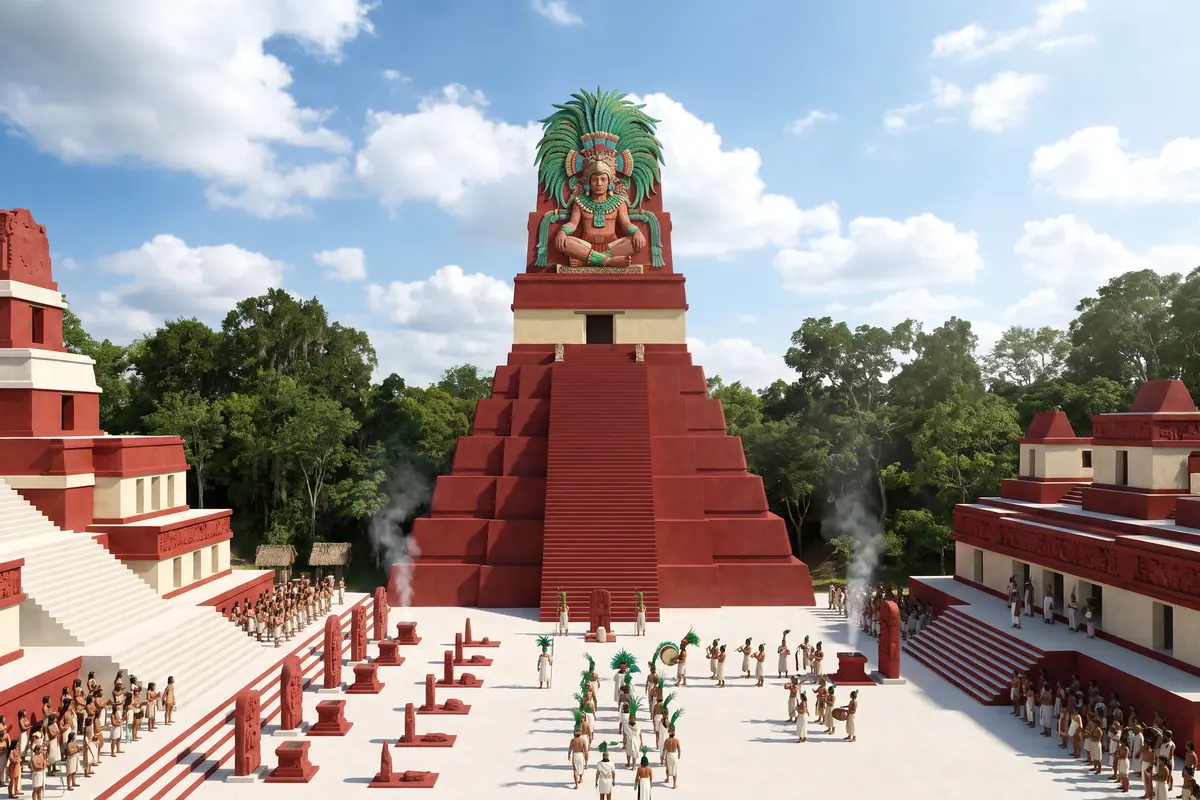
AI vision: the Great Plaza of Tikal around 750 AD, Temple I plastered red with the image of the king on the roof comb, white stuccoed plaza, painted stelae, people in feather headdresses
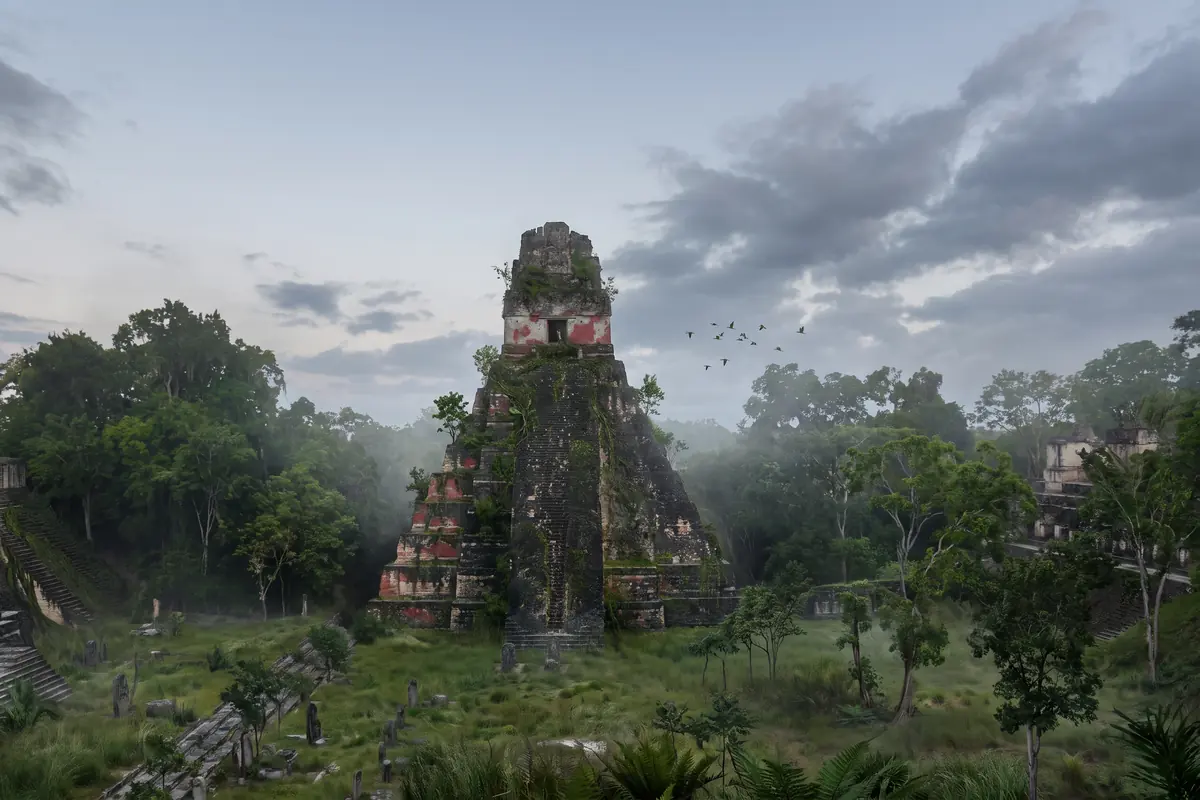
AI vision: the Great Plaza of Tikal around 1000 AD, abandoned, Temple I with flaking red plaster and young trees on its steps, overgrown plaza, mist, parrots
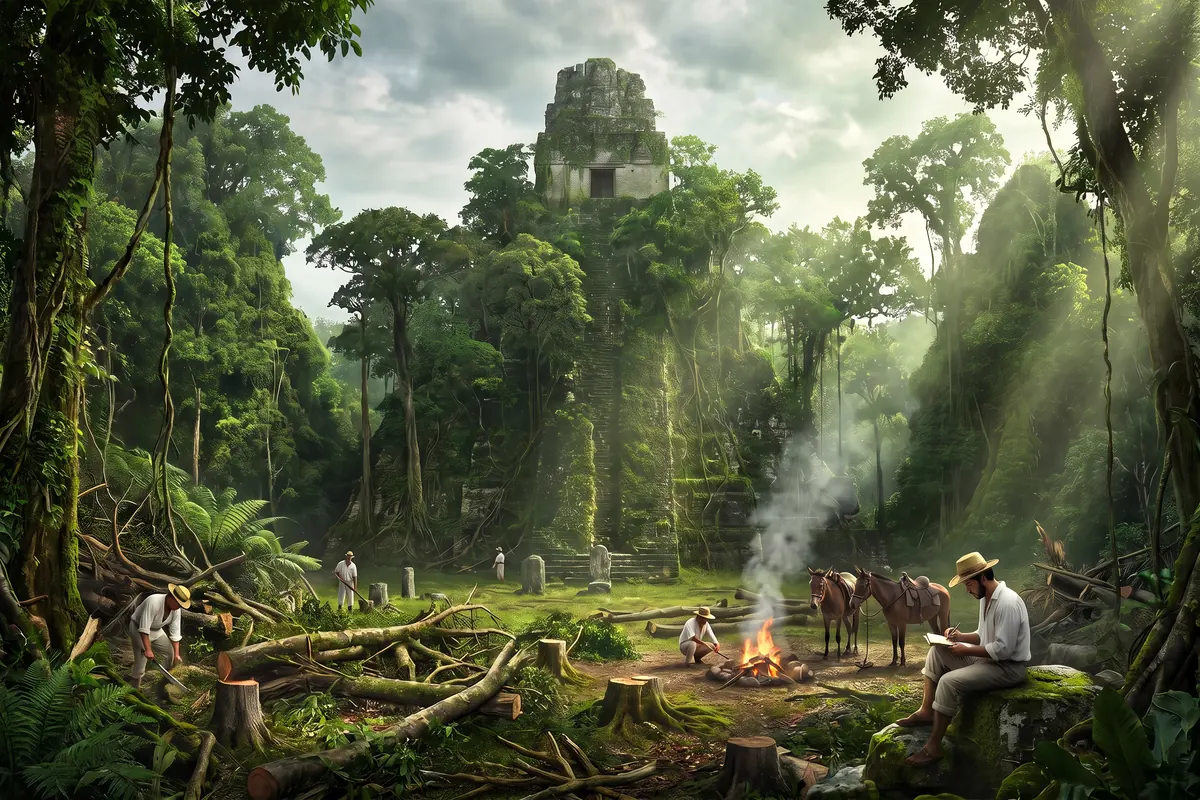
AI vision: Tikal in 1848, Temple I as a forested hill, only the roof comb rising out of the forest, men with machetes, an artist with a sketchbook, a campfire, mules
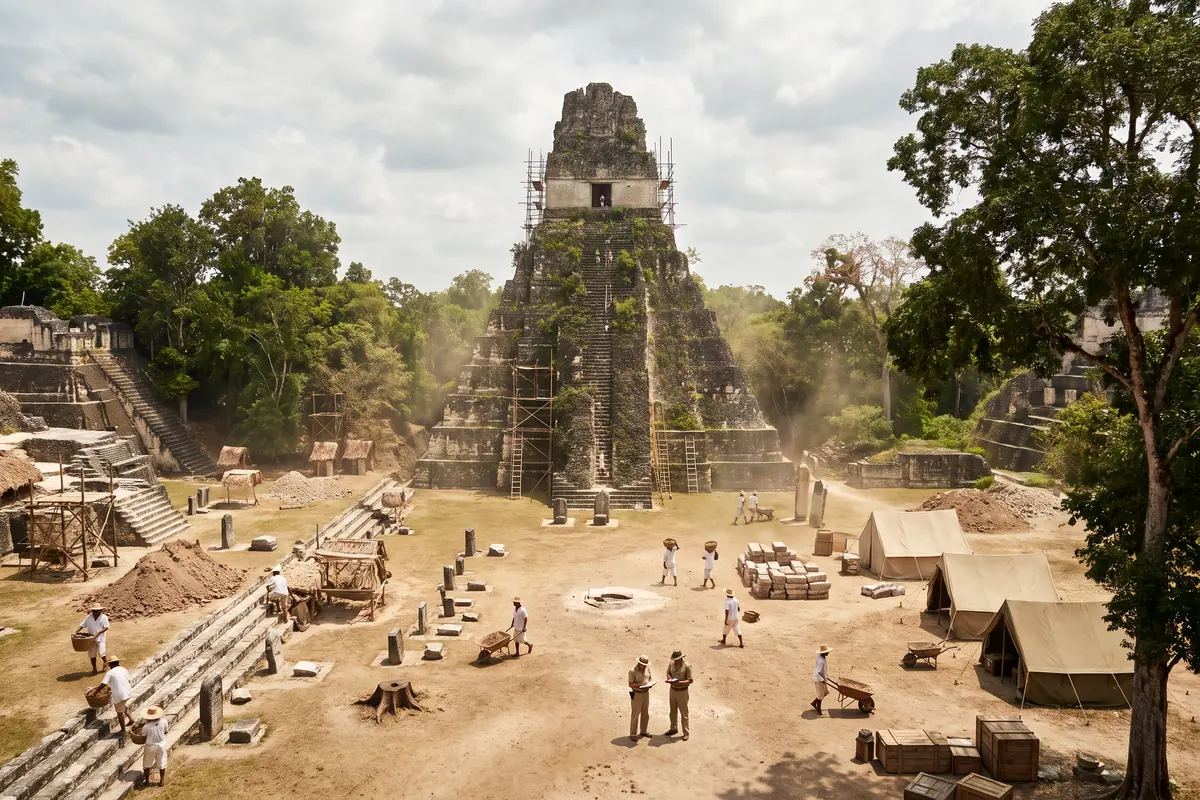
AI vision: the excavation of the Great Plaza of Tikal around 1960, Temple I with wooden scaffolding, cleared plaza with tree stumps, tents, wheelbarrows, workers from Petén
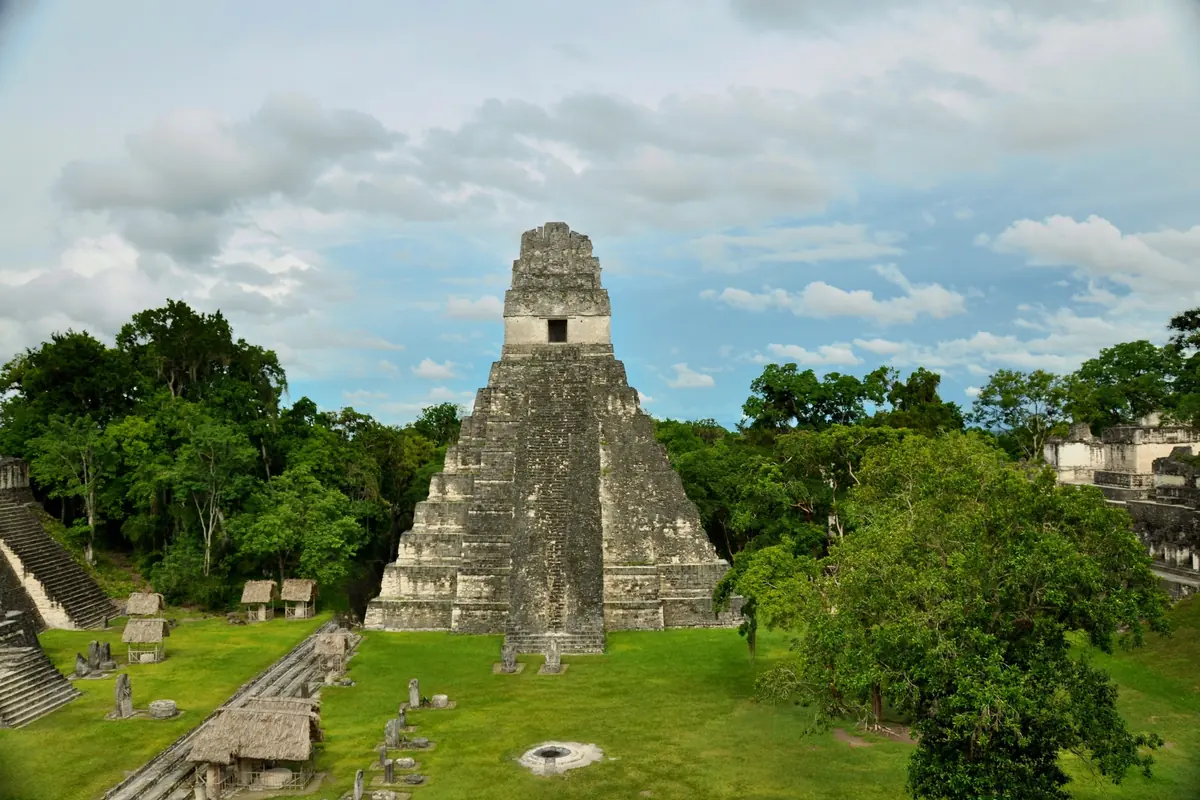
The Great Plaza of Tikal today, view from Temple II towards Temple I, on the left the stelae under thatched shelters in front of the North Acropolis, on the right the Central Acropolis (photo)
Documented Roof comb with the larger-than-life image of the king, in stone blocks with stuccoDocumented Temple I, begun around 732, tomb of Jasaw Chan K’awiil I (died 734)Documented North Acropolis: temples and royal tombs, stelae and altars in frontAssumed Colours: red and cream certain, distribution and patterns assumedInvented Feast, people, feather headdresses, music
Documented Abandoned: last dated stela 869, urban centre given up around 900Documented Roof comb and temple of masonry remained standingAssumed How quickly the forest reclaimed the plazaAssumed Condition of the Central Acropolis palaces around 1000Invented Parrots, mist, remains of paint
Documented Roof comb rising out of the forest: as described by Méndez in 1848 and Maler in 1895Documented Artist Eusebio Lara: the first pictures of TikalAssumed How dense the growth on Temple I really wasInvented Camp exactly here, mules, faces
Documented Temple I: investigated from 1959, tomb found in 1962, stabilised with scaffolding (Tikal Project 1956 to 1970)Documented North Acropolis: excavations of the Tikal ProjectAssumed Tents and camp on the plaza; the real camp was by the airstripInvented Persons, clothing, tools in detail
Documented Temple I, 47 metres, uncovered and stabilised 1956 to 1970Documented Stelae and altars under protective shelters in front of the North AcropolisDocumented Central Acropolis: palace complex of the kings

AI vision · artistic licence

Temple I at Tikal: one view, 1,300 years

You stand in a single spot, on top of Temple II, looking across the Great Plaza of Tikal at Temple I. Time runs, you don’t. Scroll from the red city around 750 AD through the abandoned ruins, the expedition of 1848 and the excavation around 1960 to the view that awaits you today.

I’m Ada Falk. I have spent my life digging through dirt in search of other lives. The forest hid this temple for a thousand years, and I’ll show you what it was hiding. I’ll guide you.

Ada is an invented narrator. The history is real: every fact and quotation is sourced, and the sources are listed at the end. The images are AI visions, not scientific reconstructions. The button “What is the evidence?” shows what is documented.

AI vision: the Great Plaza of Tikal around 750 AD, Temple I plastered red with the image of the king on the roof comb, white stuccoed plaza, painted stelae, people in feather headdresses

Diary 1 / 5 · around 750 AD · a feast day

Tikal at its height around 750 AD: The red city

Stand here, on the top step of Temple II, and look east. The red mountain in front of you is not a ruin, it has only just been finished: Temple I, the tomb of Jasaw Chan K’awiil I, who took the throne in 682, defeated the arch-enemy Calakmul in 695 and died in 734. His son Yik’in Chan K’awiil had the building completed, and up on the roof comb sits the dead king, larger than life in stone and stucco, looking out over his city. Beneath your feet lies Temple II, which Jasaw probably dedicated to his wife.

Nothing here is grey. The pyramids are plastered and painted red, the plaza is a white lime floor, and the stelae in front of the North Acropolis on the left, the cemetery of the kings, carry colour. How much red and how much cream, nobody knows; that Tikal was colourful is certain. The people below, the feathers, the drums: invented, but not out of thin air. The stelae show exactly such feasts.

The inscription in the temple

„Brought down were the flint and the shield of Yich’aak K’ahk’, divine lord of Kanu’l.“

Lintel 3 of Temple I, Tikal, on the victory over Calakmul in August 695 (original now in Basel). After the reading by Martin and Grube 2008. Our abridged rendering.

Image: AI vision based on a photo by Mario Bollini (CC BY 2.0), not a scientific reconstruction.

AI vision: the Great Plaza of Tikal around 1000 AD, abandoned, Temple I with flaking red plaster and young trees on its steps, overgrown plaza, mist, parrots

Diary 2 / 5 · around 1000 AD · morning mist

Tikal abandoned around 1000: The city that fell silent

Nobody has been here for a hundred years. The last dated stela was set up in 869 by a king who named himself after the great Jasaw but no longer had much to say. After that the inscriptions fall silent. By around 900 the city crumbles; the people leave, in small groups, over decades. Why, we archaeologists still argue about: drought, exhausted soils, too many people, wars. Probably all of it together.

The forest does not need long. First the grass comes onto the plaza, then the shrubs, then the first trees on the stairways. The plaster falls off in slabs, the rain washes out the red. But look: the roof comb still stands, and it will keep standing. Maya masonry is better than its reputation.

A find

„The earliest stone sculpture is Stela 29 dated to the year 292 and the last monument sculptured is Stela 11 dated to the year 869.“

UNESCO World Heritage List, Tikal National Park: statement of Outstanding Universal Value.

Image: AI vision based on a photo by Mario Bollini (CC BY 2.0), not a scientific reconstruction.

AI vision: Tikal in 1848, Temple I as a forested hill, only the roof comb rising out of the forest, men with machetes, an artist with a sketchbook, a campfire, mules

Diary 3 / 5 · 26 February 1848

The rediscovery of 1848: A hill with a window

Almost a thousand years of forest. What you see is no longer a temple, it is a mountain with trees on it, and only at the very top does a piece of wall show through, with a dark window. On 26 February 1848 Modesto Méndez, the corregidor of Petén, and Ambrosio Tut, the governor, stand here with a few men and machetes. People in Petén had long known about the ruins; now somebody writes it down. With them is the artist Eusebio Lara, and his drawings are the first pictures of Tikal the world gets to see.

Méndez sends his report to the government, the Gaceta de Guatemala prints it, and five years later it appears in German in Berlin. Then it goes quiet again. In 1877 the Swiss Gustav Bernoulli saws the carved lintels out of Temples I and IV and ships them to Basel. In 1881 Alfred Maudslay takes the first photographs, in 1895 Teobert Maler arrives, surveys the temples and calculates 47.2 metres for Temple I. His figure still stands today.

The corregidor

„Shortly afterwards, standing on a hill of moderate height, we discovered on a further rise the first palace, whose proud prospect not one of my companions wished to miss.“

Modesto Méndez, report on the ruins of Tikal, March 1848, published in the Gaceta de Guatemala. Our translation.

Image: AI vision based on a photo by Mario Bollini (CC BY 2.0), not a scientific reconstruction.

AI vision: the excavation of the Great Plaza of Tikal around 1960, Temple I with wooden scaffolding, cleared plaza with tree stumps, tents, wheelbarrows, workers from Petén

Diary 4 / 5 · around 1960

The excavation around 1960: Clearing the forest

In 1951 Guatemala cuts an airstrip into the forest not far from here, and suddenly Tikal can be reached by plane instead of after days on a mule. In 1956 Edwin Shook of the University of Pennsylvania lands with a handful of people and twenty-five workers from Petén. The Tikal Project stays for fourteen years, until 1970, and in that time the forest becomes the city you visit today: the plaza is cleared, the North Acropolis dug layer by layer, Temple I investigated from 1959, stabilised and brought back into shape with scaffolding.

In 1962 the excavators find the burial chamber inside the pyramid: a man on a mat, under jade, pearls and shells, with jaguar skins and painted vessels. It is Jasaw Chan K’awiil I. The stucco on the steps, the paint, the king on the roof comb are long gone. What remains is the core, and they put it back together stone by stone.

The excavator, on arrival

„Nothing more than several dilapidated palm-thatched huts on the fringe of the airstrip surrounded by the towering green forest which seemed to threaten to engulf the tiny clearing.“

Edwin M. Shook, The Tikal Project, University Museum Bulletin, 1957, on the arrival in January 1956. Abridged.

Image: AI vision based on a photo by Mario Bollini (CC BY 2.0), not a scientific reconstruction.

The Great Plaza of Tikal today, view from Temple II towards Temple I, on the left the stelae under thatched shelters in front of the North Acropolis, on the right the Central Acropolis (photo)

Diary 5 / 5 · Today

Tikal today: And now you

This is real. Exactly this view awaits you when you climb the wooden staircase at the back of Temple II: Temple I, 47 metres high, with the roof comb where the king once sat. The stelae on the left stand under thatched shelters so the rain does not wash them away further. The Central Acropolis on the right was the palace, the North Acropolis on the left the cemetery of the dynasty.

Temple I itself you may not climb; the stairway is too steep and too worn, and the view from here is the better one anyway. Around you howler monkeys, toucans and coatis live in the forest that hid the city for a thousand years. Since 1979 Tikal has been a World Heritage Site, for the ruins and for the forest at once. If you stand here at dusk and half close your eyes, the pyramid is red.

UNESCO, today

„In the heart of the jungle, surrounded by lush vegetation, lies one of the major sites of Mayan civilization, inhabited from the 6th century B.C. to the 10th century A.D.“

UNESCO World Heritage List, Tikal National Park, inscribed 1979.

Real photo: Mario Bollini, CC BY 2.0, via Wikimedia Commons.

Your expedition

Visit Temple I at Tikal: Stand exactly here

“The rest you have to see for yourself. And when you stand on top of Temple II, wait until the howler monkeys start. Then you’ll know why the city stayed hidden so long.” Ada Falk

  1. To the Great Plaza. From the entrance the main path leads through the forest to the plaza in about 20 minutes; you come out between Temple I and the Central Acropolis.
  2. Up Temple II. Cross the plaza to the west side. A wooden staircase at the back of Temple II leads up. At the top you stand at the edge looking east: that is the view of this time journey.
  3. Then to the left. From the plaza take in the North Acropolis with its stelae, then walk on to Temple IV, the Star Wars view across the forest.
  • Sunrise: With the sunrise (amanecer) ticket you may enter the park from 4 am, regular entry from 6 am. The mist over the plaza is the moment for the stage around 1000.
  • Temple I closed: It may not be climbed. Temples II and IV have wooden staircases; they are the viewpoints.
  • Check first: Prices, tickets and how to get there are in our guide Tikal tickets and admission; all highlights are on our map.

At a glance

Temple I at Tikal in facts

Built
around 732 to about 740 AD, completed under Yik’in Chan K’awiil
Height
47 metres to the top of the roof comb
Tomb
Jasaw Chan K’awiil I, king 682 to 734, burial chamber found in 1962
Abandoned
last dated stela 869, urban centre given up around 900
Rediscovery
26 February 1848, Modesto Méndez and Ambrosio Tut
Excavation
1956 to 1970, Tikal Project of the University of Pennsylvania

Frequently asked questions about Tikal and Temple I

Why was Tikal abandoned?

Not in a day but over generations. The last dated stela is from 869; by around 900 the urban centre had been given up. Causes discussed are droughts, exhausted soils and deforestation, overpopulation and wars between the Maya cities; probably all of them worked together. Within a few centuries the forest had taken the city back.

How tall is Temple I at Tikal?

About 47 metres to the top of the roof comb. Teobert Maler measured 47.2 metres in 1895, and that figure still stands. Temple IV in the west of the city is considerably taller at about 70 metres and one of the tallest structures of pre-Hispanic America.

Who is buried in Temple I?

Jasaw Chan K’awiil I, king of Tikal from 682 to 734, who defeated the arch-rival Calakmul in 695. Archaeologists of the University of Pennsylvania found his burial chamber inside the pyramid in 1962: a man on a mat, with jade jewellery, pearls, shells, jaguar skins and painted vessels.

Can you climb Temple I?

No. The stairway of Temple I is closed; it is steep and badly worn. The best view of Temple I is from Temple II opposite, which may be climbed by a wooden staircase at the back. Temple IV also has wooden stairs; from there you look across the forest to the roof combs.

Who discovered Tikal?

The people of Petén never forgot Tikal. It was written down on 26 February 1848: Modesto Méndez, corregidor of Petén, and governor Ambrosio Tut reached the ruins with the artist Eusebio Lara. Méndez’s report appeared in the Gaceta de Guatemala and in 1853 in German in Berlin. Alfred Maudslay took the first photographs in 1881; Teobert Maler surveyed the temples in 1895 and 1904.

Where was Star Wars filmed at Tikal?

In 1977 Tikal served as the rebel base on the moon Yavin 4 in Star Wars. The famous shot in which a sentry watches the Millennium Falcon land was filmed from Temple IV: the view east across the forest to the roof combs of Temples I, II and III. Exactly that view awaits visitors who climb Temple IV today.

What did Tikal look like in its heyday?

Colourful. The pyramids were coated in lime plaster and painted red, the plaza was a white stucco floor, the stelae carried paint, and on the roof comb of Temple I sat a larger-than-life image of the king in stone and stucco. The images on this page are AI visions meant to convey a feeling; the exact colours and patterns are unknown.

Is sunrise at Tikal worth it?

Yes, if you get up early. The park opens at 6 am; with the sunrise (amanecer) ticket you may enter from 4 am and watch from Temple IV or Temple II as the mist rises over the forest and the howler monkeys start. Prices, tickets and how to get there are in our guide Tikal tickets and admission.

About these images

The images of stages 1 to 4 are AI visions generated with Nano Banana Pro (Google Gemini) via fal.ai; the starting point was a photograph of the plaza today taken from Temple II (Mario Bollini, CC BY 2.0). As adaptations of that photo the visions are published under the same licence. They are meant to convey a feeling and are not scientific reconstructions: people, clothing, colours and scenes are invented, and the buildings follow the evidence only in broad strokes. The image files are labelled as AI-generated (IPTC). The last image is the unaltered photograph.

Sources and status

Text: Daniela Pieper, Back in Time Travel editorial team. Updated 25 September 2026. Specialist review is still pending. Translations are our own, abridged.

  1. UNESCO World Heritage: Tikal National Park
  2. Penn Museum: Edwin M. Shook, The Tikal Project (University Museum Bulletin, 1957)
  3. Penn Museum: Aubrey S. Trik, The Splendid Tomb of Temple I at Tikal (Expedition, 1963)
  4. Penn Museum: Froelich Rainey, Tikal (Expedition, 1970)
  5. Teobert Maler: Explorations in the Department of Peten, Guatemala: Tikal (Peabody Museum, 1911, digitised)
  6. Prensa Libre: Méndez y Tut llegan a Tikal el 26 de febrero de 1848 (with excerpts from the report)
  7. Estudios de Cultura Maya: Tikal, más de un siglo de arqueología (history of research)
  8. Ministerio de Cultura y Deportes de Guatemala: admission to Tikal National Park
  9. S. Martin, N. Grube: Chronicle of the Maya Kings and Queens. 2nd edition, London 2008, chapter on Tikal.
  10. W. R. Coe: Tikal Report 14. Excavations in the Great Plaza, North Terrace and North Acropolis of Tikal. Philadelphia 1990.
  11. A. P. Maudslay: Biologia Centrali-Americana, Archaeology. London 1889 to 1902, section on Tikal.
  12. M. Méndez: report on the ruins of Tikal, March 1848, Gaceta de Guatemala; German translation Berlin 1853.
Image credits

Plaza today and source image of the AI visions: Mario Bollini, Wikimedia Commons, CC BY 2.0. Cropped, resized.

AI visions: Back in Time Travel, generated with Nano Banana Pro via fal.ai, adaptations of the photo by Mario Bollini, CC BY 2.0. Not a scientific reconstruction.

Barlow Condensed / Manrope · SIL Open Font License. Barlow OFL · Manrope OFL