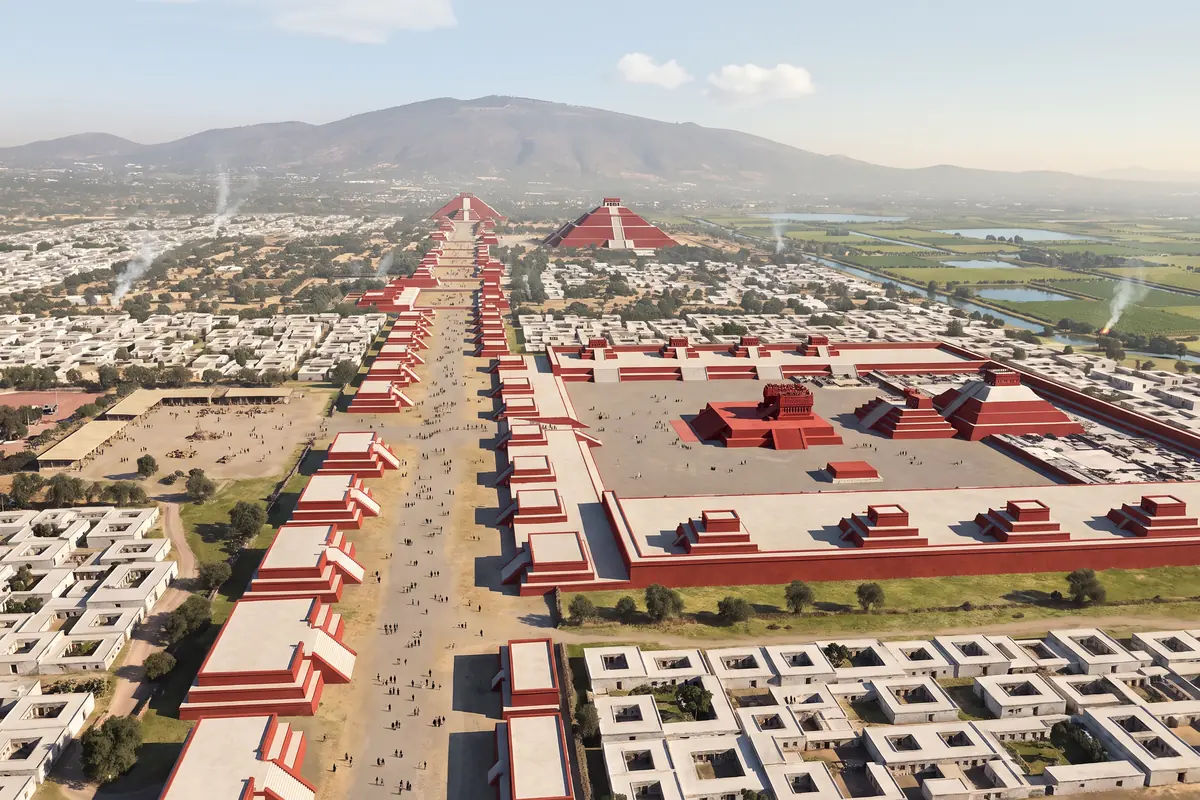
AI vision: Teotihuacan around AD 450 from the air, red-plastered pyramids and temples along the Avenue of the Dead, the Ciudadela with its temples, and thousands of flat-roofed apartment compounds stretching to Cerro Gordo
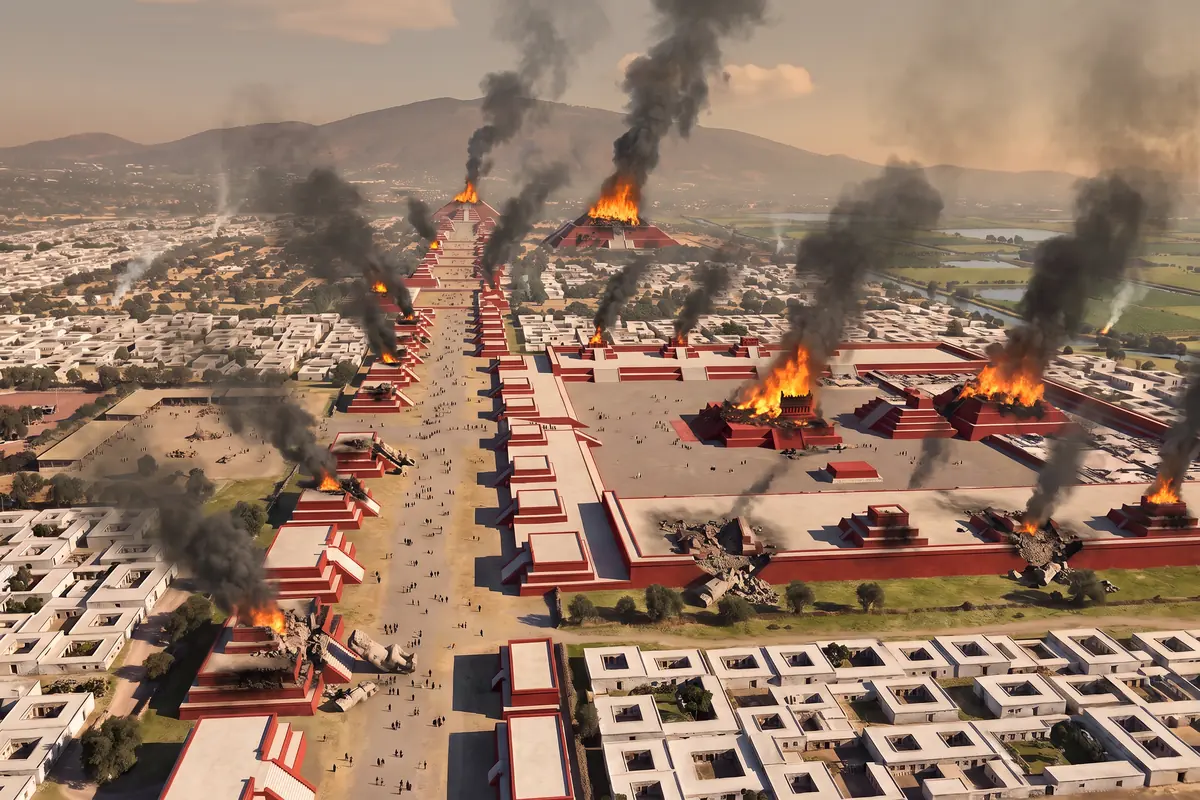
AI vision: the great fire of Teotihuacan around AD 550 from the air, columns of smoke over the temples of the Avenue of the Dead, the Ciudadela and the Pyramid of the Sun, the residential quarters around them intact
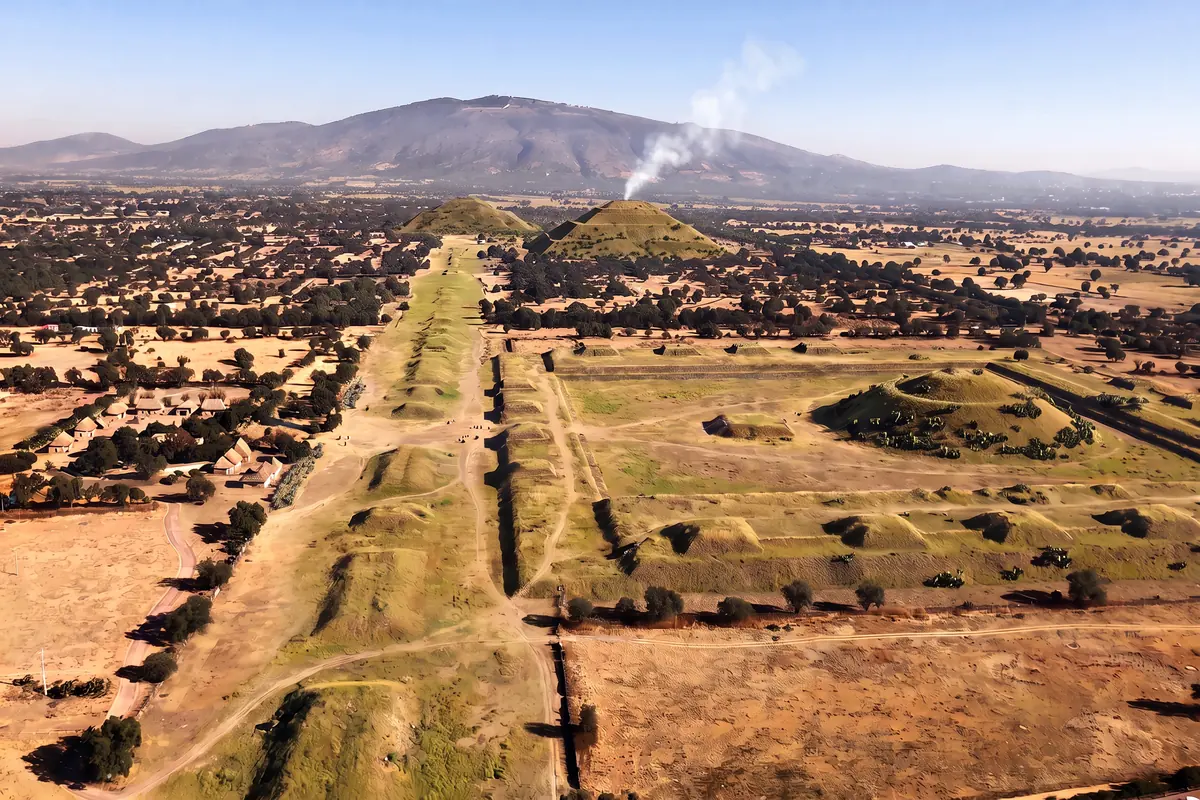
AI vision: Teotihuacan around 1500 from the air, the Pyramids of the Sun and Moon as grassy hills with prickly-pear cactus, the Avenue of the Dead as a row of mounds, fields, a small village, incense smoke on the Pyramid of the Sun
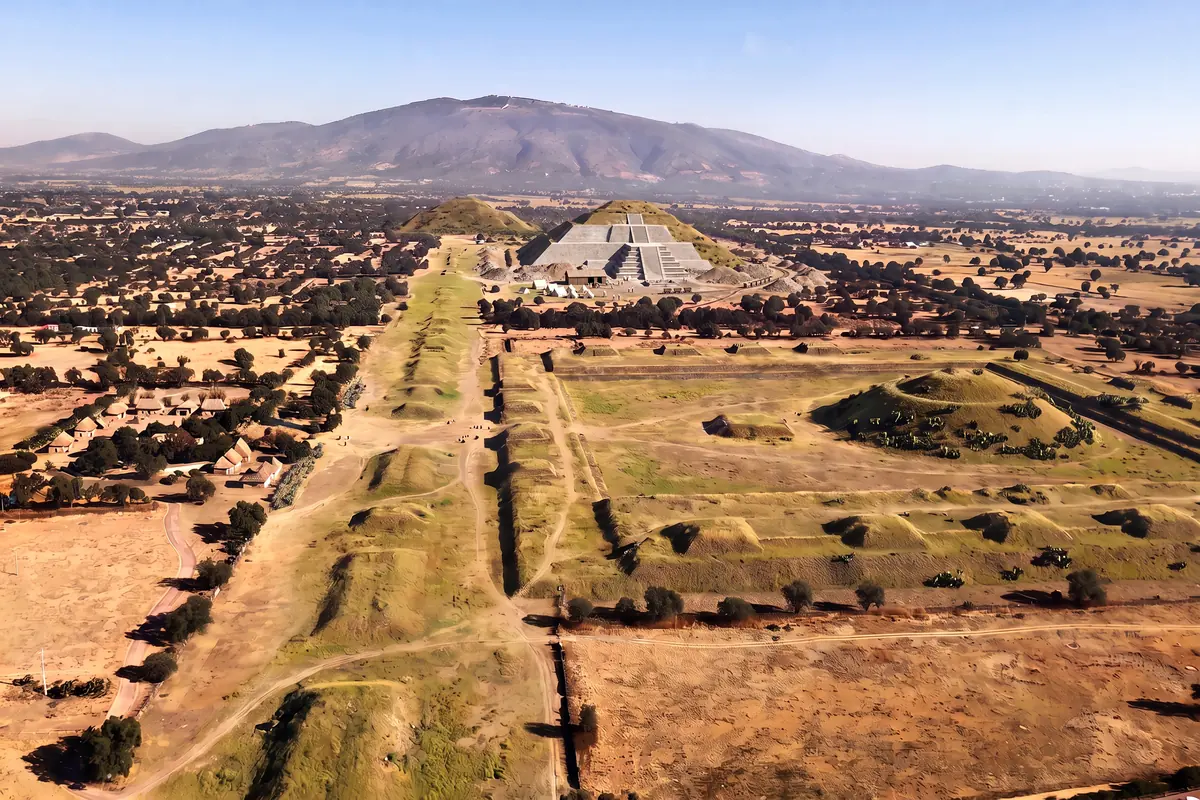
AI vision: the excavation of the Pyramid of the Sun around 1908 from the air, one side with freshly exposed stone tiers, spoil heaps, light-railway tracks with tipping wagons, tents, the Avenue of the Dead and the Ciudadela still overgrown mounds
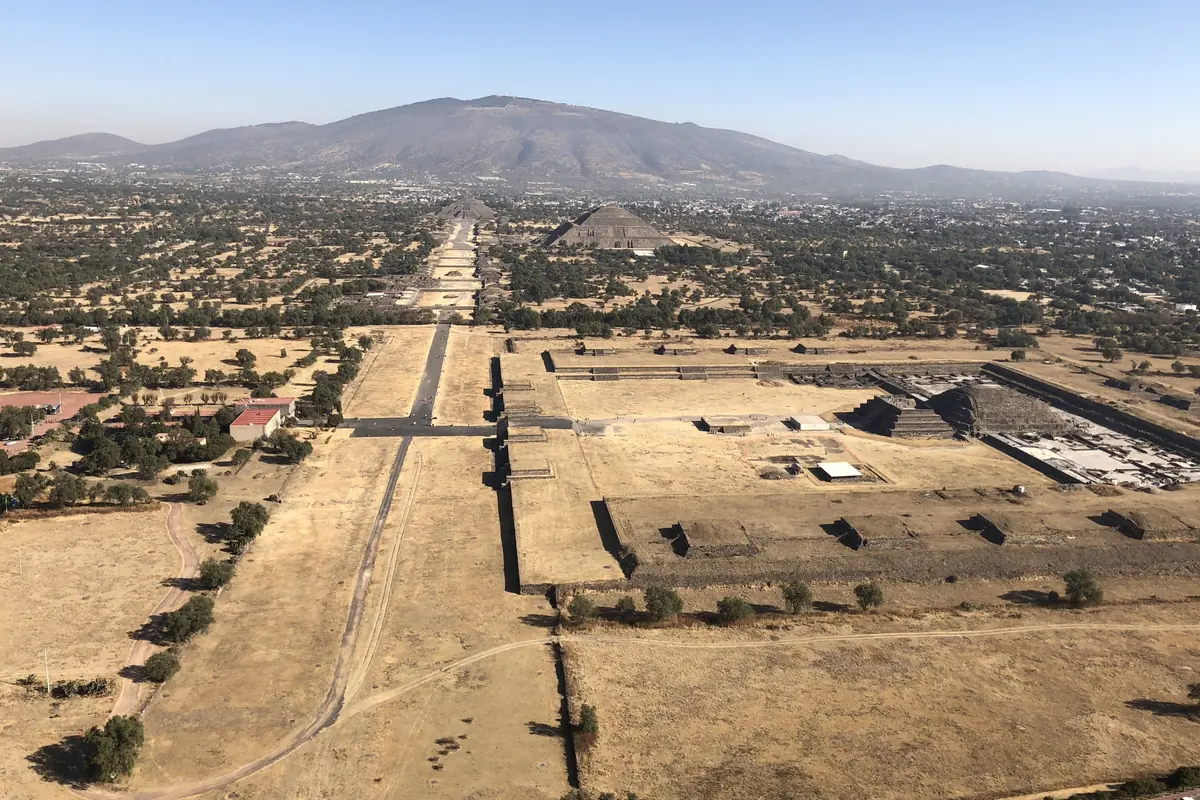
Teotihuacan from a hot-air balloon: the Ciudadela with the Temple of the Feathered Serpent, the Avenue of the Dead, the Pyramid of the Sun and the Pyramid of the Moon in front of Cerro Gordo
Documented Avenue of the Dead, 40 m wide, laid out AD 150 to 225Documented Ciudadela with 15 temples; Temple of the Feathered Serpent hidden behind the Adosada since about 350Documented Pyramid of the Sun, about 65 m high, completed around AD 250; facades plastered red and whiteAssumed Large plaza opposite the Ciudadela: interpreted as a marketAssumed Apartment compounds: position, density and appearance only in broad strokesInvented People, smoke, scenes, trees
Documented Deliberate burning of the temples and palaces at the centre, sculptures smashedDocumented Residential quarters largely sparedAssumed Date: around 550, perhaps not until the 7th centuryAssumed Fire on the Pyramid of the Sun itselfInvented Toppled colossi, flames and smoke in detail
Documented Pyramids as overgrown mounds, taken for tombs by the MexicaDocumented Names Teotihuacan and Miccaotli from the Nahua groups who arrived from the 13th centuryDocumented Pilgrims and offerings: the Mexica dug here for sacred objectsAssumed Ciudadela as overgrown embankments: its state around 1500Invented Village, fields, paths
Documented Pyramid of the Sun uncovered and reconstructed by Leopoldo Batres, 1905 to 1910Documented Railway link from 1908 to carry off the spoilDocumented Ciudadela still unexcavated: Manuel Gamio dug it in 1917 to 1922Assumed State of the dig around 1908, blasting and the disputed fifth tierInvented Village, tents, workers in detail
Documented Ciudadela with the Temple of the Feathered Serpent and the Adosada, excavated 1917 to 1922Documented Pyramid of the Sun in Batres’ reconstructionDocumented Pyramid of the Moon in front of Cerro GordoDocumented Museum and car park at Gate 1

AI vision · artistic licence

Teotihuacan: one view from above, 1,600 years

You float in a single spot, high above the Ciudadela of Teotihuacan, looking up the Avenue of the Dead. Time runs, you don’t. Scroll from the red city around AD 450 through the fire, the mounds of the Aztecs and Batres’ dig of 1908 to the view that awaits you today from a hot-air balloon.

I’m Ada Falk. I have spent my life digging through dirt in search of other lives. This city got its name from people who only ever knew it as mounds, and I’ll show you what came before. I’ll guide you.

Ada is an invented narrator. The history is real: every fact and quotation is sourced, and the sources are listed at the end. The images are AI visions, not scientific reconstructions. The button “What is the evidence?” shows what is documented.

AI vision: Teotihuacan around AD 450 from the air, red-plastered pyramids and temples along the Avenue of the Dead, the Ciudadela with its temples, and thousands of flat-roofed apartment compounds stretching to Cerro Gordo

Diary 1 / 5 · around AD 450 · one morning

Teotihuacan around AD 450: The largest city in the Americas

You hang in the air a few hundred metres above the Ciudadela, looking north. Below you lies the largest city in the Americas at this time: more than 100,000 people on over 20 square kilometres, in well over 2,000 apartment compounds laid out like a grid around the Avenue of the Dead. Every bit of stone you see is plastered and painted, mostly in this deep red. Nothing here is grey.

The avenue itself is 40 metres wide and about five kilometres long; from the Ciudadela to the plaza in front of the Pyramid of the Moon it climbs 27 metres in steps of sunken plazas. Lower right is the Ciudadela, a court of 400 by 400 metres with room for 100,000 people. Its Temple of the Feathered Serpent has been hidden for a century behind the plain red Adosada platform that was built in front of it around 350. Why, nobody knows. To the right the Pyramid of the Sun, 65 metres high, finished two centuries ago. And what these people called their city? We do not know. Their writing has not been deciphered.

INAH, today

„There is a moment, during any visit, when attention shifts away from the buildings themselves toward the space between them. That space is the Avenue of the Dead: 40 metres wide and roughly 5 kilometres long.“

Instituto Nacional de Antropología e Historia, Visit Teotihuacan, Avenue of the Dead. Abridged.

Image: AI vision based on an aerial photo by Ralibreros112 (CC BY-SA 4.0), not a scientific reconstruction.

AI vision: the great fire of Teotihuacan around AD 550 from the air, columns of smoke over the temples of the Avenue of the Dead, the Ciudadela and the Pyramid of the Sun, the residential quarters around them intact

Diary 2 / 5 · around AD 550 · one afternoon

The fire around 550: Fire at the centre

A hundred years later the centre burns. And it is no accident: the traces show that the temples and palaces along the Avenue of the Dead were deliberately set on fire, sculptures smashed and facades torn down, and almost only there. In the residential quarters, where craftsmen, traders and farmers lived, hardly any burn marks are found. Who did it is the big question. Invaders, people said for a long time. Today most suspect an uprising from within the city against its rulers.

When exactly is also open: the radiocarbon dates point to around 550, while INAH places the crisis in the 6th or 7th century. What followed is certain: the elites, priests and long-distance traders left, and the city shrank to a fraction of its size. Small groups went on living among the ruins. Nobody dismantled the pyramids.

World History Encyclopedia

„Mysteriously, around 600 CE, the major buildings of Teotihuacan were deliberately destroyed by fire, and artworks and religious sculptures were smashed in what must have been a complete changing of the ruling elite.“

Mark Cartwright, Teotihuacan, World History Encyclopedia.

Image: AI vision based on an aerial photo by Ralibreros112 (CC BY-SA 4.0), not a scientific reconstruction.

AI vision: Teotihuacan around 1500 from the air, the Pyramids of the Sun and Moon as grassy hills with prickly-pear cactus, the Avenue of the Dead as a row of mounds, fields, a small village, incense smoke on the Pyramid of the Sun

Diary 3 / 5 · around 1500 · dry season

The Aztecs and the mounds: The place where the gods were born

Nine hundred years later grass and prickly pear grow on the pyramids, and the Avenue of the Dead is a row of mounds. The people who live here now speak Nahuatl. Their ancestors came from the north in the 13th century, found the city abandoned and gave it a name that has stuck to this day: Teotihuacan, the place where one becomes a god, or the place where the gods were born. Both are possible; the scholars argue. The mounds along the avenue they took for the tombs of rulers, hence Miccaotli, road of the dead.

For the Mexica of Tenochtitlan, two days’ march away, this place is sacred: here, they tell, the gods threw themselves into the fire so that the sun of this world age could rise. People come on pilgrimage, and they dig in the mounds for masks and figures of the ancients to bury them anew in their own temples. A good twenty years later the Spaniards will arrive and take the great square below you for a fortress. Hence its name: Ciudadela.

The Florentine Codex, around 1577

„It is told that when all was yet in darkness, when no sun had yet shone, the gods gathered and took counsel there at Teotihuacan. They spoke: who will take it upon himself to be the sun, to bring the dawn?“

Bernardino de Sahagún, Historia general de las cosas de Nueva España (Florentine Codex), Book 7, chapter 2. Abridged, after the translation by Anderson and Dibble.

Image: AI vision based on an aerial photo by Ralibreros112 (CC BY-SA 4.0), not a scientific reconstruction.

AI vision: the excavation of the Pyramid of the Sun around 1908 from the air, one side with freshly exposed stone tiers, spoil heaps, light-railway tracks with tipping wagons, tents, the Avenue of the Dead and the Ciudadela still overgrown mounds

Diary 4 / 5 · around 1908

Batres’ excavation, 1905 to 1910: A pyramid for the centenary

In 1910 Mexico celebrates a hundred years of independence, and the government of Porfirio Díaz wants to show the world a country both ancient and modern. So Leopoldo Batres, inspector of monuments, has the Pyramid of the Sun uncovered from 1905: workers with picks, shovels and tipping wagons strip away centuries of earth, and in 1908 a railway line is laid to the ruins to carry off the spoil. The peasants who farmed plots on the site are expropriated; compensation comes later.

The haste has its price. Batres rebuilds the pyramid to his own taste, with a fifth tier that probably never existed, and to this day scholars accuse him of having destroyed more than he preserved. By the centenary of 1910 the pyramid is finished at any rate, and the delegates of the International Congress of Americanists, among them Eduard Seler and Franz Boas, are driven out to admire it. The Ciudadela below you remains a square of mounds: only Manuel Gamio excavates it, from 1917 to 1922, with the methods of the new archaeology.

Finding

„In 1908 a branch railway is built to the ruins to haul away the spoil; later it brings tourists. In 1910 the delegates of the Congress of Americanists are taken to the newly finished excavations.“

Summarised from the research history of the site (see sources). Not a verbatim quotation.

Image: AI vision based on an aerial photo by Ralibreros112 (CC BY-SA 4.0), not a scientific reconstruction.

Teotihuacan from a hot-air balloon: the Ciudadela with the Temple of the Feathered Serpent, the Avenue of the Dead, the Pyramid of the Sun and the Pyramid of the Moon in front of Cerro Gordo

Diary 5 / 5 · Today

Teotihuacan today: And now you

This is real, taken from a hot-air balloon early in the morning. Exactly this view awaits you if you go up at sunrise: below, the Ciudadela, whose Adosada platform has stood beside the Temple of the Feathered Serpent again since Gamio’s excavation, the Avenue of the Dead, to the right the Pyramid of the Sun with Batres’ tiers, and at the end the Pyramid of the Moon repeating the outline of Cerro Gordo. On the left the museum and the car park of Gate 1, and behind them the towns of San Juan and San Martín reaching right up to the zone.

What you do not see: of the city, only the two kilometres or so of the avenue that you overlook here have been excavated. The rest, almost everything, lies under fields and houses. And the excavators are still here: in 2003 a tunnel full of offerings was found beneath the Temple of the Feathered Serpent, and every field season shifts a little of what we thought we knew.

INAH, today

„Teotihuacan is not a solved enigma: it is a living space, a site in constant rediscovery. And you, the visitor, are also part of that process.“

INAH, Visit Teotihuacan, Teotihuacan. Our translation.

Real photo: Ralibreros112, CC BY-SA 4.0, via Wikimedia Commons.

Your expedition

Visit Teotihuacan: How to find this view

“The rest you have to see for yourself. And when you stand on the Avenue of the Dead, remember: almost everything you see lay under grass for a thousand years.” Ada Falk

  1. Into the air. To be honest: this view exists only from a hot-air balloon or in your imagination. Flights take off at sunrise from launch sites on the edge of the zone and drift north over the Ciudadela at a few hundred metres. Book via the bar below or our ticket page.
  2. Or up the Adosada. The walkable alternative: from Gate 1 straight into the Ciudadela, then up the stairway of the Adosada platform. From the top you see the Temple of the Feathered Serpent in front of you and, over the northern embankments, the Pyramid of the Sun, in the same direction as in the images.
  3. Then north. Back onto the Avenue of the Dead and walk the two kilometres to the plaza in front of the Pyramid of the Moon. The route climbs 27 metres in steps of sunken plazas, exactly as around 450.
  • Sunrise: Balloons launch at dawn because the air is calm then; nobody flies later in the morning. Stay overnight in San Juan or San Martín, or leave Mexico City around 4 am.
  • On foot: The zone opens at 8 am; until 10 the Avenue of the Dead is almost empty, and at midday the sun burns at 2,300 metres above sea level. Hat, water, sturdy shoes. Climbing the Pyramid of the Sun is no longer allowed.
  • Check first: Prices, opening hours and gates are in our guide Teotihuacan tickets and admission; all the highlights are on our map.

At a glance

Teotihuacan in facts

Founded
around 100 BC; the great monuments are built until about AD 250
Height
about AD 350 to 550, then the sixth-largest city in the world
Population
over 100,000, estimates up to 200,000; over 20 km², more than 2,000 apartment compounds
Fire
around AD 550 (INAH: 6th to 7th century), deliberately set at temples and palaces
Aztec name
Teotihuacan, “place where one becomes a god” or “where the gods were born”; the avenue: Miccaotli
Excavation
1905 to 1910 Leopoldo Batres (Pyramid of the Sun), 1917 to 1922 Manuel Gamio (Ciudadela)

Frequently asked questions about Teotihuacan

Who built Teotihuacan?

Nobody knows for certain. It was not the Aztecs: they arrived in the valley some 700 years after the city’s end and found ruins. The builders left no deciphered writing and no royal name; excavations show a population drawn from many regions of Mesoamerica, with quarters of their own for Zapotecs, Maya and people from the Gulf coast. What the inhabitants called their city is unknown.

Why was Teotihuacan abandoned?

Around AD 550, or on other datings not until the 7th century, the temples and palaces at the centre were deliberately burnt down and sculptures smashed, while the residential quarters show hardly any burn marks. Most researchers therefore suspect an uprising against the elite, together with droughts and broken trade networks. The city then shrank to a fraction of its size, but it was never entirely empty.

What does the name Teotihuacan mean?

The name is Nahuatl and comes from the Aztecs, not from the builders. It is usually translated as “place where one becomes a god” or “place where the gods were born”, because in Aztec myth the gods sacrificed themselves here so that the sun would rise. “Avenue of the Dead” (Miccaotli) and “Pyramid of the Sun” are Aztec names too: they took the mounds along the avenue for tombs.

Can you climb the Pyramid of the Sun?

No. INAH no longer allows climbing the Pyramid of the Sun, and access to other structures is restricted for conservation reasons. The Avenue of the Dead and the plazas are open to walk; the Adosada platform in the Ciudadela is usually accessible. You will find the current position in our guide to tickets and admission.

How big was Teotihuacan?

At its height between AD 350 and 550, according to INAH, more than 100,000 people lived here, some estimates say up to 200,000, on over 20 square kilometres with more than 2,000 apartment compounds. That made Teotihuacan the largest city in the Americas and one of the largest in the world of its day. Only the two kilometres or so along the Avenue of the Dead have been excavated.

Why is it called the Avenue of the Dead?

Because the Aztecs took the overgrown platforms on both sides for the burial mounds of rulers and called the axis Miccaotli, road of the dead. Archaeology found no tombs there; the mounds were temples, platforms and palaces. The avenue is 40 metres wide, about five kilometres long and was laid out between AD 150 and 225.

Are the pyramids real or reconstructed?

The cores are real, the surfaces not everywhere. Leopoldo Batres uncovered the Pyramid of the Sun in 1905 to 1910 and rebuilt it in haste, with a disputed fifth tier; the stone facade you see is his version. Originally all the buildings were plastered and painted, mostly red. The Pyramid of the Moon consists of seven pyramids built one over the other; the last is the one you see.

Can you see Teotihuacan from the air?

Yes, by hot-air balloon. Flights take off at sunrise from launch sites on the edge of the zone, last about an hour and show exactly the view of this time journey. Drones are banned inside the zone. You can book via the bar at the bottom of the page or our ticket guide; check whether admission to the zone is included.

About these images

The images of stages 1 to 4 are AI visions generated with Nano Banana Pro (Google Gemini) via fal.ai; the starting point was an aerial photograph taken from a hot-air balloon (Ralibreros112, CC BY-SA 4.0). As adaptations of that photo the visions are published under the same licence. Stage 2 was derived from stage 1 and stage 4 from stage 3; the dig at the Pyramid of the Sun was generated as a detail and mounted into the image. The visions are meant to convey a feeling and are not scientific reconstructions: people, villages, colours and scenes are invented, and the buildings follow the evidence only in broad strokes. The image files are labelled as AI-generated (IPTC). The last image is the unaltered photograph.

Sources and status

Text: Daniela Pieper, Back in Time Travel editorial team. Updated 25 September 2026. Specialist review is still pending. Translations are our own, abridged.

  1. INAH, Visit Teotihuacan: Avenue of the Dead
  2. INAH, Visit Teotihuacan: Attached Platform (Adosada)
  3. INAH, Visit Teotihuacan: Pyramid of the Sun
  4. INAH, Visita Teotihuacán: 22 centuries of history (timeline, Spanish)
  5. INAH, Visit Teotihuacan: rules, opening hours, prices
  6. UNESCO World Heritage: Pre-Hispanic City of Teotihuacan
  7. World History Encyclopedia: Teotihuacan
  8. Getty Research Institute: Digital Florentine Codex
  9. G. L. Cowgill: Ancient Teotihuacan. Early Urbanism in Central Mexico. Cambridge University Press 2015.
  10. R. Millon: Urbanization at Teotihuacan, Mexico. Vol. 1: The Teotihuacan Map. University of Texas Press 1973.
  11. B. de Sahagún: Florentine Codex, Book 7, ch. 2 and Book 10, ch. 29 (transl. A. J. O. Anderson, C. E. Dibble).
  12. L. Batres: Teotihuacán. Memoria. Mexico 1906.
  13. M. Gamio (ed.): La población del Valle de Teotihuacán. Mexico 1922.
Image credits

Aerial view today and source image of the AI visions: Ralibreros112, Wikimedia Commons, CC BY-SA 4.0. Cropped, resized.

AI visions: Back in Time Travel, generated with Nano Banana Pro via fal.ai, adaptations of the aerial photo by Ralibreros112, CC BY-SA 4.0. Not a scientific reconstruction.

Barlow Condensed / Manrope · SIL Open Font License. Barlow OFL · Manrope OFL