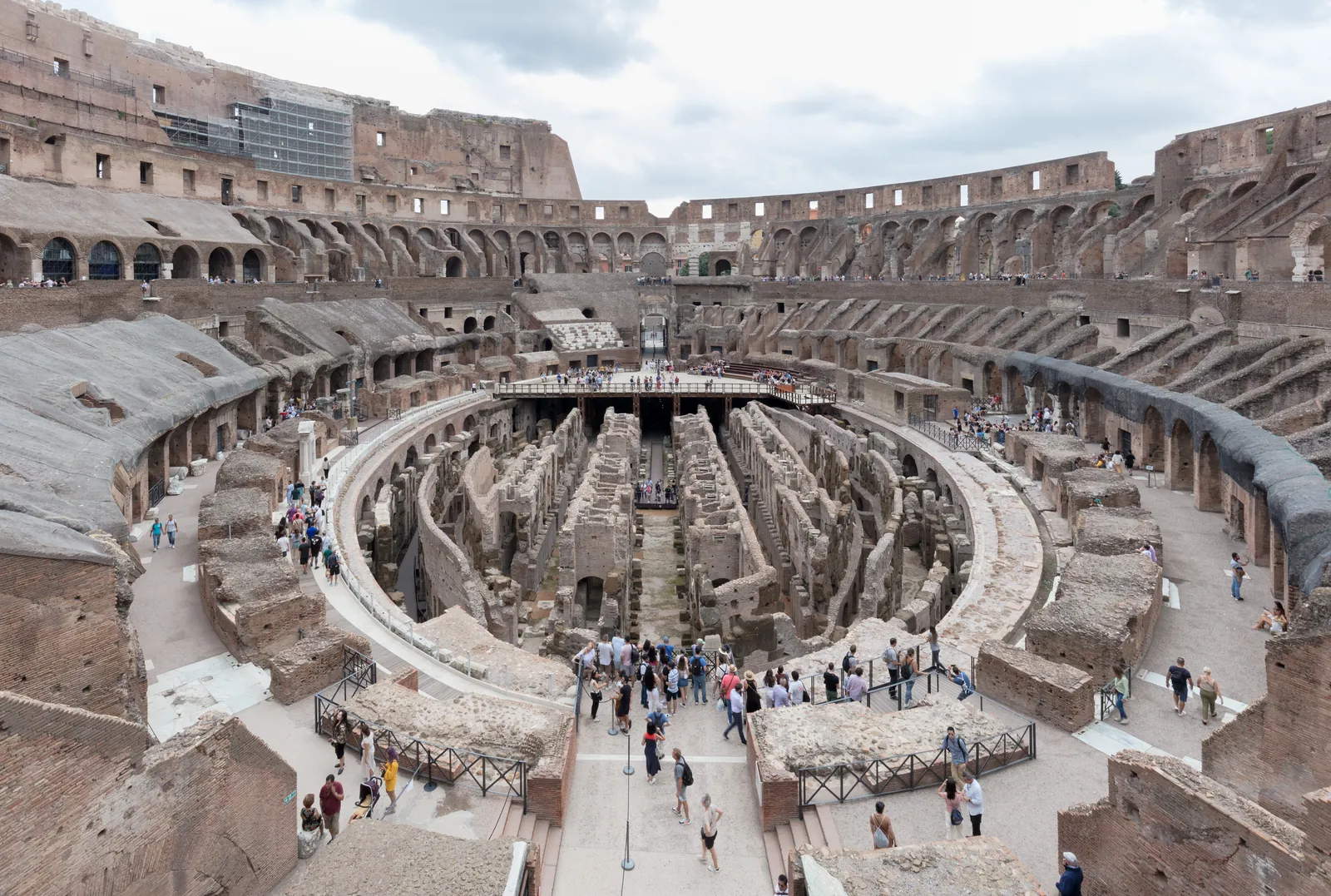
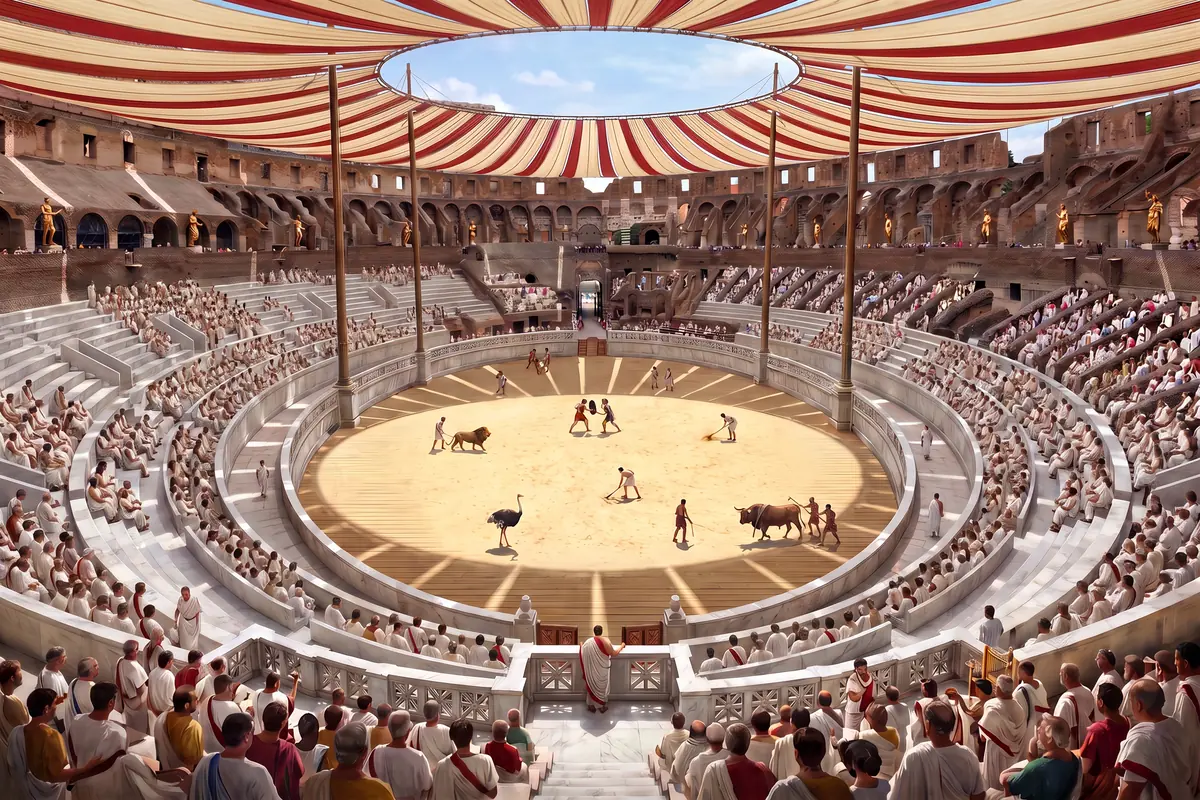
In the hypogeum, the team led by Heinz-Jürgen Beste recorded semicircular recesses in the walls, paired vertical channels, floor holes with bronze collars and diagonal slots. It interprets them as clearance for capstans, as guides for cages and platforms, as bearings for shafts and as seats for ramps. Four main building phases could be distinguished; the park describes a timber substructure at the inauguration, translated into masonry under Domitian.
Evidence / source: Smithsonian Magazine · Secrets of the Colosseum (H.-J. Beste, DAI Rom, 2011)Read the walls beneath the arena not as corridors but as the negative imprint of an installation of timber, rope and metal. Every groove had a counterpart that has vanished. The researchers built models from these traces and tested whether cage, winch and ramp actually fit together. A bewildering plan thus becomes a sequence: animals below in the dark, men at the capstans, scenery rising through the floor. The photograph from above shows the stage without its machinery.
What the evidence cannot establish on its own
The number of capstans and the exact mechanics are reconstructions from traces and written sources, not surviving machines. Which installation operated in which building phase, and what was staged on a given day, cannot be derived from them.