Herculaneum map: plan of the excavations
Our own plan of Herculaneum with 20 highlights, the boat houses on the ancient beach, the terrace of Balbus, the houses with their upper floors, the baths, the palaestra, both entrances and the Circumvesuviana station. Tap a number for details, choose a route, or print the map for your visit.
Map of the excavations of Herculaneum
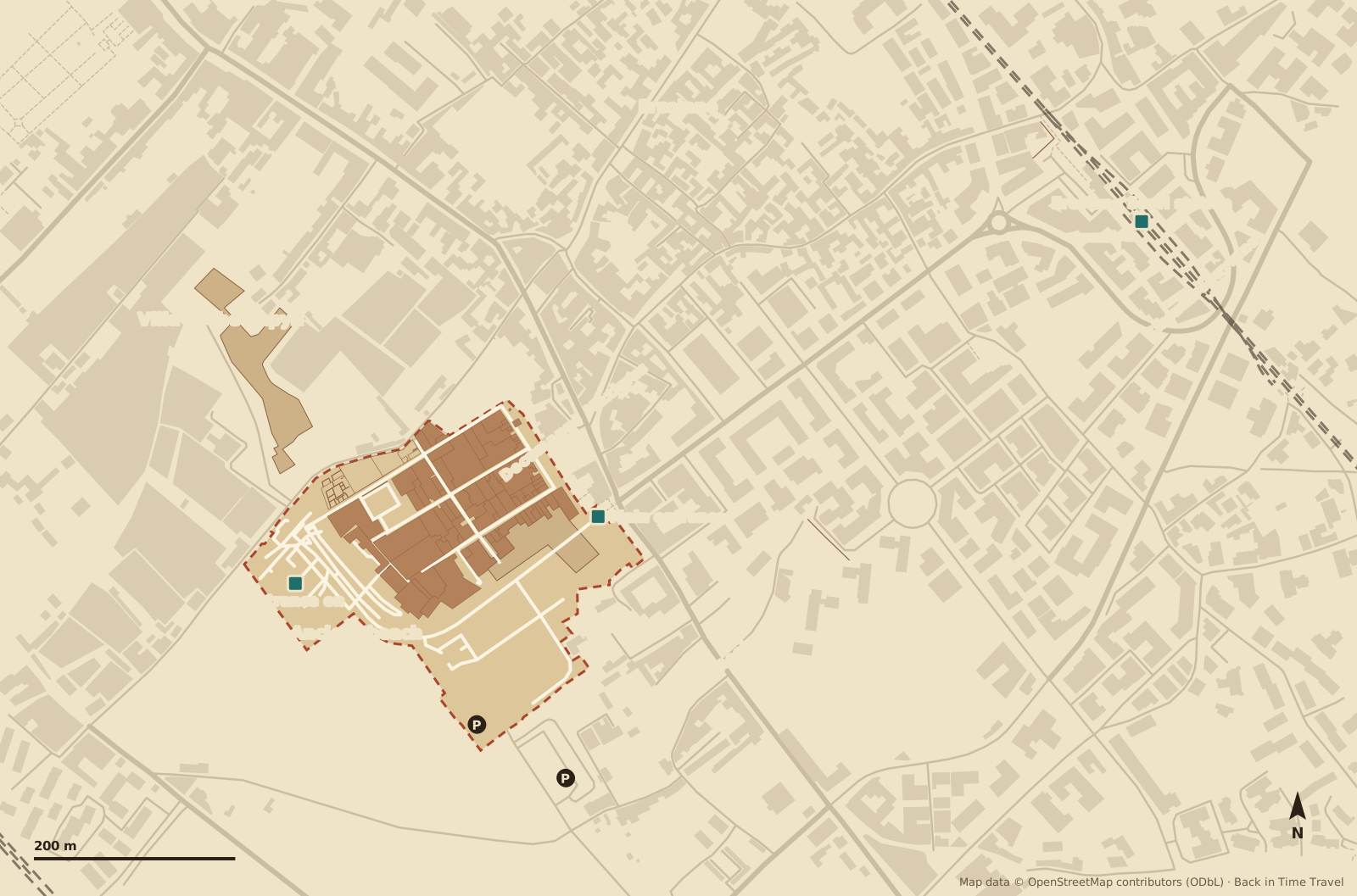
Map data © OpenStreetMap contributors, ODbL. Drawn by Back in Time Travel, data as of 25 September 2026. The map is a guide to orientation; paths, closures and access may change.
The 20 highlights on the map
The numbers match the map. The order follows a walk from the main entrance down the ramp to the ancient beach, through the Suburban Baths and the museums, then cardo by cardo through the town to the palaestra; the Villa of the Papyri and the theatre are neighbours outside the walk.
Main entrance Corso Resina 187
The entrance at the top edge of the pit, ten minutes below the station: ticket office, lockers, toilets, bookshop. From here the ramp with the famous view over the whole town leads down; only at the end of the ramp do you cross a bridge into the ancient streets.
Read more →Terrace of Balbus Terrazza di Marco Nonio Balbo
The viewing terrace above the ancient beach with the altar and statue base of the proconsul Marcus Nonius Balbus, the town’s great benefactor. From here you look over the row of boat house arches where the sea once began.
Ancient beach and boat houses Antica spiaggia, Fornici
The beach of AD 79 now lies four metres below the water table and has been walkable again since June 2024. In the twelve vaults, the fornici, excavators found from 1980 the skeletons of about 300 people waiting for rescue from the sea; replicas show the scene.
Read more →Suburban Baths Terme Suburbane
The best-preserved baths of the town, right on the beach: cold, warm and hot rooms with stucco, marble and the wooden window frame carbonised by the surge. Normally seen from outside; inside only on special tours with a helmet.
Antiquarium Museum by the beach
The park’s small museum: sculptures and wall paintings from public buildings and from the Villa of the Papyri, plus the belongings of the dead from the boat houses, jewellery, coins, tools. Open 8.30 am to 5 pm.
Read more →Boat Pavilion Padiglione della barca
The carbonised boat that emerged from the volcanic mud in front of the Suburban Baths on 3 August 1982: more than nine metres long, six rowers and a helmsman, probably a military vessel bringing help. Beside it, finds relating to seafaring.
Read more →House of the Deer Casa dei Cervi
The most splendid villa on the seafront, named after the marble groups of deer being savaged by hounds. Its terrace with pergola once stood directly above the beach; its wall paintings and floors are among the finest in the town.
House of the Relief of Telephus Casa del Rilievo di Telefo
A large villa with an atrium full of marble discs that chimed in the wind, and the relief of Telephus, son of Hercules, in a side room. Probably the house of Balbus, whose terrace lies next door.
House of the Mosaic Atrium Casa dell’Atrio a Mosaico
The floor of the atrium, a chessboard of black and white mosaic, has buckled under the weight of the volcanic rock. Behind it a garden with a portico and rooms facing the sea.
House of the Wooden Partition Casa del Tramezzo di Legno
The emblem of the wooden finds: a carbonised folding wooden screen with bronze fittings separates atrium and tablinum, as on the day of the eruption. The facade on Cardo IV shows a surviving upper floor.
Casa a Graticcio Trellis house
A tenement of timber framing with rubble infill, the cheap building method of the imperial age, with a balcony over the street and two separate flats. Nothing like it survives at Pompeii; here the upper floor and the wooden stair still stand.
House of Neptune and Amphitrite Casa di Nettuno e Anfitrite
The most famous picture in the town: a glass mosaic of Neptune and Amphitrite on the wall of the summer dining room. The shop next door still has its wooden shelves and amphorae.
Forum Baths Terme del Foro
The town baths on Cardo III with separate sections for men and women, mosaic floors with tritons and dolphins and the wooden shelves for clothes, all from the 1st century BC.
Samnite House Casa Sannitica
One of the oldest houses in the town, from the 2nd century BC, with an atrium whose upper storey shows a blind gallery with Ionic columns. This is how the houses looked before the Roman rebuilding.
House of the Bicentenary Casa del Bicentenario
Uncovered in 1938 on the 200th anniversary of the Bourbon excavations, on the Decumanus Maximus: wall paintings, a wooden shrine, and upstairs the imprint of a cross that has been argued over for decades. Accessible again after a long restoration.
College of the Augustales Collegio degli Augustali
The hall of the freedmen who kept the imperial cult, with wall paintings of Hercules among the gods. In a side room the caretaker lay on his bed when the surge came.
Palaestra Sports ground with cruciform pool
The town’s great sports complex with a colonnade and a cross-shaped pool in whose centre a bronze serpent spouted water. Only partly excavated; the rest lies under Ercolano.
House of the Beautiful Courtyard Casa del Bel Cortile
A small house around an inner courtyard with an external stair and gallery, looking more like a medieval town house. Three skeletons were found in the courtyard; they are now in storage.
Villa of the Papyri Villa dei Papiri
The largest villa in the area with the only surviving library of antiquity: more than 1,800 carbonised scrolls, found through the Bourbon tunnels in 1750. Only part is excavated, and access is closed for stabilisation works; the bronzes are in Naples.
Read more →Ancient theatre Teatro romano
The theatre beneath modern Ercolano, found in 1709 by a well shaft dug for the Prince d’Elbeuf and stripped through the Bourbon tunnels. To this day only underground and only on special tours; entrance on Corso Resina.
Read more →
Routes through Herculaneum
Three suggestions, all from the main entrance. Choose a route and its stops are highlighted on the map. The excavation lies in a windless pit; water and a hat are essential in summer.
The highlights in 2 hours
Down the ramp to the terrace of Balbus and the beach with the boat houses, through the Suburban Baths into the town, then the House of the Deer, the House of the Wooden Partition, the Casa a Graticcio, the House of Neptune and Amphitrite and the Forum Baths.
The whole morning with the museums
All 18 stops inside the park: first the beach, Antiquarium and Boat Pavilion, then the houses of Cardo IV and V, and last the College of the Augustales and the palaestra. Four hours with breaks; the villa and the theatre from outside or on special tours only.
- 1 Main entrance
- 2 Terrace of Balbus
- 3 Ancient beach and boat houses
- 4 Suburban Baths
- 5 Antiquarium
- 6 Boat Pavilion
- 7 House of the Deer
- 8 House of the Relief of Telephus
- 9 House of the Mosaic Atrium
- 10 House of the Wooden Partition
- 11 Casa a Graticcio
- 12 House of Neptune and Amphitrite
- 13 Forum Baths
- 14 Samnite House
- 15 House of the Bicentenary
- 16 College of the Augustales
- 17 Palaestra
- 18 House of the Beautiful Courtyard
Just the houses, when the beach is crowded
Straight across the bridge into the town: the houses with upper floors and wood on Cardo IV and V, the two baths and the palaestra. Save the beach for the late afternoon when the groups have gone.
Entrances, station and car park
- Main entrance, Corso Resina 187
- At the top of the eastern edge of the excavation, ten minutes’ walk downhill from the station: ticket office, lockers, toilets and bookshop. From here the ramp with the panoramic view runs along the edge of the pit down to the ancient beach and across a bridge into the town.
- Entrance on Via dei Papiri Ercolanesi with the Antiquarium
- In the west by the Villa of the Papyri, with the park’s car park, the Antiquarium and the Boat Pavilion. From here you enter the town past the Suburban Baths; this entrance is not always staffed, so if in doubt use Corso Resina.
- Ercolano Scavi station
- Circumvesuviana from Napoli Garibaldi towards Sorrento or Poggiomarino, a good twenty minutes, and the Campania Express. From the station walk straight downhill along Via IV Novembre to Corso Resina; the Vesuvio Express bus to the volcano also leaves from the station.
- Car park
- The park’s paid car park at Via dei Papiri Ercolanesi 19, A3 motorway exit Ercolano Scavi. Parking in the town itself is tight and tiresome.
Prices, opening hours and how to get there by Circumvesuviana are in our guide to Herculaneum tickets and admission.
Where is Herculaneum?
Herculaneum lies in the town of Ercolano on the Bay of Naples, at the foot of Vesuvius, between Naples and Pompeii. The ancient coastline ran at the foot of the excavation; today the sea is 400 metres further away. By Circumvesuviana it is a good twenty minutes from Napoli Garibaldi, about fifty from Sorrento. Distances from the Decumanus Maximus, as the crow flies:
- Naples
- 8 km
- Pompeii
- 13 km
- Sorrento
- 20 km
- Vesuvius (crater)
- 7 km
- Salerno
- 38 km
Frequently asked questions about the Herculaneum map
Where is Herculaneum?
Herculaneum lies in Ercolano on the Bay of Naples, at the foot of Vesuvius. As the crow flies it is 8 kilometres to Naples, 13 kilometres to Pompeii, 20 kilometres to Sorrento and 7 kilometres to the crater of Vesuvius. By Circumvesuviana from Napoli Garibaldi it takes a good twenty minutes to Ercolano Scavi, then ten minutes on foot downhill.
How big is Herculaneum?
The excavation measures about 300 by 200 metres, four and a half hectares; the ancient town covered about twenty hectares, the rest lies under Ercolano. From the main entrance to the beach you walk a good 400 metres down the ramp, across the town less than 300. Two hours for the highlights, a morning for all the stops.
Is there a Herculaneum map as a PDF?
This page can be printed or saved as a PDF with the “Print the map” button; the map, highlights and routes are printed. The ticket office also has a folding plan of the park, and the houses carry number plates.
Where are the skeletons at Herculaneum?
In the boat houses on the ancient beach, number 3 on the map, below the terrace of Balbus. The beach has been walkable again since June 2024; the vaults hold replicas, the real bones are in storage. The Antiquarium shows the belongings of the dead.
When is Herculaneum least crowded?
At 8.30 am when it opens and, in summer, after 5 pm. The groups from Naples and the cruise ships come between 10 am and 2 pm. On the first Sunday of the month admission is free and the pit is full.
How do I get from the station to the excavations?
From Ercolano Scavi station walk straight downhill along Via IV Novembre, always towards the sea, ten minutes to Corso Resina; the entrance is on the left. The way back is the same way uphill; if you would rather not, take a taxi at the station.
Can you see the Villa of the Papyri and the theatre?
The villa is closed for excavation and stabilisation works with no date for reopening; the fence at the western edge of the excavation shows the excavated part. The theatre lies beneath the town and is accessible only on special tours through the Bourbon tunnels; the park announces the dates.