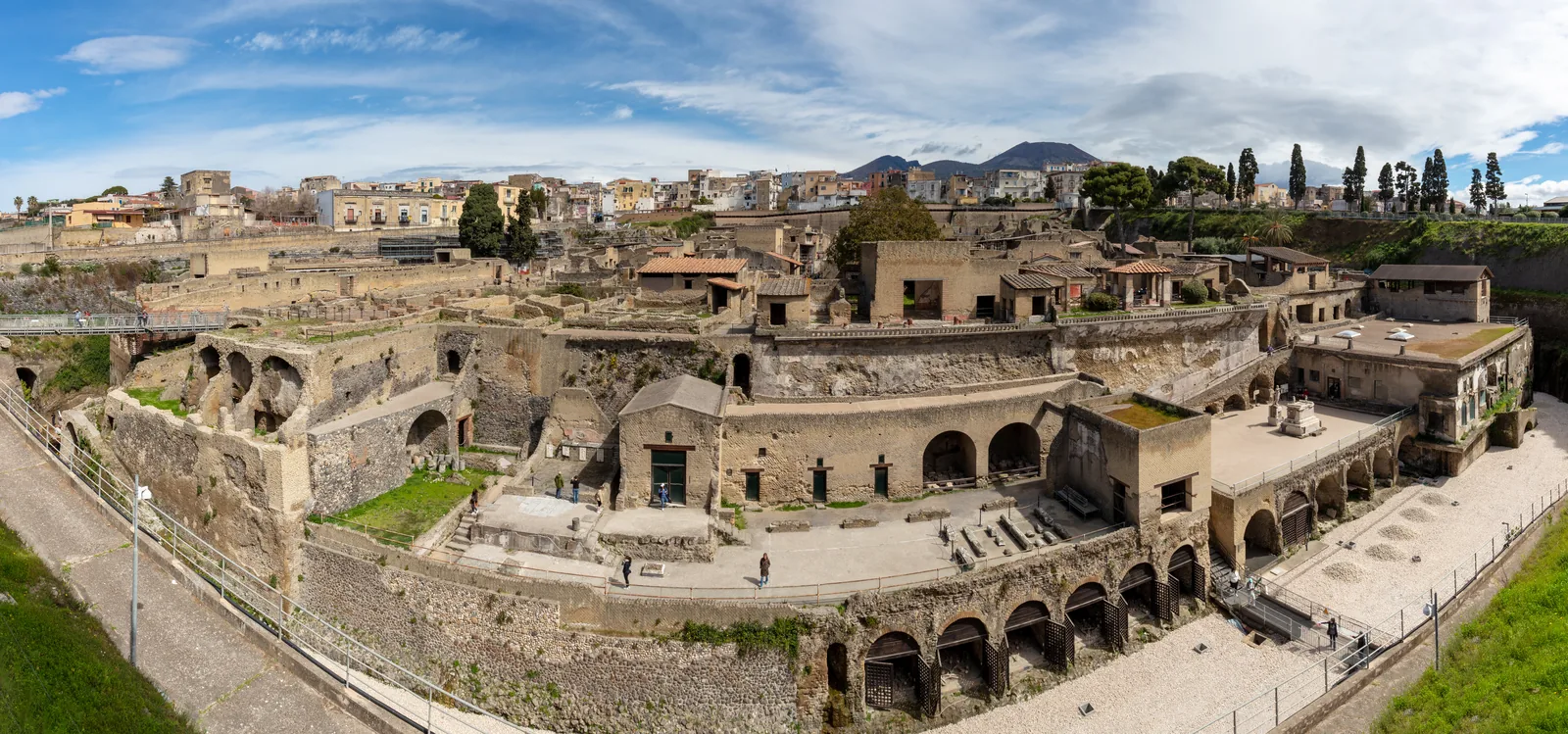
Panorama of the excavations of Herculaneum: the row of boat house arches below, the terrace with the altar of Balbus, the excavated houses behind, modern Ercolano and Vesuvius above.
The excavations of Herculaneum seen from the access ramp: the boat houses on the ancient beach below, above them the terrace of Marcus Nonius Balbus, the town and Vesuvius; modern Ercolano on top. Photograph taken on 27 March 2023. Diego Delso · CC BY-SA 4.0

Italy · Roman world

Herculaneum.
The little sister that kept more.

From the ramp you see the town from above: rows of arches on the beach, houses with upper floors, and above them the roofs of modern Ercolano. Pompeii was buried by pumice, Herculaneum by pyroclastic flows. That made the difference: here wood survived, here libraries survived, here the people on the beach survived as skeletons.

79CE
Selection: 600 BCE–79 CE8 chapters
The history
Smaller than Pompeii, buried deeper.

Herculaneum lay on a promontory right by the sea, ten kilometres from Pompeii, a small, wealthy town of about 4,000 people. In the eruption of 79 it received little pumice at first; then, in the night, pyroclastic surges of around 400 degrees buried everything under twenty metres of hardened volcanic material. That is why upper floors, wooden doors and beds still stand here, and why most of the town still lies beneath modern Ercolano. Since 1997 Herculaneum has been a UNESCO World Heritage Site together with Pompeii and Oplontis. Source: UNESCO · Archaeological Areas of Pompei, Herculaneum and Torre Annunziata

Through the centuries

No place
stands still.

Choose a period. See how the story changes over time.

01c. 600 BCEBeginnings

A town on the promontory.

According to legend Hercules founded the town on his way back from Iberia; archaeologically it begins among the Oscans, Greeks and Samnites who shared the Bay of Naples. The site was well chosen: a spur of older volcanic rock about twenty metres above the sea, bounded by two streams, with a beach at its feet. The rectangular grid of cardines and decumani you walk today is a legacy of that pre-Roman planning.

Source: Parco Archeologico di Ercolano · The Story
0289 BCEMunicipium

Roman, wealthy, small.

In the Social War Herculaneum sided against Rome and was conquered in 89 BCE; afterwards it was a municipium with Roman citizenship. The town stayed small, about 4,000 people on twenty hectares, but it grew rich: senators and knights built villas with sea views, above all the Villa of the Papyri west of the walls with its library and its bronzes. The proconsul Marcus Nonius Balbus endowed buildings and received an altar on the terrace above the beach.

Source: Parco Archeologico di Ercolano · The Story
0362 CEEarthquake

The warning nobody understood.

A severe earthquake shook the towns around Vesuvius in 62 CE. In Herculaneum people built and repaired for seventeen years; that the mountain behind them was a volcano, nobody remembered. The flats, shops and baths you see today often show this last state: freshly plastered, half rebuilt, in the middle of everyday life.

Source: Parco Archeologico di Ercolano · The Story
0479 CEDestruction

The night of the pyroclastic flows.

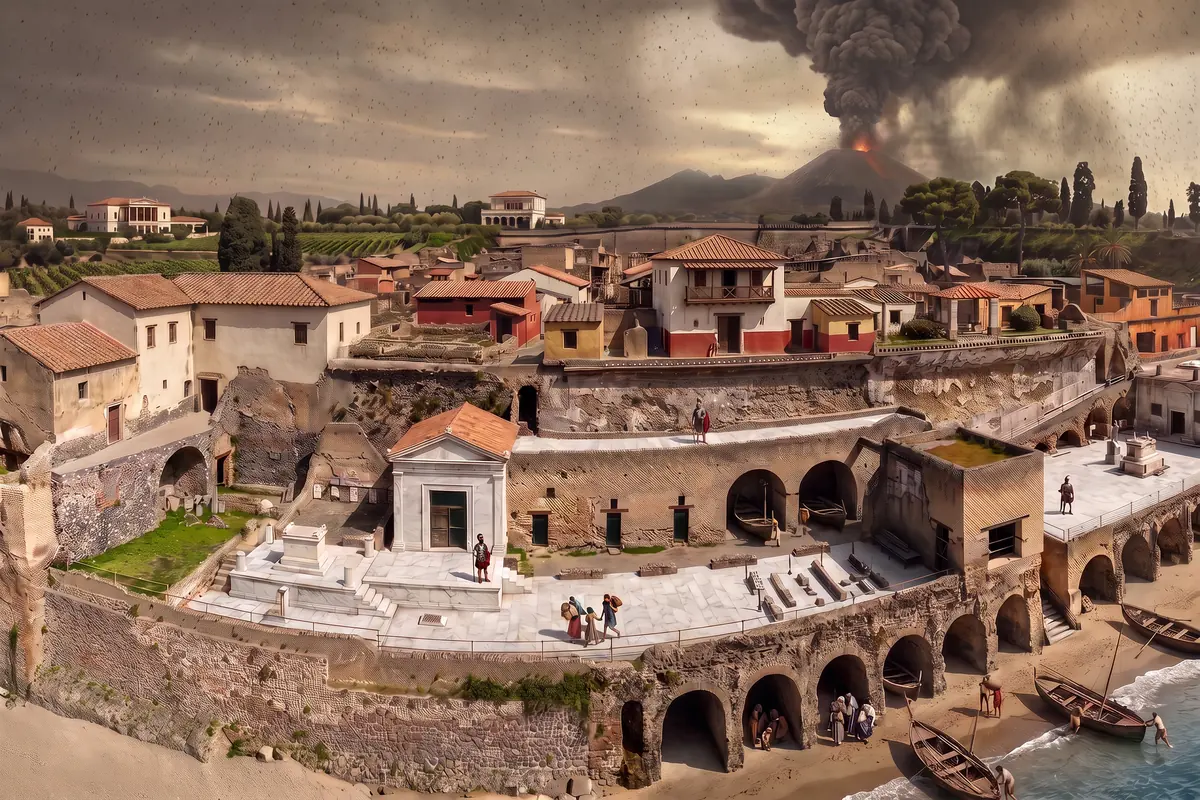
When Vesuvius erupted, the wind carried the pumice towards Pompeii; over Herculaneum little fell on the first day. Many fled, others waited on the beach and in the boat houses for rescue from the sea. In the night the surges came: according to the park around 400 degrees hot and faster than 80 kilometres an hour, followed by mudflows that buried the town under about twenty metres. The heat carbonised wood and papyrus instead of burning them; that is why Herculaneum is better preserved than Pompeii.

Source: Parco Archeologico di Ercolano · The Eruption
051709–1765Tunnels

The well that struck a theatre.

In 1709 a well shaft dug for the Prince d’Elbeuf at Resina hit marble and statues: the ancient theatre. From 1738 King Charles of Bourbon had tunnels dug; statues, bronzes and wall paintings went to the royal collection at Portici and Naples. In 1750 the diggers reached the Villa of the Papyri, whose plan the Swiss engineer Karl Weber drew in 1754; then the tunnels were abandoned. The theatre can still be seen only underground.

Source: Parco Archeologico di Ercolano · Villa of the Papyri
061828–1958Excavation

Maiuri brings the town to light.

Only in 1828 did open-air excavation begin, lasting until 1875; then everything stopped. In 1927 Amedeo Maiuri resumed the work and led it until 1958: he uncovered the core of the town with its seafront, about four and a half hectares, had wood conserved and houses secured with their upper floors. The rest, the forum, the basilica, most temples, lies under Ercolano.

Source: Parco Archeologico di Ercolano · The Story
071980–1982Boat houses

On the beach they waited for the boats.

For a long time Herculaneum was thought to be the town everyone had escaped from. Then, from 1980, excavators found in the twelve vaults on the ancient beach the skeletons of about 300 people, packed together, with jewellery, coins and tools. On 3 August 1982 the keel of a boat more than nine metres long emerged from the volcanic mud in front of the Suburban Baths, probably a military vessel bringing help. How the people died, in a split second or over minutes, is still debated.

Source: Parco Archeologico di Ercolano · Antiquarium and Boat Pavilion
082001 to todayConservation

The beach is open again.

Since 2001 the Herculaneum Conservation Project, a partnership of the Packard Humanities Institute with the park, has worked on drainage, roofs and wall paintings; excavation itself has largely given way to conservation. In 2024 the ancient beach with the boat houses was opened to visitors. And the carbonised papyrus scrolls of the villa are now being read without opening them: in 2026 the first scroll was deciphered from end to end.

Source: Herculaneum Conservation Project (Packard Humanities Institute, seit 2001)
Swipe or scroll

Look closer

A difference of material.

Pompeii sank beneath pumice and ash falling from the sky; roofs collapsed, upper floors vanished. Herculaneum was reached in the night by pyroclastic surges that enveloped everything and set into a hard, tuff-like rock. Wood, cloth, bread and papyrus were carbonised rather than burned at temperatures of several hundred degrees without oxygen. So doors, stairs, beds and the only library of antiquity survived.

Source: Parco Archeologico di Ercolano · The Eruption
What the evidence cannot show
Temperature estimates vary by method between about 250 and 500 degrees; they come from studies of bone, wood and volcanic rock, not from eyewitness accounts.
What to look for on a visit
Look up inside the houses: Herculaneum has standing upper floors, wooden balconies and carbonised door frames that Pompeii lacks. On the ancient beach you see the row of boat house arches where the people were found; the casts inside are replicas, the bones are in storage.
Source: Archaeology News · Ancient Roman beach at Herculaneum reopens to the public (June 2024)

Reading the place

Beneath the surface.

Buildings and finds reveal more when we consider their context. These close readings connect the evidence with questions to take on a visit.

01

How did the people in the boat houses die?

In the twelve vaults on the ancient beach excavators found about 300 skeletons from 1980 onwards. A study in Nature in 2001 examined eighty of them and inferred from bone fractures, tooth enamel and body postures a death by thermal shock at about 500 degrees, within a fraction of a second. In 2020 a re-evaluation in Antiquity came to a different picture: collagen and bone structure were too well preserved for such temperatures; soft tissue and the stone vaults had buffered the heat, and the people were more likely heated slowly. In 2023 volcanologists calculated that even a short-lived, detached ash cloud of a few hundred degrees was lethal.

Evidence / source: Martyn et al. · A re-evaluation of manner of death at Roman Herculaneum, Antiquity 94 (2020)

Three methods, three pictures of the same event: the bones say something about the temperature at the body, the volcanic deposits about the cloud, the postures about the last seconds. Visitors to the boat houses see replicas of the skeletons; how much time these people had is not finally answered.

What the evidence cannot establish on its own

All three studies work with subsamples and models. A temperature figure for Herculaneum without its method is always a shortcut.

02

The library nobody could open.

The Villa of the Papyri, found through Bourbon tunnels in 1750, held more than 1,800 carbonised papyrus scrolls, the only surviving library of antiquity, probably the writings of the Epicurean Philodemus. For centuries the scrolls crumbled when anyone tried to unroll them. Since 2023 the Vesuvius Challenge has sought ways to read them in CT scans: within a year the first passages became legible, and in 2026 PHerc. 1667 became the first scroll to be virtually unwrapped and read from end to end.

Evidence / source: Vesuvius Challenge · Reading the Herculaneum scrolls without opening them

The villa itself remains under Ercolano and is currently closed. What can be seen of it is in Naples: the bronzes in the National Museum, the scrolls in the National Library. Anyone standing at the fence to the villa in the park is looking at a library that is only just beginning to speak.

What the evidence cannot establish on its own

Of the 1,800 scrolls only a few are fully legible so far. Whether further library rooms lie beneath the villa, as some researchers suspect, has not been excavated.
03

Why Herculaneum is better preserved than Pompeii.

UNESCO puts it briefly: Pompeii was buried by ash and lapilli, Herculaneum disappeared under pyroclastic surges and flows. The result shows in the upper floors, wooden stairs, doors and beds that stand here, and in the carbonised food in the Antiquarium. At the same time most of the town, including the forum and the basilica, lies under the modern town and is known only through the 18th-century tunnels.

Evidence / source: UNESCO · Archaeological Areas of Pompei, Herculaneum and Torre Annunziata

Better preserved does not mean more fully excavated: about four and a half hectares of Herculaneum are open, 44 of Pompeii. Compare the two and you see the city at Pompeii and the house at Herculaneum.

What the evidence cannot establish on its own

How much still lies under Ercolano is an estimate; UNESCO mostly does not count those areas as part of the World Heritage property. Full excavation is neither planned nor technically in sight.

Plan a visit

Give Herculaneum half a day.

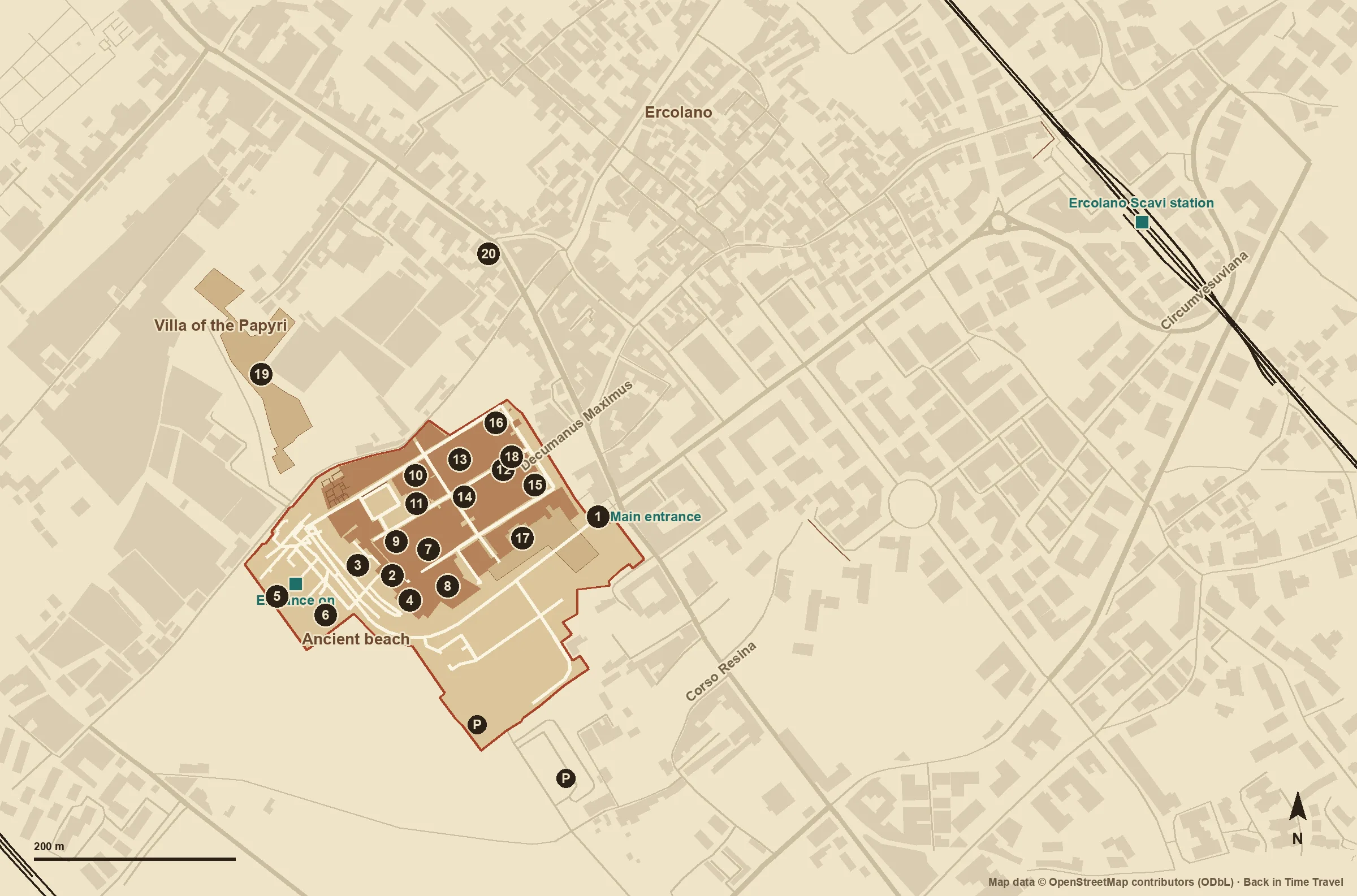
The park is open daily, until 7.30 pm in summer and 5 pm in winter; tickets are sold online by CoopCulture or at the booth on Corso Resina. From Naples the Circumvesuviana takes a good twenty minutes to Ercolano Scavi station, then ten minutes on foot downhill.

The Villa of the Papyri is closed for excavation and stabilisation work, and the theatre opens only for special tours. The ancient beach may close for a few hours during works; ask at the ticket office.

Affiliate link: we may receive a commission when you book through GetYourGuide. The historical interpretation remains independent.

Visiting sources checked on 24 September 2026. Prices and availability are provided by the operator.

Keep exploring

More of
Herculaneum.

Sources and context

These texts combine published research with editorial explanation. Some dates are approximate. Photographs show documented surviving conditions. Specialist archaeological review is still pending.

  1. Source: UNESCO · Archaeological Areas of Pompei, Herculaneum and Torre Annunziata
  2. Source: Parco Archeologico di Ercolano · The Story
  3. Source: Parco Archeologico di Ercolano · The Eruption
  4. Source: Parco Archeologico di Ercolano · Villa of the Papyri
  5. Source: Parco Archeologico di Ercolano · Antiquarium and Boat Pavilion
  6. Source: Herculaneum Conservation Project (Packard Humanities Institute, seit 2001)
  7. Source: Parco Archeologico di Ercolano · Tickets
  8. Source: Archaeology News · Ancient Roman beach at Herculaneum reopens to the public (June 2024)
Images and usage rights

The excavations of Herculaneum seen from the access ramp: the boat houses on the ancient beach below, above them the terrace of Marcus Nonius Balbus, the town and Vesuvius; modern Ercolano on top. Photograph taken on 27 March 2023. Diego Delso / Wikimedia Commons · CC BY-SA 4.0. Resized to 1600 pixels wide and compressed as WebP; no crop or content alterations. Framing varies by screen. Derived photograph under the same licence.

Barlow OFL · Manrope OFL