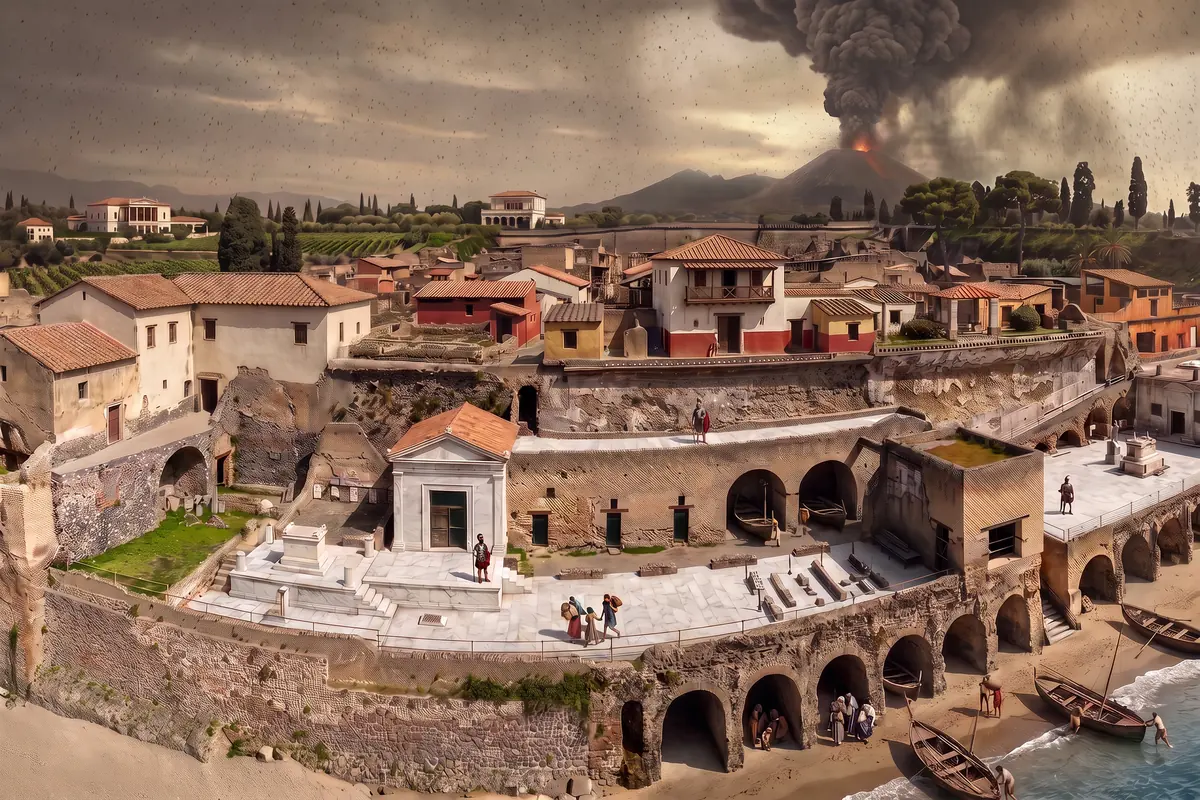
AI vision: Herculaneum on the afternoon of the eruption of AD 79, the town with tiled roofs above the beach with boats, people with bundles, the pine-shaped ash column above Vesuvius in yellow-brown light
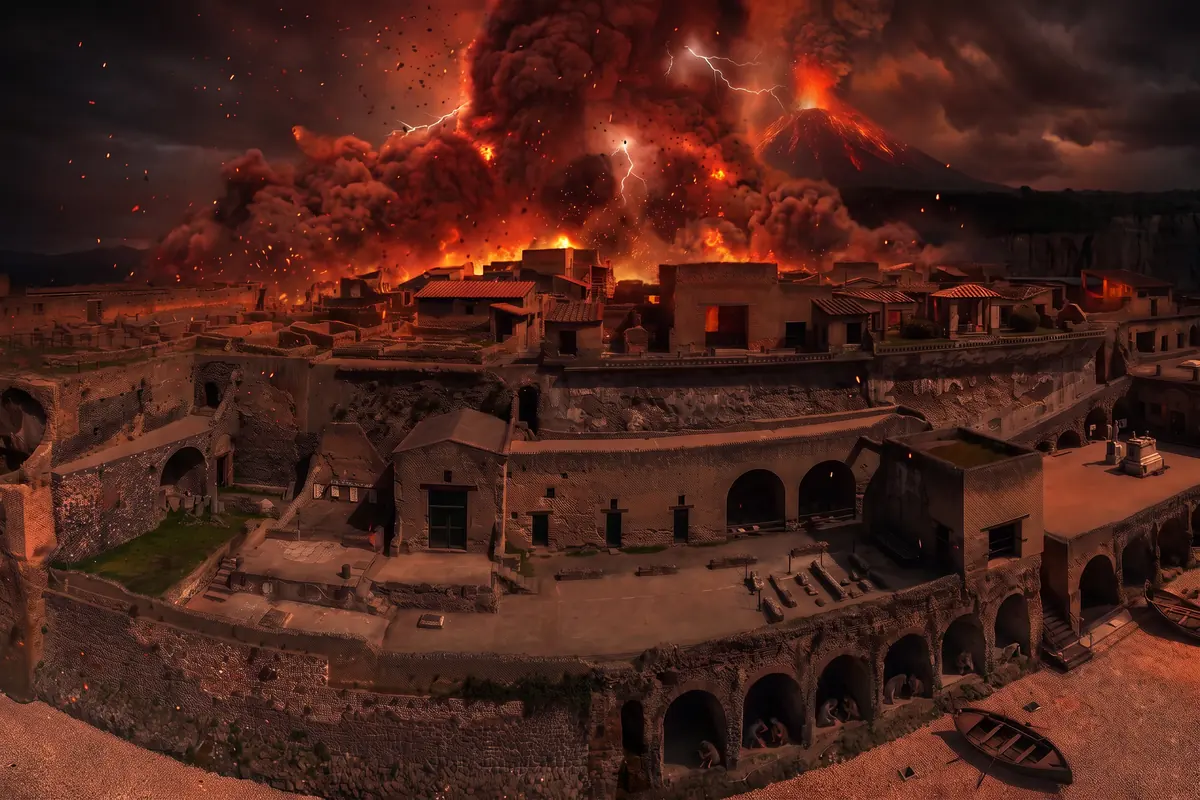
AI vision: Herculaneum in the night of the eruption, a glowing wall of ash rolling down from Vesuvius over the town, lightning in the cloud, the sea black with red reflections, overturned boats, people in the vaults
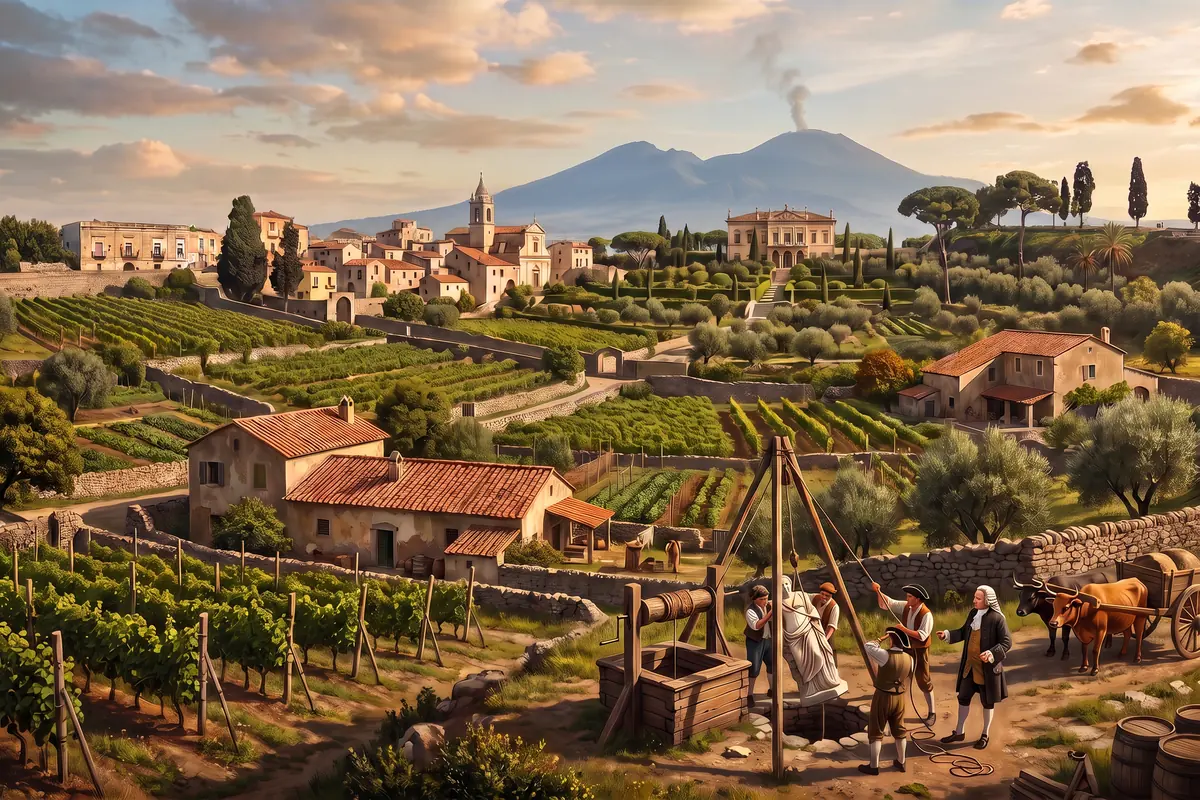
AI vision: the site of the excavation around 1740, vineyards, gardens and farmhouses above the buried town, the village of Resina with a church tower, a well shaft with a winch, workmen hauling out a marble statue
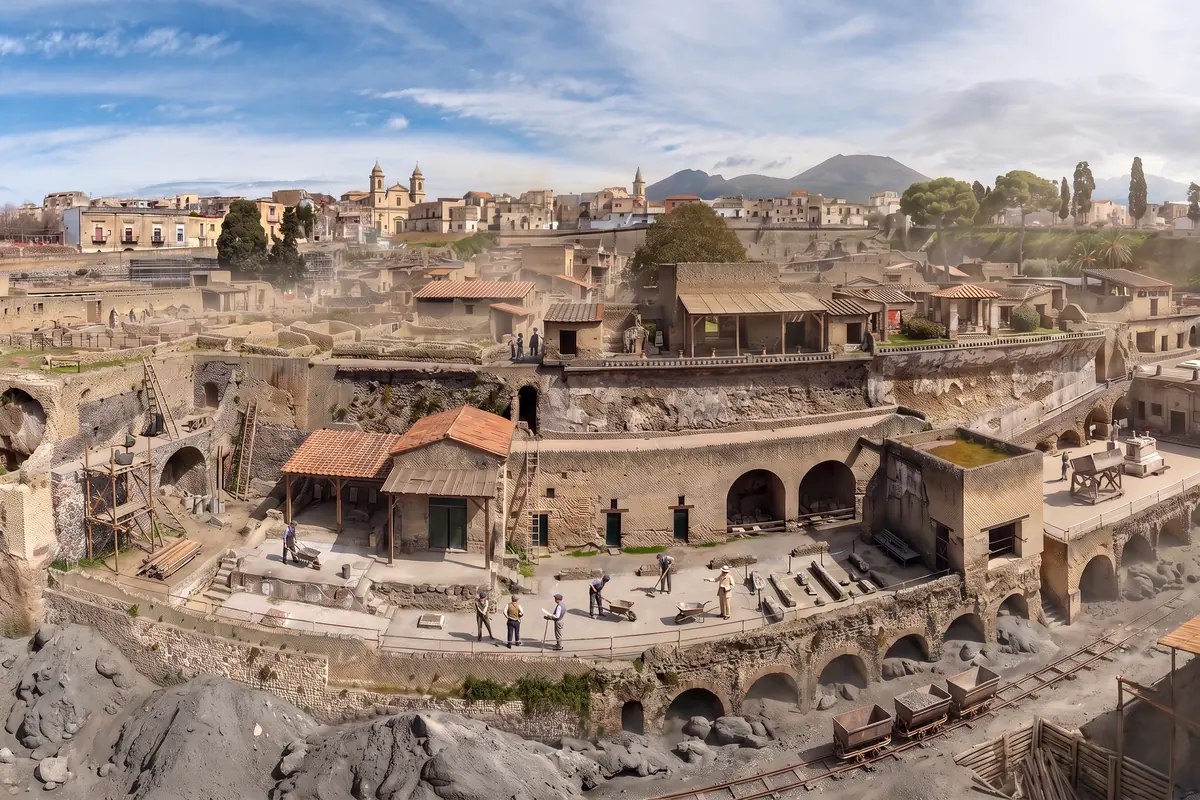
AI vision: the excavation of Herculaneum around 1935, the vaults still half buried in grey volcanic rock, the upper houses with new shelter roofs, narrow-gauge rails and tipping wagons, scaffolding, workmen with wheelbarrows, Amedeo Maiuri in a light suit
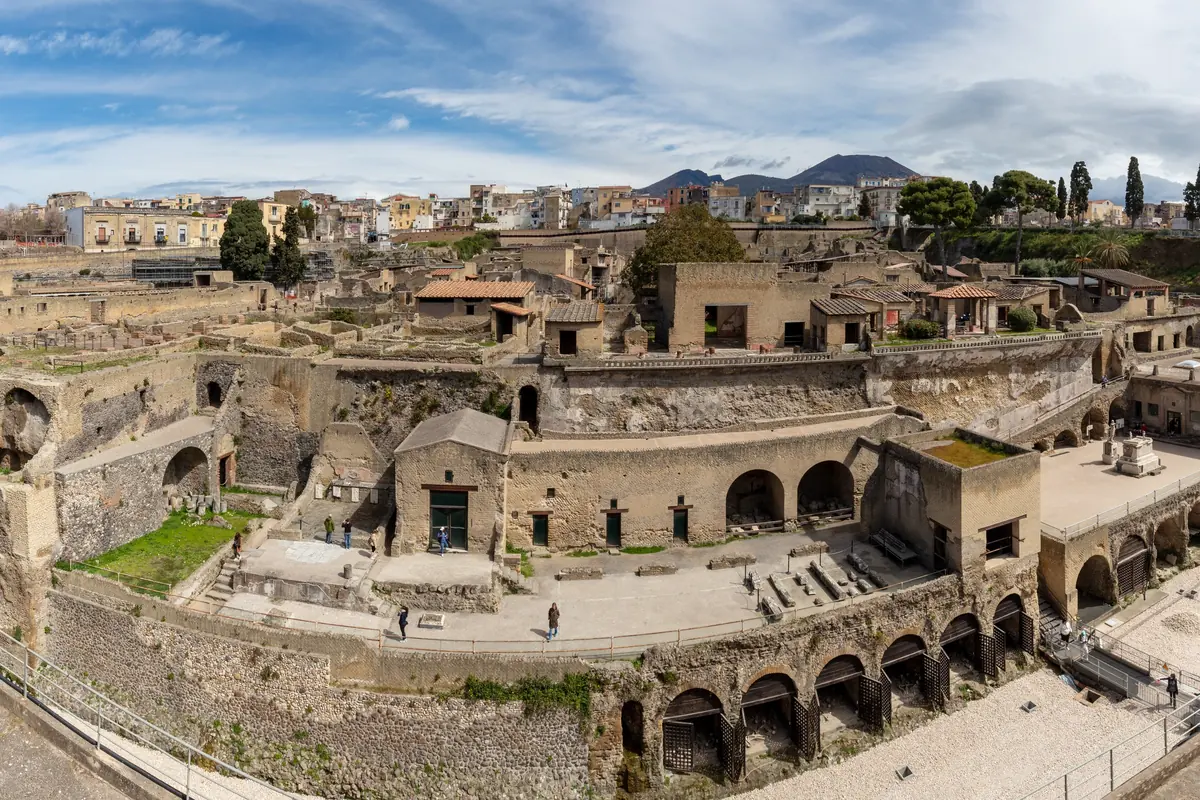
The excavations of Herculaneum today from the access ramp: the row of boat house arches, the terrace of Balbus, the houses of the town, above them Ercolano and Vesuvius (photo)
Documented Beach with boats in front of the vaults: the sea reached here, a boat was found in 1982Documented Terrace of Balbus with altar: survivingDocumented Ash column above Vesuvius: Pliny’s pine tree, visible on the first dayAssumed Colours and roofs of the houses: plaster and tiles documented, distribution guessedInvented Fleeing people, bundles, the soldier on the terrace
Documented Surge from Vesuvius: pyroclastic flows, temperature 250 to 500 degrees depending on the studyDocumented People in the vaults: about 300 skeletons, found from 1980Documented Overturned boat on the beach: found on 3 August 1982Assumed Lightning in the cloud: Pliny describes it for the night at MisenumInvented Colour of the glow, reflection in the sea
Documented Town under twenty metres: nothing visible, tunnel excavation 1738 to 1765Documented Well shaft and winch: the well of 1709 struck the theatre, shafts documentedAssumed Vineyards, gardens, Resina with church tower: location documented, appearance assumedInvented Statue on the rope, workmen, the gentleman in a wig
Documented Upper houses uncovered and secured with shelter roofs: Maiuri’s method from 1927Documented Vaults still in the rock: the skeletons were found only from 1980Assumed Narrow-gauge railway and wagons: usual on Maiuri’s excavations, not attested hereInvented Scaffolding, workmen, the man in the light suit
Documented Boat houses: about 300 skeletons found from 1980 to 1982, beach walkable since 19 June 2024Documented Terrace of Balbus with altar and statue base: survivingDocumented Ercolano above the town: the forum, basilica and theatre lie beneath

AI vision · artistic licence

The night of the boat houses: one view, 1,950 years

You stand in a single spot, on the ramp above Herculaneum, looking across the boat houses and the town to Vesuvius. Time runs, you don’t. Scroll from the afternoon of the eruption in AD 79 through the surge of the night, the vineyards above the buried town and the excavation of the 1930s to the view that awaits you today.

I’m Ada Falk. I have spent my life digging through dirt in search of other lives. In the vaults down there three hundred people waited for boats. I’ll show you what happened that night. I’ll guide you.

Ada is an invented narrator. The history is real: every fact and quotation is sourced, and the sources are listed at the end. The images are AI visions, not scientific reconstructions. The button “What is the evidence?” shows what is documented.

AI vision: Herculaneum on the afternoon of the eruption of AD 79, the town with tiled roofs above the beach with boats, people with bundles, the pine-shaped ash column above Vesuvius in yellow-brown light

Diary 1 / 5 · summer or autumn 79 · early afternoon

Herculaneum on the afternoon of the eruption of 79: The town sees the cloud

Stand here, on the slope above the town, and look north-west. What you see below is not an excavation but a living town: red tiled roofs, balconies, the terrace with the altar of Balbus, and in front of it the sea, reaching up to the vaults where the boats are kept. Above the mountain, since midday, stands a cloud that Pliny compares to a pine tree. The wind carries the pumice towards Pompeii; here only fine ash falls, and the light turns yellow.

People go down to the beach. Those with a boat push it into the water; the others wait in the vaults for rescue from the sea, with bundles, jewellery, a doctor with his instruments. From Misenum Pliny the Elder sends out the fleet to fetch Rectina, whose villa lies at the foot of the mountain. He does not get through. The people on the beach, the boats, the yellow light: imagined from the finds and Pliny’s letter, invented in detail.

The nephew, to Tacitus

„He was now so close to the mountain that the cinders, which grew thicker and hotter the nearer he approached, fell into the ships, together with pumice-stones, and black pieces of burning rock.“

Pliny the Younger, Letters VI 16, to Tacitus on the death of his uncle in the eruption of Vesuvius. Melmoth translation, abridged.

Image: AI vision based on a photo by Diego Delso (CC BY-SA 4.0), not a scientific reconstruction.

AI vision: Herculaneum in the night of the eruption, a glowing wall of ash rolling down from Vesuvius over the town, lightning in the cloud, the sea black with red reflections, overturned boats, people in the vaults

Diary 2 / 5 · the same night · around one o’clock

The surge over Herculaneum in the night: The night of the boat houses

Twelve hours after the first cloud the column above the mountain collapses. What now comes down the slope is not ash falling but a wall rolling: according to the park around 400 degrees hot and faster than 80 kilometres an hour. It reaches this town first, Pompeii only hours later. The people in the vaults have no time left; researchers argue whether they died in seconds or in minutes, not whether they had a chance.

Then come further flows and mud, layer upon layer, until the town lies under twenty metres and the beach is four hundred metres from the sea. The heat carbonises wood, bread and papyrus instead of burning them. That is why you see doors and beds today. The colour of the glow, the lightning, the boats: imagined from Pliny and the deposits, not seen.

The park, today

„Herculaneum was first hit by fiery clouds with a temperature of around 400 °C, travelling at speeds of over 80 km per hour, and then by mudslides that buried the city under a blanket of around 20 m of volcanic material.“

Parco Archeologico di Ercolano: The Eruption.

Image: AI vision based on a photo by Diego Delso (CC BY-SA 4.0), not a scientific reconstruction.

AI vision: the site of the excavation around 1740, vineyards, gardens and farmhouses above the buried town, the village of Resina with a church tower, a well shaft with a winch, workmen hauling out a marble statue

Diary 3 / 5 · around 1740 · an afternoon

Resina above the buried town around 1740: Vineyards above the town

Sixteen centuries later there is nothing to see. The pit you look into today is full: twenty metres of hardened volcanic mud, and on top vineyards, figs, gardens and the village of Resina that will one day become Ercolano. In 1709 a well shaft dug for the Prince d’Elbeuf struck marble and statues, the theatre. Since 1738 King Charles of Bourbon has been digging, with tunnels as in a mine: Alcubierre directs, statues, bronzes and wall paintings go to the collection at Portici.

In 1750 the tunnels reach the Villa of the Papyri; in 1754 Karl Weber draws its plan and finds the carbonised scrolls, taken at first for charcoal. In 1765 the tunnels are abandoned. The landscape in the picture follows what is known of Resina; the well shaft with the winch and the men with the statue are my invention, but it must have looked much like this.

UNESCO, today

„In the case of Herculaneum large areas of the ancient town still lie under the modern town and have only been explored and surveyed by the network of 18th-century tunnels that drew the attention of Grand Tour visitors.“

UNESCO World Heritage List, Archaeological Areas of Pompei, Herculaneum and Torre Annunziata: statement of Outstanding Universal Value.

Image: AI vision based on a photo by Diego Delso (CC BY-SA 4.0), not a scientific reconstruction.

AI vision: the excavation of Herculaneum around 1935, the vaults still half buried in grey volcanic rock, the upper houses with new shelter roofs, narrow-gauge rails and tipping wagons, scaffolding, workmen with wheelbarrows, Amedeo Maiuri in a light suit

Diary 4 / 5 · around 1935

Maiuri’s excavation around 1935: The rock becomes a town

After the Bourbons, open-air excavation begins for the first time in 1828, lasting until 1875, then everything rests for half a century. In 1927 Amedeo Maiuri, director of the excavations at Pompeii, resumes the work and leads it until 1958. He has the rock removed with compressed air and wagons, secures wood with paraffin, reassembles upper floors and puts up shelter roofs so the wall paintings do not fade. Four and a half hectares he brings to light, the whole seafront.

The vaults below are still half in the rock around 1935; nobody suspects that three hundred people lie inside, and Herculaneum is thought to be a town everyone escaped from. Only in 1980 do workmen digging a drainage ditch hit the first skeletons. The rails and wagons are likely for Maiuri’s excavation; the scaffolding and the people in detail are invented.

The park, today

„Work resumed in 1927 under the archaeologist Amedeo Maiuri, who led the project until 1958, bringing to light a large part of the city’s waterfront and a small section of the Villa dei Papiri.“

Parco Archeologico di Ercolano: The Story.

Image: AI vision based on a photo by Diego Delso (CC BY-SA 4.0), not a scientific reconstruction.

The excavations of Herculaneum today from the access ramp: the row of boat house arches, the terrace of Balbus, the houses of the town, above them Ercolano and Vesuvius (photo)

Diary 5 / 5 · Today

Herculaneum today: And now you

This is real. Exactly this view awaits you when you walk down the ramp from the entrance on Corso Resina: below, the twelve vaults where the people were found, accessible again from the beach since June 2024; above them the terrace of Balbus; behind it the town with its upper floors; and on top the apartment blocks of Ercolano on twenty metres of volcanic rock, beneath which lie the forum and the theatre.

The sea is four hundred metres away. The vaults stand four metres below the water table, and the pumps run day and night. Since 2001 the Herculaneum Conservation Project has worked to keep the town from being lost a second time. Stand on the ramp, half close your eyes, and the cloud stands above the mountain.

UNESCO, today

„Pompeii was buried largely by a thick layer of volcanic ash and lapilli and Herculaneum disappeared under pyroclastic surges and flows.“

UNESCO World Heritage List, Archaeological Areas of Pompei, Herculaneum and Torre Annunziata, inscribed 1997.

Real photo: Diego Delso, CC BY-SA 4.0, via Wikimedia Commons.

Your expedition

Visit the boat houses of Herculaneum: Stand exactly here

“The rest you have to see for yourself. And when you stand down on the beach in front of the vaults, look up at the edge. That is not where the sea was. That is where the cloud was.” Ada Falk

  1. From the entrance onto the ramp. Behind the ticket office on Corso Resina the ramp begins along the edge of the pit. After about a hundred metres the view opens over the boat houses, the terrace and the town to Vesuvius: that is the view of this time journey.
  2. Down to the beach. At the end of the ramp go through the tunnel down to the level of AD 79, in front of the twelve vaults with the replicas of the skeletons; next to them the Antiquarium and the Boat Pavilion with the boat of 1982.
  3. Then inside. Across the bridge into the town, the houses with upper floors on Cardo IV and V, and last the palaestra.
  • At 8.30 am: The ramp is empty at opening time; from 10 am the groups from Naples and the ships arrive.
  • Beach open? The ancient beach may close for a few hours during works; ask at the ticket office. The Villa of the Papyri and the theatre open only for special tours.
  • Check first: Prices, opening hours and how to get there are in our guide to Herculaneum tickets and admission; all highlights are on our map.

At a glance

Herculaneum in facts

Destroyed
AD 79, in the night after the eruption, by surges of around 400 degrees
Buried
under about 20 metres of hardened volcanic material; the sea today 400 metres away
Boat houses
twelve vaults on the beach, about 300 skeletons, found 1980 to 1982; boat of 3 August 1982
Rediscovery
1709 well of the Prince d’Elbeuf; tunnels 1738 to 1765; Villa of the Papyri 1750
Excavation
1828 to 1875 and 1927 to 1958 (Maiuri), about 4.5 hectares
Today
World Heritage since 1997, Herculaneum Conservation Project since 2001, beach walkable since 2024

Frequently asked questions about Herculaneum and the boat houses

How did the people of Herculaneum die?

From the surges that swept over the town in the night after the eruption: according to the park around 400 degrees hot. About 300 people were found in the vaults on the beach, where they were waiting for rescue from the sea. Whether they died within seconds, as a study of 2001 assumed, or were heated more slowly, as a re-evaluation of 2020 suggests, remains open.

Why is Herculaneum better preserved than Pompeii?

Because it was buried not by falling pumice but by pyroclastic flows that enveloped everything and set into hard rock. Wood, cloth, bread and papyrus were carbonised without oxygen instead of burning. That is why upper floors, doors and beds still stand here, and why the library of the Villa of the Papyri survived.

How deep does Herculaneum lie beneath the modern town?

About twenty metres. Most of the ancient town, including the forum, the basilica and the theatre, still lies under Ercolano and is known only through the 18th-century tunnels. About four and a half hectares by the former sea are excavated.

Who discovered Herculaneum?

In 1709 a well shaft dug for the Prince d’Elbeuf in the village of Resina struck the ancient theatre. From 1738 King Charles of Bourbon had tunnels dug; in 1750 the Villa of the Papyri was found, and Karl Weber drew its plan in 1754. Open-air excavation began only in 1828, systematically from 1927 under Amedeo Maiuri.

Can you visit the boat houses?

Yes. The ancient beach with the twelve vaults has been walkable again since June 2024; you descend through a tunnel to the level of AD 79. The vaults hold replicas of the skeletons where they were found; the real bones are in storage. The belongings of the dead are shown in the Antiquarium at the entrance to the beach.

What was found in the Villa of the Papyri?

More than 1,800 carbonised papyrus scrolls, the only surviving library of antiquity, plus dozens of bronze and marble statues now in the National Archaeological Museum in Naples. The scrolls have been read in CT scanners since 2023; in 2026 the first was fully deciphered. The villa itself is currently closed.

What did Herculaneum look like?

A small town by the sea: tiled roofs, plastered facades in white, red and ochre, balconies, a beach with boats, villas with sea views above. The images on this page are AI visions meant to convey a feeling; colours and scenes are interpretation, and the buildings follow the evidence only in broad strokes.

When is the best time for this view?

At 8.30 am when the park opens and the ramp is empty, or in summer in the late afternoon. The view over the boat houses is the first you get from the entrance. Prices, opening hours and how to get there are in our guide to Herculaneum tickets and admission.

About these images

The images of stages 1 to 4 are AI visions generated with Nano Banana Pro (Google Gemini) via fal.ai; the starting point was a photograph of the excavations taken from the ramp (Diego Delso, CC BY-SA 4.0, cropped). As adaptations of that photo the visions are published under the same licence. They are meant to convey a feeling and are not scientific reconstructions: people, clothing, colours and scenes are invented, and the buildings follow the evidence only in broad strokes. The image files are labelled as AI-generated (IPTC). The last image is the unaltered photograph.

Sources and status

Text: Daniela Pieper, Back in Time Travel editorial team. Updated 25 September 2026. Specialist review is still pending. Translations are our own, abridged.

  1. Parco Archeologico di Ercolano: The Eruption
  2. Parco Archeologico di Ercolano: The Story
  3. Parco Archeologico di Ercolano: Villa of the Papyri
  4. Parco Archeologico di Ercolano: Antiquarium and Boat Pavilion
  5. UNESCO World Heritage: Archaeological Areas of Pompei, Herculaneum and Torre Annunziata
  6. Pliny the Younger: Letters VI 16 and VI 20 (Melmoth translation, Project Gutenberg)
  7. Mastrolorenzo et al.: Herculaneum victims of Vesuvius in AD 79, Nature 410 (2001)
  8. Martyn et al.: A re-evaluation of manner of death at Roman Herculaneum, Antiquity 94 (2020)
  9. Archaeology News: reopening of the ancient beach, June 2024
  10. Herculaneum Conservation Project
  11. Parco Archeologico di Ercolano: tickets and opening hours
  12. A. Wallace-Hadrill: Herculaneum. Past and Future. London 2011.
  13. S. C. Bisel: The Human Skeletons of Herculaneum. In: International Journal of Anthropology 6 (1991).
  14. C. C. Parslow: Rediscovering Antiquity. Karl Weber and the Excavation of Herculaneum, Pompeii, and Stabiae. Cambridge 1995.
  15. A. Maiuri: Ercolano. I nuovi scavi (1927–1958). Rome 1958.
Image credits

Excavations today and source image of the AI visions: Diego Delso, Wikimedia Commons, CC BY-SA 4.0. Cropped, resized.

AI visions: Back in Time Travel, generated with Nano Banana Pro via fal.ai, adaptations of the photo by Diego Delso, CC BY-SA 4.0. Not a scientific reconstruction.

Barlow Condensed / Manrope · SIL Open Font License. Barlow OFL · Manrope OFL