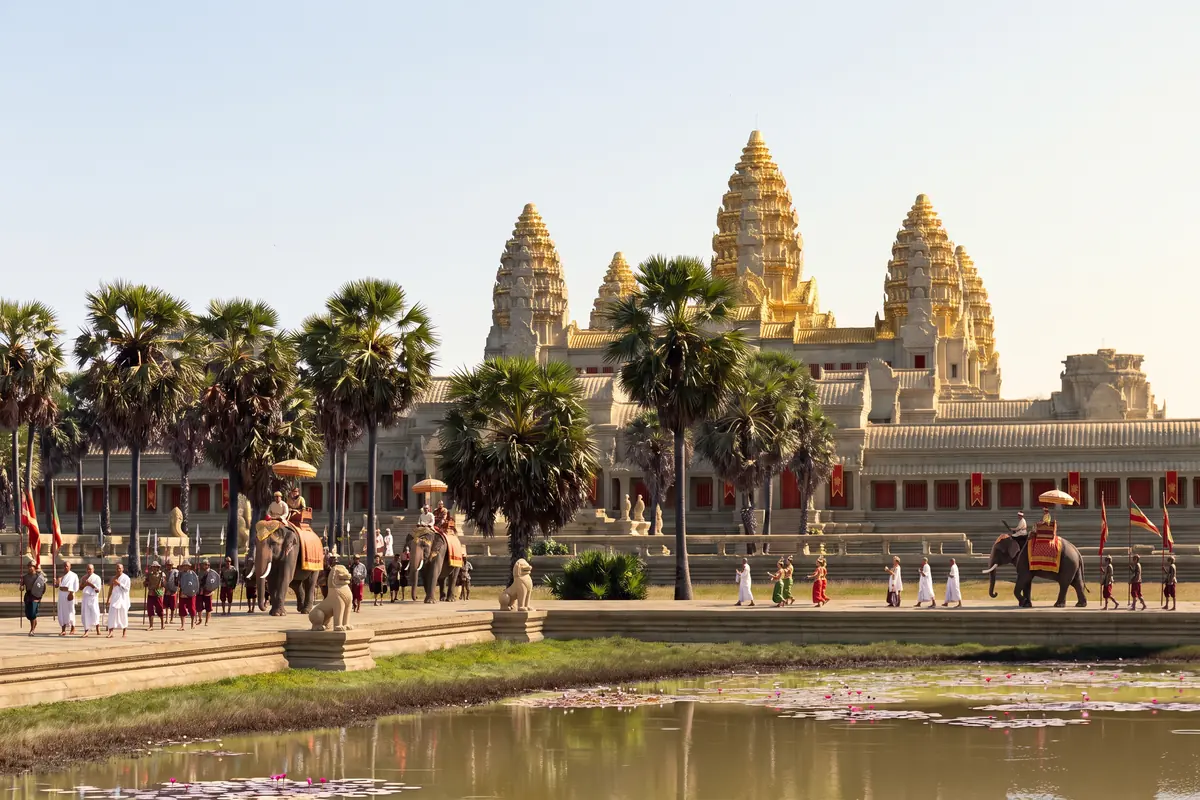
AI vision: Angkor Wat around 1150, freshly cut pale sandstone, gilded tower tips, red banners on the western gallery, a procession with elephants, soldiers and priests on the terrace, a clear pond with lotus
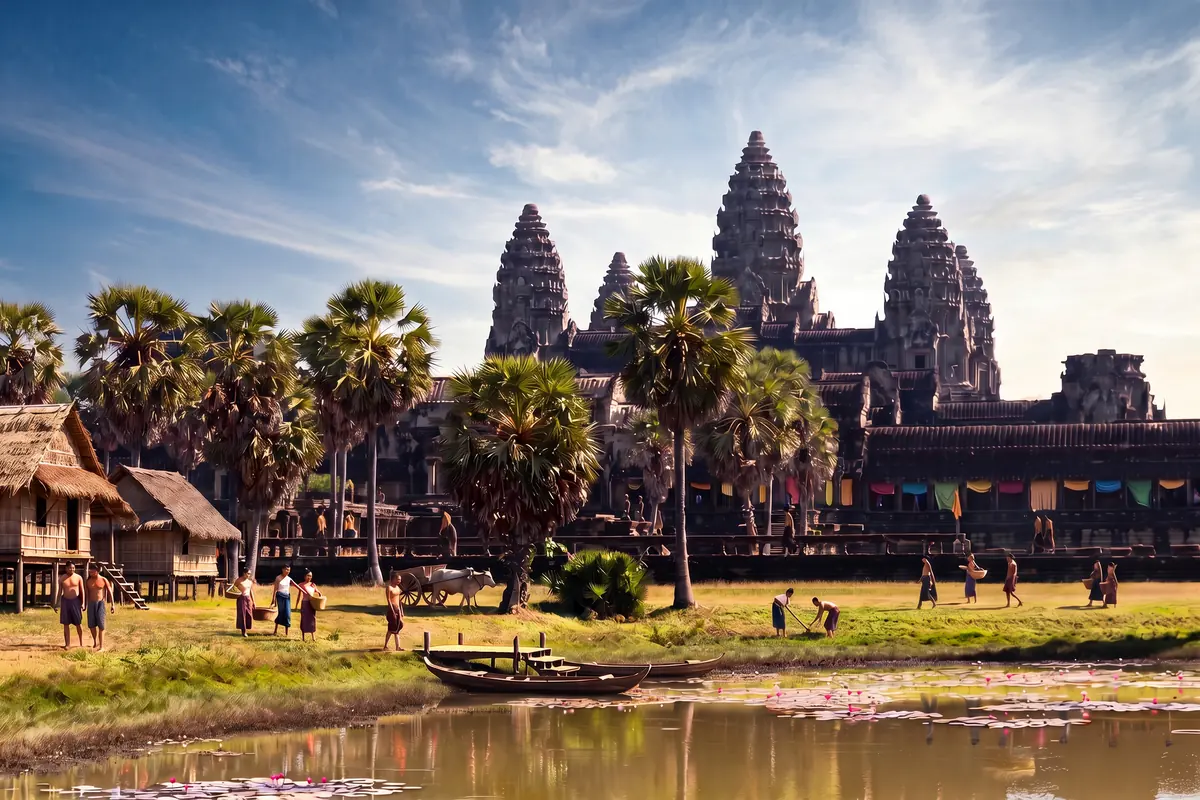
AI vision: Angkor Wat in 1296, cloth awnings in the gallery openings, stilt houses with thatched roofs beside the palms, boats on the pond, market people in sampot, a Chinese delegation in silk under a canopy
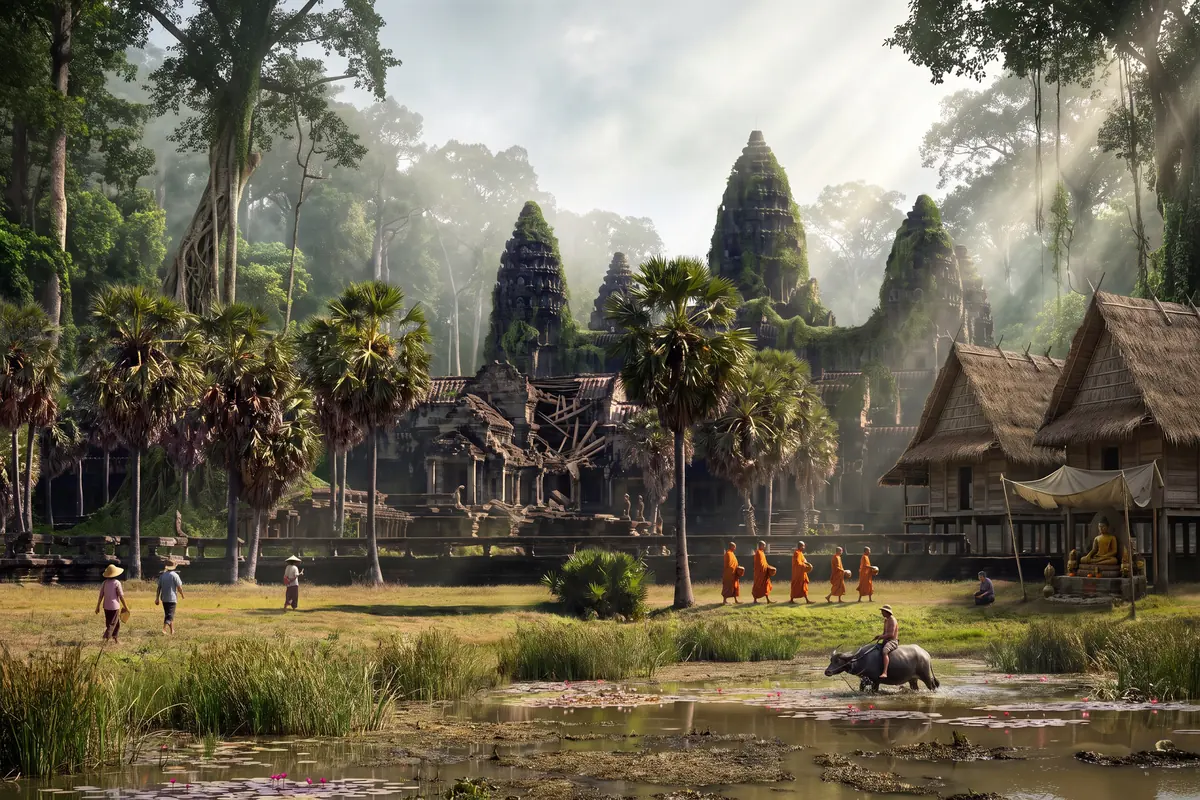
AI vision: Angkor Wat around 1600 as a Buddhist monastery, tall trees and strangler figs by the galleries, mossy sandstone, a collapsed gallery roof, a silted pond, wooden halls and a Buddha shrine, monks in orange, a man on a water buffalo
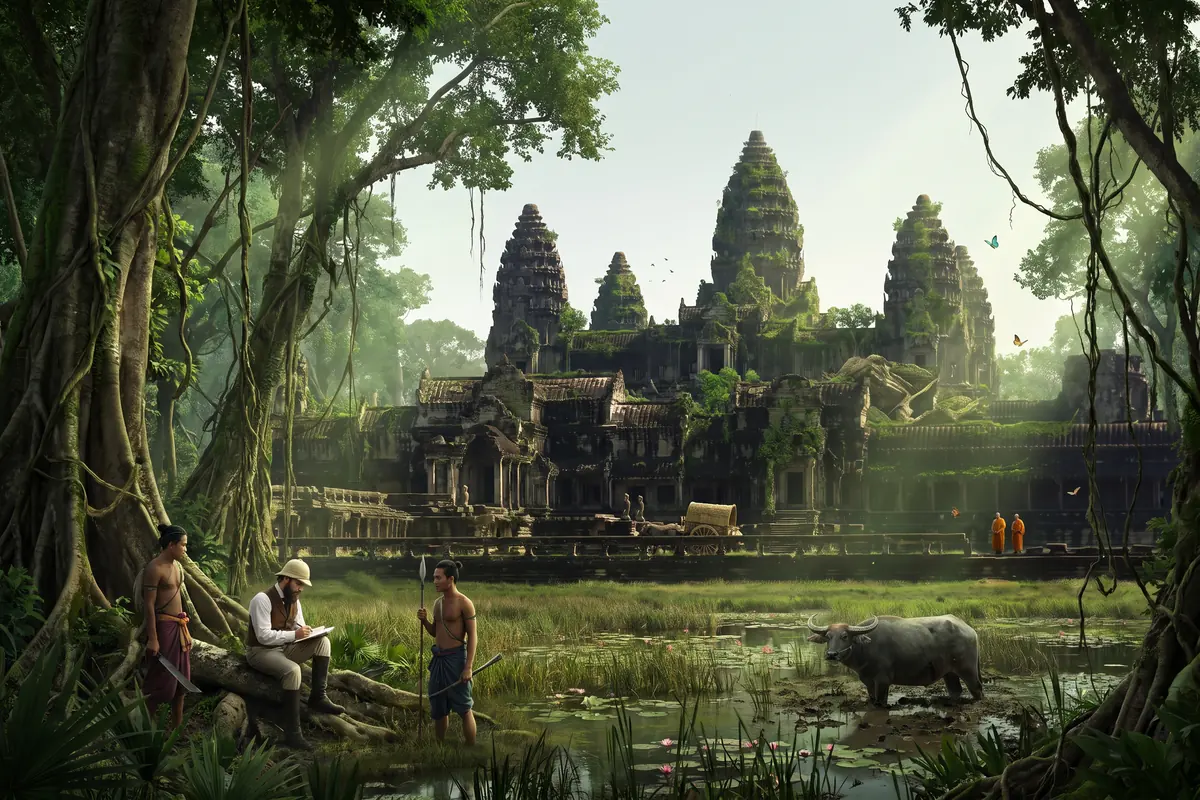
AI vision: Angkor Wat in January 1860, dense jungle with buttress roots and lianas, dark mossy towers, collapsed roofs with trees, a swamp with a water buffalo, Henri Mouhot with a sketchbook on a stone, Khmer guides, an ox cart, two monks
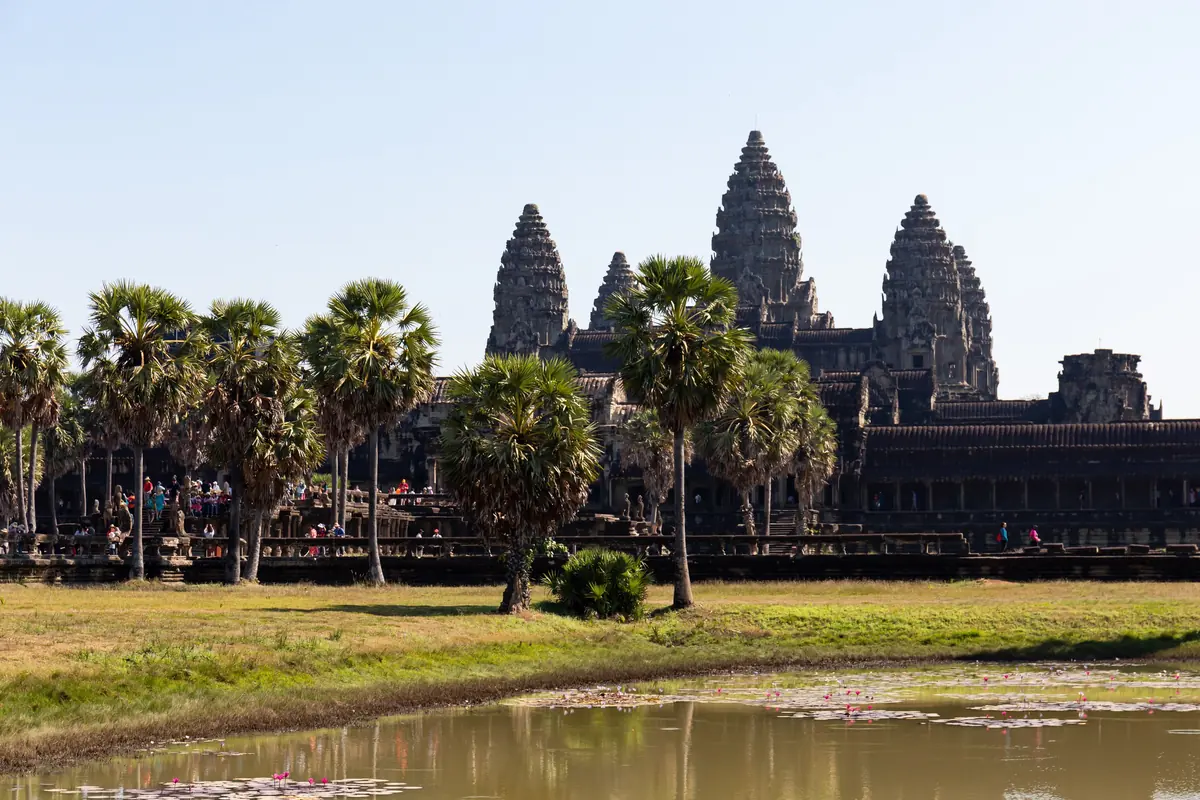
Angkor Wat today, seen from the west across the northern pond with water lilies, sugar palms in front of the western gallery, the five towers in morning light (photo)
Documented Five towers, western gallery, pond: built under Suryavarman II, 1113 to c. 1150Documented Terrace with lions and naga balustrades: survivingAssumed Gilded tower tips: remains of gilded stucco documented, extent assumedAssumed Royal procession with elephants: after the gallery reliefsInvented Banners, dancers, the feast day
Documented Temple in use, towers intact: Zhou Daguan 1296/97Documented Terrace and stairs: survivingAssumed Stilt houses with thatched roofs: after Zhou’s description, location guessedAssumed Boats and landing stage on the pond: plausible, not documentedInvented The delegation, the canopy, the faces
Documented Monastery with Buddha shrine: Theravada use since the 13th century, monastery to this dayDocumented Towers intact, stone mossy: use without a long gap (excavations of 2019)Assumed Wooden halls at this spot: assumedAssumed Collapsed gallery roof and trees on the gallery: extent around 1600 unknownInvented Monks, pilgrims, water buffalo in detail
Documented Mouhot with sketchbook: visit in January 1860, journals printed 1863/64Documented Towers and galleries standing: never collapsed, cared for since 1908 (EFEO)Documented Monks at the temple: the monastery existed, Mouhot describes itAssumed Density of the jungle: after Mouhot’s description, no surveyInvented Guides, ox cart, water buffalo in detail
Documented Five towers, 65 metres high: 12th-century fabric, cared for since 1908Documented Sugar palms and pond: the sunrise spot; the pond is partly dry in the dry seasonDocumented Water lilies: the pond is a remnant of the old water landscape of Angkor

AI vision · artistic licence

The rediscovery of Angkor Wat: one view, 900 years

You stand in a single spot, on the bank of the northern pond, looking across the palms at the five towers of Angkor Wat. Time runs, you don’t. Scroll from the completed temple around 1150 through the guest from China, the monastery in the forest and the naturalist of 1860 to the view that awaits you today.

I’m Ada Falk. I have spent my life digging through dirt in search of other lives. Nobody discovered this temple; it was never gone. I’ll show you everyone who found it anyway. I’ll guide you.

Ada is an invented narrator. The history is real: every fact and quotation is sourced, and the sources are listed at the end. The images are AI visions, not scientific reconstructions. The button “What is the evidence?” shows what is documented.

AI vision: Angkor Wat around 1150, freshly cut pale sandstone, gilded tower tips, red banners on the western gallery, a procession with elephants, soldiers and priests on the terrace, a clear pond with lotus

Diary 1 / 5 · around 1150 AD · a feast day

Angkor Wat at its height around 1150: The temple is finished

Stand here, on the bank of the northern pond, and look east. The temple in front of you has just been completed. Suryavarman II, on the throne since 1113, had it built in about thirty years as a state temple for Vishnu, and as his mausoleum; unlike every other temple at Angkor it faces west, towards where you stand. The sandstone is pale and sharp, nothing is black, nothing mossy.

The golden tips: assumed, not proven. Remains of gilded stucco were found on the towers; how much gold lay on top, nobody knows. The elephant procession is borrowed from the reliefs of the gallery, where the king rides his elephant under fifteen parasols. The banners, the dancers, the day: invented. That processions passed here: not.

UNESCO, today

„Angkor is one of the most important archaeological sites in South-East Asia. Stretching over some 400 km2, including forested area, Angkor Archaeological Park contains the magnificent remains of the different capitals of the Khmer Empire, from the 9th to the 15th century.“

UNESCO World Heritage List, Angkor, inscribed 1992: brief description.

Image: AI vision based on a photo by Balon Greyjoy (CC0 1.0), not a scientific reconstruction.

AI vision: Angkor Wat in 1296, cloth awnings in the gallery openings, stilt houses with thatched roofs beside the palms, boats on the pond, market people in sampot, a Chinese delegation in silk under a canopy

Diary 2 / 5 · 1296 · a market day

Zhou Daguan at Angkor in 1296: A guest from China takes notes

In 1296 Zhou Daguan arrives at Angkor with an embassy of the Mongol emperor and stays almost a year. His report is the only detailed eyewitness source for the living city: palaces, festivals, markets, clothing, women with topknots, men with nothing but a cloth around the hips. The temple in front of you he calls the tomb of Lu Ban and credits it with several hundred stone chambers. He probably never went inside.

The temple is in use, but time is running: Angkor Wat becomes Buddhist towards the end of the 12th century, and Zhou already describes the monks in yellow. The stilt houses are built from his description of the city; whether they stood exactly here, nobody knows. The delegation under the canopy is invented; that an official from Wenzhou stood here with a brush: not.

The envoy

„The tomb of Lu Ban is about a li outside the south gate; it is about ten li in circumference and has several hundred stone chambers.“

Zhou Daguan, A Record of Cambodia’s Land and Customs, c. 1297, on Angkor Wat. After the translation by Paul Pelliot (1902), abridged.

Image: AI vision based on a photo by Balon Greyjoy (CC0 1.0), not a scientific reconstruction.

AI vision: Angkor Wat around 1600 as a Buddhist monastery, tall trees and strangler figs by the galleries, mossy sandstone, a collapsed gallery roof, a silted pond, wooden halls and a Buddha shrine, monks in orange, a man on a water buffalo

Diary 3 / 5 · around 1600 · a morning

Angkor Wat as a monastery around 1600: The forest comes, the monks stay

The capital has moved on; since the attacks of Ayutthaya around 1431 the kings rule in the south. But Angkor Wat is not abandoned: excavations show no long gap, the temple becomes a Theravada monastery and draws pilgrims from all over South-East Asia. In 1586 the Portuguese friar António da Madalena stands here, between 1612 and 1632 Japanese visitors leave ink inscriptions, and one of them draws the oldest known plan of the temple.

The forest eats at the edges. How far it really reached around 1600, whether the gallery roof had already collapsed, whether the wooden halls stood here: assumed. The monks in orange are invented, the monastery is not; it exists to this day, just behind the pond.

The chronicler, after a friar’s account

„It is of such extraordinary construction that it is not possible to describe it with a pen, particularly since it is like no other building in the world. It has towers and decoration and all the refinements which the human genius can conceive of.“

Diogo do Couto, Década, after the account of the Capuchin friar António da Madalena on Angkor Wat, 1586. English rendering as commonly quoted.

Image: AI vision based on a photo by Balon Greyjoy (CC0 1.0), not a scientific reconstruction.

AI vision: Angkor Wat in January 1860, dense jungle with buttress roots and lianas, dark mossy towers, collapsed roofs with trees, a swamp with a water buffalo, Henri Mouhot with a sketchbook on a stone, Khmer guides, an ox cart, two monks

Diary 4 / 5 · January 1860

Henri Mouhot at Angkor in 1860: Grander than Greece and Rome

In January 1860 the French naturalist Henri Mouhot sits here, with sketchbook and butterfly net, and writes the sentence that will make Angkor famous in Europe: grander than anything left to us by Greece or Rome. He did not discover the temple; the monks next door have known for centuries where it stands, and a Portuguese friar described it in 1586. But Mouhot dies of fever in Laos in 1861, and his journals appear in 1863 and 1864, with engravings the world wants to read.

In 1907 Siam returns the province, in 1908 the École française d’Extrême-Orient sets up the Conservation d’Angkor and begins taking the forest off the stones. The jungle in the picture follows Mouhot’s description, not a survey; the water buffalo and the ox cart are invented, the monks in orange are not, they really stood beside him.

The naturalist

„One of these temples, a rival to that of Solomon, and erected by some ancient Michael Angelo, might take an honourable place beside our most beautiful buildings. It is grander than anything left to us by Greece or Rome.“

Henri Mouhot, Travels in the Central Parts of Indo-China, vol. I, London 1864, chapter XII, on Angkor Wat. Abridged.

Image: AI vision based on a photo by Balon Greyjoy (CC0 1.0), not a scientific reconstruction.

Angkor Wat today, seen from the west across the northern pond with water lilies, sugar palms in front of the western gallery, the five towers in morning light (photo)

Diary 5 / 5 · Today

Angkor Wat today: And now you

This is real. Exactly this view awaits you when you turn left from the western causeway to the northern pond: the five towers above the gallery, the palms in front, the water lilies in the water and, when the wind drops, the temple once more. In the morning the crowds stand here for sunrise; in the afternoon the bank is almost yours.

Angkor has been a World Heritage Site since 1992, the APSARA Authority has managed the park since 1995, and since 2012 airborne laser scanning has shown how large the city around the temple really was. The monastery behind the pond never closed. Stand here at dusk, half close your eyes, and the tips gleam.

The APSARA Authority, today

„Angkor Wat is the only temple in the park that has remained in continuous religious use since its foundation.“

Angkor Enterprise / APSARA National Authority, note on Angkor Wat (Explore Angkor Wat), 2026. Paraphrased.

Real photo: Balon Greyjoy, CC0 1.0, via Wikimedia Commons.

Your expedition

Visit Angkor Wat: Stand exactly here

“The rest you have to see for yourself. And when you stand by the pond, wait until the wind drops. Then the temple has ten towers, and the lower five are nine hundred years old like the upper ones.” Ada Falk

  1. Across the western causeway. From the entrance over the floating bridge and the causeway through the west gate, then the path between the libraries to the two ponds.
  2. To the northern pond. Keep left. On the north bank, where the crowds stand in the morning, you look across the palms at the five towers: that is the view of this time journey.
  3. Then inside. Over the cruciform terrace into the gallery of reliefs, clockwise, and, if you like, up the steep stairs to the Bakan.
  • In the afternoon: Sunrise is famous and crowded. In the late afternoon the sun is behind you, the towers glow, and the bank is yours.
  • Dress: Shoulders and knees covered, or no entry; no children under 12 on the Bakan.
  • Check first: Angkor Pass, hours and how to get there are in our guide to Angkor Wat tickets and the Angkor Pass; all temples are on our map.

At a glance

Angkor Wat in facts

Built
1113 to c. 1150 under Suryavarman II, about thirty years
Dimensions
moat 190 metres wide, enclosure about 1.5 by 1.3 kilometres, central tower 65 metres
Orientation
west, the only temple at Angkor to face that way; Vishnu temple and mausoleum
Visitors
Zhou Daguan 1296/97, António da Madalena 1586, Japanese pilgrims 1612 to 1632, Henri Mouhot 1860
Buddhist
since the late 12th century, a Theravada monastery to this day
Protection
Conservation d’Angkor 1908 (EFEO), World Heritage 1992, APSARA 1995

Frequently asked questions about Angkor Wat and its rediscovery

Who discovered Angkor Wat?

Nobody, because it was never lost: the monastery beside the temple existed without a break, and pilgrims came from all over South-East Asia. The Portuguese friar António da Madalena described it in 1586; Japanese pilgrims left inscriptions until 1632. Henri Mouhot made it famous in Europe with his journals of 1860; he did not discover it.

Why does Angkor Wat face west?

All the other temples at Angkor open to the east, towards sunrise. Angkor Wat faces west, the direction of Vishnu and of death. That is why it is taken to be both the state temple and the mausoleum of Suryavarman II, who after his death bore the name Paramavishnuloka. The tomb interpretation is not proven, but it best explains the orientation.

How long did it take to build Angkor Wat?

About thirty years, from the accession of Suryavarman II in 1113 to around 1150, the year of his death. Some reliefs were left unfinished. Roughly five to ten million sandstone blocks were brought from the Kulen hills, a good forty kilometres away, probably by canal.

What did Zhou Daguan write about Angkor Wat?

Little, because he apparently never went inside. He calls it the tomb of Lu Ban, a legendary Chinese master builder, and credits it with several hundred stone chambers. His report of 1296/97 is nonetheless the most important source for the living city: palaces, festivals, markets, clothing, everyday life.

Was Angkor Wat ever abandoned?

Not really. After the capital moved in the 15th century the temple became a Theravada monastery and place of pilgrimage. Excavations in the temple enclosure show no long gap in use; the forest overgrew the edges, not the sanctuary. Angkor Wat is the only temple in the park that was never wholly given up.

Were the towers of Angkor Wat gilded?

Probably in part. Traces of gilded stucco were found on the towers and reliefs, and Zhou Daguan describes golden towers in Angkor Thom. How much gold lay on Angkor Wat, nobody knows; the golden tips on this page are an assumption.

What did Angkor Wat look like in its heyday?

Paler and more colourful than today: freshly cut sandstone without the black lichen, wooden doors and ceilings long since gone, stucco and in places gold, cloth in the galleries. The images on this page are AI visions meant to convey a feeling, not reconstructions.

When is the best time for this view?

The pond is the sunrise spot, packed from 5 am. In the late afternoon the sun is behind you, the towers glow, and the bank is almost empty. Angkor Pass, opening hours and how to get there are in our guide to Angkor Wat tickets and the Angkor Pass.

About these images

The images of stages 1 to 4 are AI visions generated with Nano Banana Pro (Google Gemini) via fal.ai; the starting point was a photograph of the west side taken from the northern pond (Balon Greyjoy, CC0 1.0). They are meant to convey a feeling and are not scientific reconstructions: people, clothing, colours and scenes are invented, and the buildings follow the evidence only in broad strokes. The image files are labelled as AI-generated (IPTC). The last image is the unaltered photograph.

Sources and status

Text: Daniela Pieper, Back in Time Travel editorial team. Updated 25 September 2026. Specialist review is still pending. Translations are our own, abridged.

  1. UNESCO World Heritage: Angkor
  2. APSARA National Authority: Angkor Wat
  3. Angkor Enterprise: Explore Angkor Wat (Suryavarman II, orientation, use)
  4. Zhou Daguan / Paul Pelliot: Mémoire sur les coutumes du Cambodge, BEFEO 2 (1902)
  5. Yoshiaki Ishizawa: The World’s Oldest Plan of Angkor Vat, Udaya 13 (2015)
  6. Carter et al.: Temple occupation and the tempo of collapse at Angkor Wat, PNAS 116 (2019)
  7. Henri Mouhot: Travels in the Central Parts of Indo-China, vol. I (1864), Project Gutenberg
  8. Evans et al.: Uncovering archaeological landscapes at Angkor using lidar, PNAS 110 (2013)
  9. École française d’Extrême-Orient: Centre de Siem Reap
  10. Angkor Enterprise: Angkor Pass
  11. Zhou Daguan: A Record of Cambodia. The Land and Its People. Translated by Peter Harris, Chiang Mai 2007.
  12. Diogo do Couto: Da Ásia, Década. António da Madalena’s account of Angkor (1586); quoted after B. P. Groslier: Angkor et le Cambodge au XVIe siècle, Paris 1958.
  13. C. Jacques, M. Freeman: Ancient Angkor. Bangkok 1999.
  14. M. Freeman, C. Jacques: Angkor. Cities and Temples. London 1997.
Image credits

West side today and source image of the AI visions: Balon Greyjoy, Wikimedia Commons, CC0 1.0. Resized.

AI visions: Back in Time Travel, generated with Nano Banana Pro via fal.ai, adaptations of the photo by Balon Greyjoy (CC0 1.0). Not a scientific reconstruction.

Barlow Condensed / Manrope · SIL Open Font License. Barlow OFL · Manrope OFL