Ostia Antica map: plan of the excavations
Our own plan of Ostia Antica with 20 highlights along the Decumanus Maximus, from the entrance at the Porta Romana through the theatre, the shipowners’ mosaics, the House of Diana and the forum to the Porta Marina and the synagogue, with museum, Metromare station and car park. Tap a number for details, choose a route, or print the map for your visit.
Map of the excavations of Ostia Antica
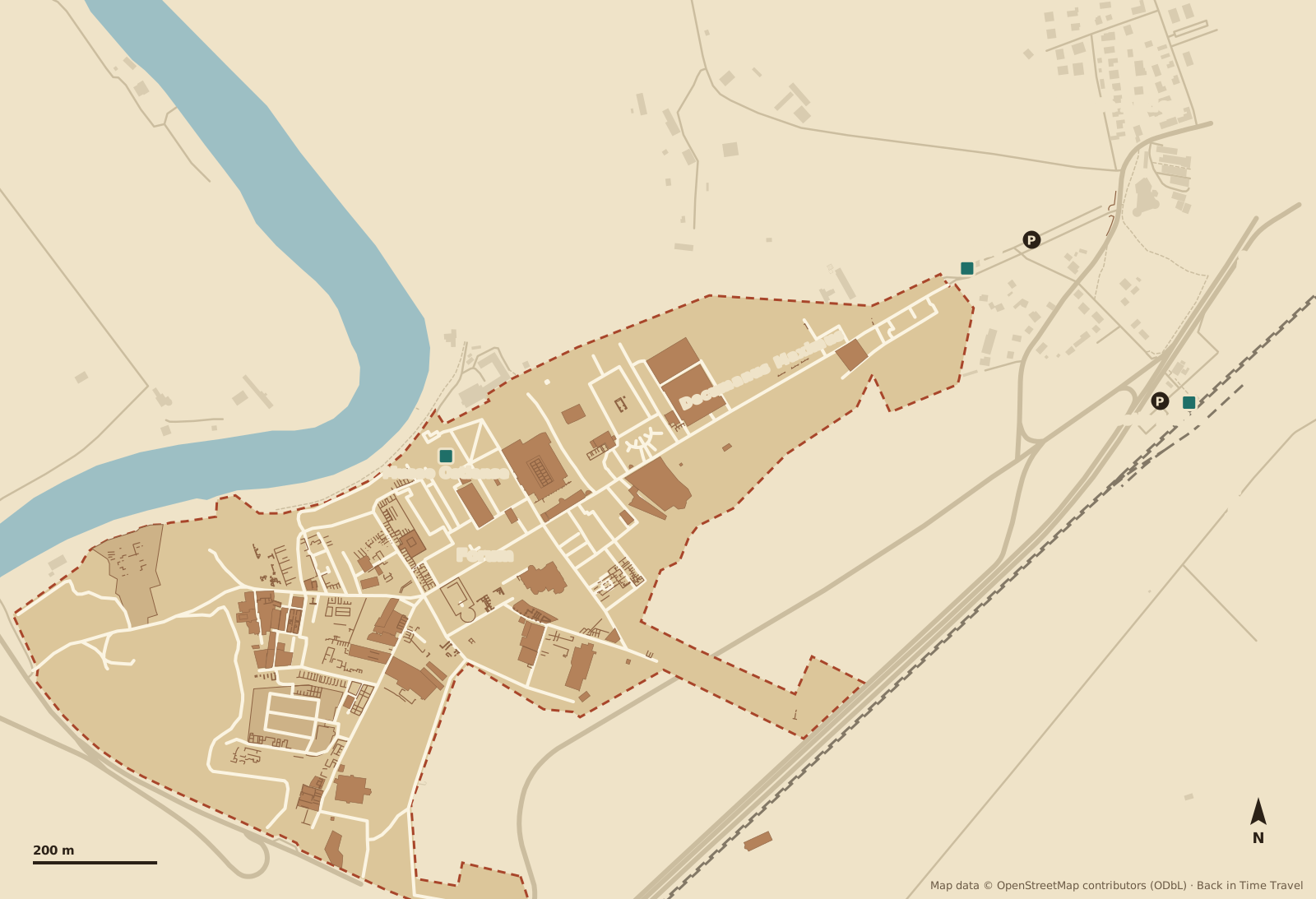
Map data © OpenStreetMap contributors, ODbL. Drawn by Back in Time Travel, data as of 26 September 2026. The map is a guide to orientation; paths, closures and access may change.
The 20 highlights on the map
The numbers match the map. The order follows a walk from the entrance at the Porta Romana west along the decumanus: first the theatre and the shipowners’ mosaics, then the House of Diana and the forum, and last the residential quarters to the Porta Marina, the synagogue and the sanctuary of the Magna Mater on the southern edge.
Porta Romana Town gate and decumanus
The main gate of the town from the time of Sulla, through which the road from Rome came in; Domitian donated the marble facing. From here the Decumanus Maximus runs straight for two kilometres to the Porta Marina, with basalt paving and cart ruts.
Read more →Necropolis of the Via Ostiense Street of tombs outside the gate
As in every Roman town the tombs lay outside the walls along the main road: brick tomb buildings, columbaria with niches for urns, inscriptions of freedmen. Right behind the entrance, often overlooked.
Baths of Neptune Terme di Nettuno
Large baths from the time of Hadrian with the black-and-white mosaic of Neptune on a team of sea horses, viewed from a raised terrace. Next to them the palaestra with its colonnaded court.
Barracks of the vigiles Caserma dei Vigili
The barracks of the vigiles, the fire brigade and night watch that Rome sent to Ostia to protect the warehouses: a courtyard with a shrine of the imperial cult, latrine and quarters.
Theatre Teatro romano
Built by Agrippa under Augustus, enlarged to 4,000 seats under Commodus and Septimius Severus, partly rebuilt in 1927. Performances take place here in summer; from the top row you look down on the piazzale behind.
Piazzale delle Corporazioni Square of the guilds
A colonnaded court behind the theatre with about sixty small offices whose black-and-white mosaics show the origin and trade of the shipowners and merchants: ships, a lighthouse, elephants, grain measures, names from Carthage to Narbonne. The emblem of Ostia.
Read more →Grandi Horrea The great warehouses
The largest granary of the town, begun under Claudius and raised under Commodus: rows of chambers around a courtyard, with raised floors against damp. Here the grain was stored before going up the Tiber to Rome.
House of Diana Apartment block with balcony
A block of flats from the middle of the 2nd century, preserved three storeys high, with a balcony over the street, shops on the ground floor, a courtyard with cistern and a mithraeum at the back. This is how most of the town lived.
Thermopolium Bar on the Via di Diana
The best-preserved bar of the Roman world: marble counter with basins, shelves for bowls, a wall painting of the menu, a fountain in the yard. The name is modern; the Romans said popina or caupona.
Capitolium Temple of Jupiter, Juno and Minerva
The main temple of the town from the time of Hadrian, around 120: a brick core on a high podium with a flight of steps, once faced with marble and fronted by six columns. The photograph on our Ostia pages shows it from the forum; the time journey begins here.
Read more →Forum and temple of Roma and Augustus The main square
The square at the crossing of decumanus and cardo, on the site of the old fort: to the north the Capitolium, to the south the temple of Roma and Augustus, on the sides basilica and curia. Here justice was done and the emperor worshipped.
Forum Baths Terme del Foro
The largest baths of the town from the 2nd century with furnace rooms, marble and windows facing south. Next to them the famous latrine with twenty seats in a row: the toilet as a communal room.
Horrea Epagathiana Warehouse with grand portal
A private warehouse of two freedmen with a brick portal of half-columns and pediment, around 145. Ostia’s brick architecture at its finest; inside a courtyard and chambers.
House of Cupid and Psyche Marble house of the 4th century
A late antique town house with marble floors, a nymphaeum and the statue of Cupid and Psyche that gave it its name. This is how the wealthy lived when Ostia was already shrinking, in the time of Augustine.
Read more →Baths of the Seven Sages Terme dei Sette Sapienti
Baths inside an apartment block with a round hall and wall paintings of the seven Greek sages giving earthy advice on digestion. Next door the Caseggiato del Serapide and the Caseggiato degli Aurighi with its charioteer paintings.
Garden Houses Residential park of the 2nd century
A complex of two apartment blocks in a shared garden with fountains, built around 128: the upmarket rented flat of the imperial age, with wall paintings in the Insula delle Muse. Open only at set times.
Read more →Schola del Traiano Guild house with a statue of Trajan
The clubhouse of a guild, probably the shipwrights, on the decumanus near the Porta Marina: a courtyard with a long pool, columns and a statue of Trajan, after which it is named.
Porta Marina Gate to the sea
The west gate of the town, where the decumanus ended and the beach began; today the sea is three kilometres further away. Outside the gate the bar of Alexander and Helix, the forum of the Porta Marina and the Maritime Baths.
Synagogue Oldest synagogue in Europe
Founded in the 1st century, rebuilt in the 4th, found in 1961 during the building of the coast road: columns with menorah capitals, Torah shrine, an oven, and since 2025 an excavated mikveh, the ritual bath. At the far south-western edge of the excavation.
Read more →Sanctuary of the Magna Mater Campo della Magna Mater
A triangular precinct at the Porta Laurentina for the Great Mother Cybele and Attis, with temple, shrine of Attis and seats for the priesthood. One of the many eastern religions of the harbour town, alongside Mithras, Serapis and Isis.
Routes through Ostia Antica
Three suggestions, all from the entrance. Choose a route and its stops are highlighted on the map. The town is two kilometres long and short of shade; water, a hat and sturdy shoes are essential in summer.
The highlights in 3 hours
Along the decumanus to the Baths of Neptune and the theatre, behind the theatre the mosaics of the Piazzale delle Corporazioni, then the House of Diana and the Thermopolium, the forum with the Capitolium and the Forum Baths with their latrine; back along the decumanus.
The whole day to the sea
All 20 stops: from the entrance through theatre and forum west to the House of Cupid and Psyche, the Baths of the Seven Sages, the Garden Houses and the Porta Marina, then back via the synagogue and the Magna Mater. Six hours with breaks; the museum last.
- 1 Porta Romana
- 2 Necropolis of the Via Ostiense
- 3 Baths of Neptune
- 4 Barracks of the vigiles
- 5 Theatre
- 6 Piazzale delle Corporazioni
- 7 Grandi Horrea
- 8 House of Diana
- 9 Thermopolium
- 10 Capitolium
- 11 Forum and temple of Roma and Augustus
- 12 Forum Baths
- 13 Horrea Epagathiana
- 14 House of Cupid and Psyche
- 15 Baths of the Seven Sages
- 16 Garden Houses
- 17 Schola del Traiano
- 18 Porta Marina
- 19 Synagogue
- 20 Sanctuary of the Magna Mater
Living in the imperial age
The houses and baths of the brick town: barracks of the vigiles, Grandi Horrea, House of Diana, Thermopolium, Forum Baths, Horrea Epagathiana, House of Cupid and Psyche, Baths of the Seven Sages and the Garden Houses, Ostia’s residential park of the 2nd century.
Entrance, museum, station and car park
- Entrance, Viale dei Romagnoli 717
- The only entrance, at the eastern edge of the excavation near the Porta Romana, five to ten minutes’ walk from the station: ticket office, toilets, bookshop, audio guides. From here the decumanus runs two kilometres west through the whole town.
- Museo Ostiense
- In the middle of the park north of the forum, reopened in 2023: sculptures, portraits, sarcophagi and the finds from the mithraea; included in the ticket, opens at 9.30 am. Café and toilets next door.
- Ostia Antica station
- Metromare from Porta San Paolo (Metro B Piramide), about 30 minutes, every ten to fifteen minutes. From the station cross the footbridge over the Via Ostiense and turn left along Viale dei Romagnoli to the entrance.
- Car park
- Paid car park at the entrance, reached along Viale dei Romagnoli from the Via del Mare or the Via Ostiense; a second car park lies at the station. Parking in the borgo next to the castle is tight.
Prices, opening hours and how to get there by Metromare are in our guide to Ostia Antica tickets and admission.
Where is Ostia Antica?
Ostia Antica lies in the south-west of Rome at the old mouth of the Tiber, 25 kilometres from the centre and six kilometres from Fiumicino airport. The coast at Lido di Ostia is now three kilometres away; in antiquity the town stood on the river and close to the sea. By Metromare it is about 30 minutes from Porta San Paolo. Distances from the forum, as the crow flies:
- Rome (centre)
- 23 km
- Fiumicino airport
- 7 km
- Civitavecchia
- 55 km
- Anzio
- 44 km
- Tivoli
- 48 km
Frequently asked questions about the Ostia Antica map
Where is Ostia Antica?
Ostia Antica lies in the south-west of Rome at the old mouth of the Tiber, near Fiumicino airport. As the crow flies it is 23 kilometres to the centre of Rome, 7 kilometres to Fiumicino airport, 55 kilometres to Civitavecchia and 44 kilometres to Anzio. By Metromare from Porta San Paolo it takes about 30 minutes to Ostia Antica station, then five to ten minutes on foot across the footbridge.
How big is Ostia Antica?
The excavated town measures about two kilometres from the Porta Romana to the Porta Marina and up to 700 metres across, about fifty hectares, as much as Pompeii; the park covers around 150 hectares, two thirds of it under fields. Three hours for the highlights, a day for all the stops.
Is there an Ostia Antica map as a PDF?
This page can be printed or saved as a PDF with the “Print the map” button; the map, highlights and routes are printed. The ticket office has a folding plan, and boards with overview plans stand in the park.
Where are the mosaics at Ostia Antica?
The most famous on the Piazzale delle Corporazioni behind the theatre, number 6, and in the Baths of Neptune, number 3, seen from a raised terrace. More mosaics lie in the Forum Baths, the Baths of the Seven Sages and many houses, mostly open to the sky.
When is Ostia Antica least crowded?
At 8.30 am when it opens and, in summer, after 5 pm. The groups from Rome come between 10 am and 2 pm but lose themselves in two kilometres of town. On the first Sunday of the month admission is free and the decumanus busier than usual.
How do I get from the station to the excavations?
From Ostia Antica station cross the footbridge over the Via Ostiense, then turn left along Viale dei Romagnoli to the entrance, five to ten minutes. The way is signposted; the borgo with the castle lies to the right.
Can you see the synagogue and the Decorated Houses?
The synagogue is freely accessible, at the far south-western edge of the park, number 19; the mikveh of 2025 is still under study. The Decorated Houses, houses with wall paintings such as the Insula delle Muse in the Garden Houses, open only at fixed times or with an escort; the times are posted at the booth.