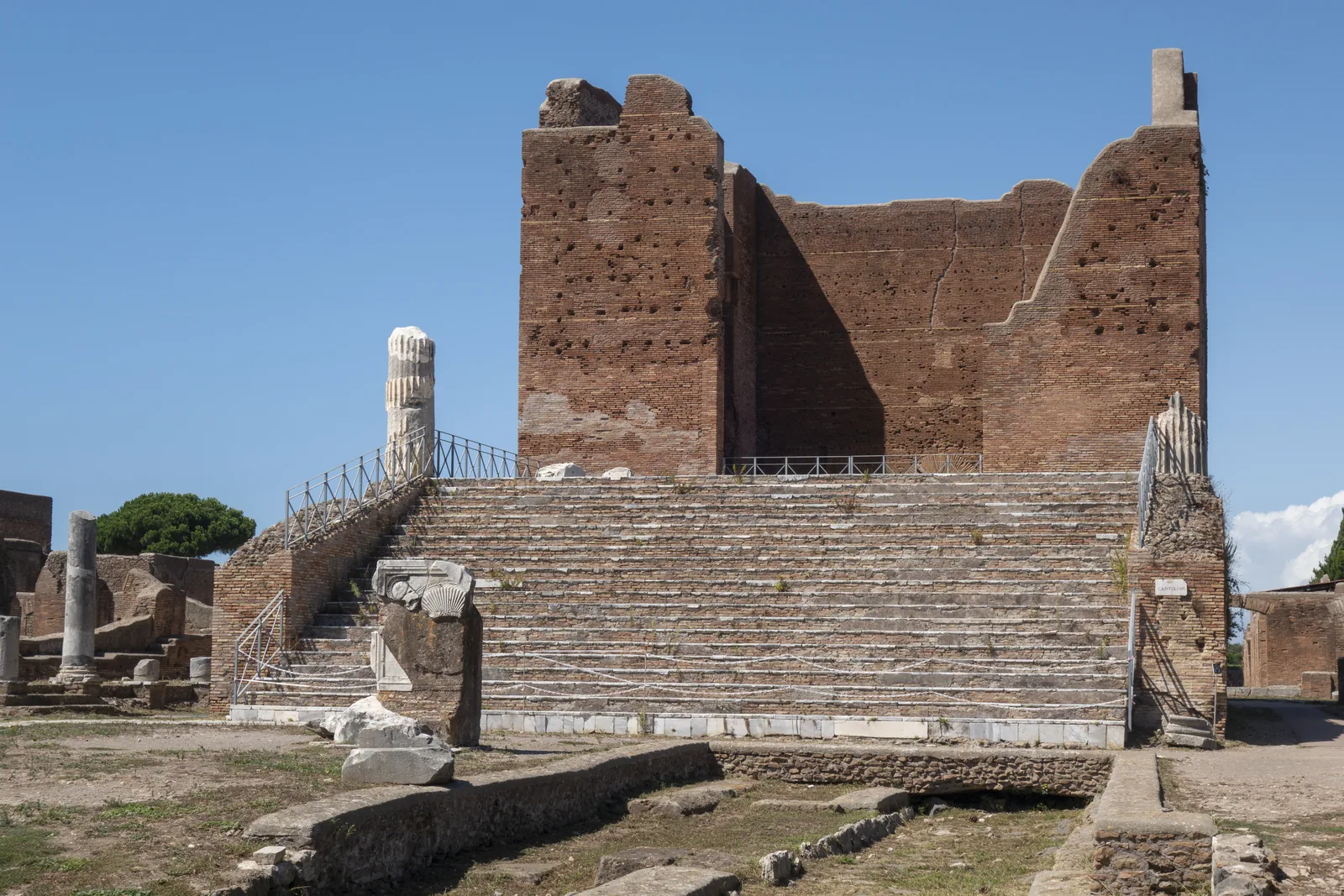
The Capitolium of Ostia Antica: a broad marble stairway, behind it the tall brick core of the temple without columns or roof, in front the paving and wall remains of the forum under a blue sky.
The Capitolium of Ostia Antica seen from the forum: the flight of steps, the brick core of the Hadrianic temple, on the left a column of the basilica, on the right the remains of the forum porticoes. Photograph taken on 7 September 2019. Nicholas Hartmann · CC BY-SA 4.0

Italy · Roman world

Ostia Antica.
The town that kept Rome fed.

Pompeii died in a day, Ostia over centuries. The harbour town at the mouth of the Tiber was not buried but abandoned: the river silted up, the sea retreated, malaria came. What remains is the most complete Roman town you can see without a volcano, with brick apartment blocks, bars, warehouses, baths and the mosaics of the shipowners, half an hour from Rome.

150CE
Selection: 350 BCE–400 CE8 chapters
The history
The harbour that fed Rome.

Ostia began in the 4th century BCE as a fort at the mouth of the Tiber, 25 kilometres from Rome. When the capital counted a million people, its grain came from Egypt and Africa through Ostia and the artificial harbour of Portus; the town grew to perhaps 50,000 inhabitants, with brick apartment blocks of four storeys, warehouses, baths, a theatre and eighteen mithraea. From the 3rd century it lost out to Portus, in the Middle Ages to marsh and pirates. Today about a third of the 150 hectares is excavated; the rest lies under fields. Source: Parco archeologico di Ostia antica · Besucherinformation

Through the centuries

No place
stands still.

Choose a period. See how the story changes over time.

014th century BCECastrum

A fort by the salt.

Tradition has King Ancus Marcius found Ostia in the 7th century BCE for the salt pans at the river mouth. What archaeologists found is younger: a rectangular fort of tufa blocks, about 200 by 130 metres, from the middle of the 4th century BCE, with two streets crossing at its centre. The decumanus and the cardo you walk along today are those two streets; the forum lies at their crossing. Ostia took its name from the place: ostium, the mouth.

Source: Ostia-antica.org · Introduction to Ostia
02267 BCEFleet

A quaestor for the harbour.

In the war against Carthage Ostia became a naval base; from 267 BCE a quaestor of its own sat here, supervising the harbour and the supply of Rome. The town grew beyond the fort; in the civil wars Marius plundered it in 87 BCE, and in 68 or 67 BCE pirates burned the fleet in the harbour. After that Ostia received the town wall still visible at the Porta Romana.

Source: Ostia-antica.org · Introduction to Ostia
0318–12 BCEAugustus

A theatre for the shipowners.

Under Augustus, Agrippa built the theatre on the decumanus, and behind it rose the square now called the Piazzale delle Corporazioni: a courtyard with about sixty offices whose mosaic floors announced the shipowners’ and traders’ origins, ships, elephants, dolphins, Carthage, Alexandria, Narbonne. Ostia became the town of the middlemen who bought the grain for Rome, stored it and sent it up the river.

Source: Ostia-antica.org · Topographisches Wörterbuch (Jan Theo Bakker)
0442 CEPortus

Claudius digs a new sea.

The mouth of the Tiber silted up; large ships had to unload off the coast. From 42 CE the emperor Claudius had an artificial harbour dug three kilometres to the north, Portus, with a lighthouse on a sunken giant ship; around 110 Trajan added the hexagonal basin. Ostia remained the administrative and residential town of the harbour: the workers lived here, the warehouses stood here, the guilds sat here.

Source: Ostia-antica.org · Introduction to Ostia
05c. 120Hadrian

A town of brick.

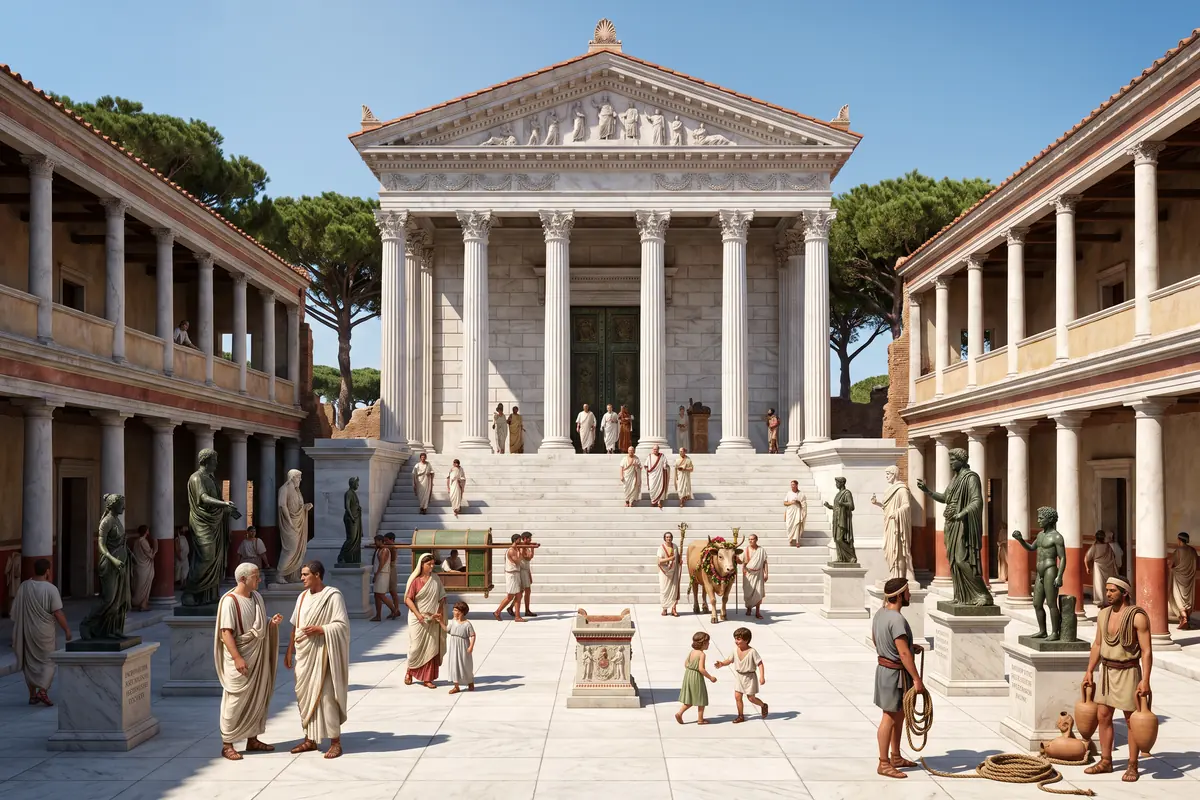
Under Hadrian Ostia was rebuilt in red and yellow brick, with apartment blocks of four and five storeys, balconies, shops on the ground floor, courtyards and cisterns. The forum received its Capitolium, the temple of Jupiter, Juno and Minerva on a high podium, the centrepiece of the photograph. The Baths of Neptune, the House of Diana, the Grandi Horrea: almost everything you see dates from the decades between 100 and 200, when Ostia may have counted 50,000 people.

Source: Ostia-antica.org · Topographisches Wörterbuch (Jan Theo Bakker)
06387 CELate antiquity

Augustine at the window.

In the 3rd century the town shrank, and under Constantine Portus became independent. Ostia remained a home for the wealthy, with marble houses like the House of Cupid and Psyche, with Christians, Jews and followers of Mithras side by side. In the autumn of 387 Augustine waited here with his mother Monica for a ship to Africa. At the window of a house they talked about eternal life; a few days later she died, aged 56. The scene is in the Confessions and is the most famous page ever written about Ostia.

Source: Augustinus · Bekenntnisse IX (Übersetzung Pusey, Project Gutenberg)
075th–9th centuryMarsh

Pirates, popes, malaria.

After the Goths and Vandals the town decayed; its marble went into lime kilns and to Pisa and Florence. In 849 the fleet of Pope Leo IV defeated the Saracens off Ostia, a victory Raphael painted in the Vatican. Around 830 Pope Gregory IV had founded the fortified settlement of Gregoriopolis east of the ruins, today’s borgo with the Castello di Giulio II of 1486. A Tiber flood moved the river in 1557, the sea retreated, the marshes brought malaria. The ruins sank into the reeds.

Source: Ostia-antica.org · Introduction to Ostia
081801–1942Excavation

Two popes and a world fair.

Pius VII had digging done in 1801, Pius IX in 1855, mostly in search of statues for the Vatican museums. From 1907 Dante Vaglieri excavated systematically, from 1938 Guido Calza at speed: for the world fair E42, which Mussolini wanted to open in Rome in 1942, more was uncovered in four years than in the hundred before. The fair never took place; the town stayed open. Since 2019 it has carried the European Heritage Label; a third is excavated.

Source: Europäische Kommission · European Heritage Label, Archaeological Area of Ostia Antica (2019)
Swipe or scroll

Look closer

No catastrophe, only time.

Pompeii and Herculaneum are snapshots of a single day. Ostia is the opposite: a town built, rebuilt, raised and abandoned over eight hundred years. So you will find no casts and no loaves in the oven here, but brick houses with surviving upper floors, stairs, balconies, latrines, bar counters faced with marble and the mosaics with which baths and guilds advertised. Anyone who wants to know how the people of a Roman city lived learns it better in Ostia than in Rome itself.

Source: Ostia-antica.org · Introduction to Ostia
What the evidence cannot show
The population of 50,000 is an estimate from the built-up area and the height of the apartment blocks; older figures go up to 75,000, some recent ones well below.
What to look for on a visit
Do not just walk straight along the decumanus: the mosaics of the Piazzale delle Corporazioni lie behind the theatre, the bar with the marble counter, the Thermopolium, is in the Via di Diana, and the latrine of the Forum Baths still has its row of seats. And look up: the House of Diana shows what a tenement of the imperial age looked like, with a balcony and windows on the first floor.
Source: Ostia-antica.org · Topographisches Wörterbuch (Jan Theo Bakker)

Reading the place

Beneath the surface.

Buildings and finds reveal more when we consider their context. These close readings connect the evidence with questions to take on a visit.

01

How many people lived in Ostia?

The built-up area inside the walls measures about 69 hectares; the apartment blocks had three to five storeys, and an imperial law capped their height at a good twenty metres. From area, storeys and comparisons with Rome, scholars since Meiggs have calculated populations between 50,000 and 75,000 for the 2nd century; more recent studies that subtract warehouses, baths and shops arrive at considerably less.

Evidence / source: Ostia-antica.org · Introduction to Ostia

Whichever figure is right, Ostia was one of the largest towns in Italy after Rome, and its people lived as tenants, stacked above one another in brick blocks of a kind that still stand in Rome today. The House of Diana and the Garden Houses show the principle.

What the evidence cannot establish on its own

No ancient source gives a population figure. All numbers are model calculations; we write “up to 50,000” and mean the lower end of the classic estimate.

02

The window nobody can find.

Augustine writes that in the autumn of 387 he and his mother “stood alone, leaning in a certain window, which looked into the garden of the house where we now lay, at Ostia”. A few days later Monica died, in her 56th year, and was buried at Ostia. In 1945 two boys playing beside the church of Sant’Aurea in the borgo found a fragment of her epitaph, whose text was known from medieval copies.

Evidence / source: Augustinus · Bekenntnisse IX (Übersetzung Pusey, Project Gutenberg)

The house with the window has not been identified and probably never will be: Ostia in the 4th century had hundreds of houses with gardens. If you look for the scene, you will find it in the House of Cupid and Psyche or the House of Fortuna Annonaria, two rich houses of those decades, best in the late afternoon when it grows quiet.

What the evidence cannot establish on its own

The inscription of 1945 is genuine; the story of its finding has been embroidered into legend. Monica’s bones were moved to the church of Sant’Agostino in Rome as early as 1430.

03

Why Ostia is so well preserved.

Ostia was not destroyed but abandoned. When Portus took over the harbour in the 4th century and the mouth of the Tiber silted up, people moved away; the marshes and malaria kept settlers at bay for centuries, and brick walls were less valuable to stone robbers than marble. So whole streets stood to the first floor beneath earth and reeds until popes, and finally the Italian state, uncovered them.

Evidence / source: Europäische Kommission · European Heritage Label, Archaeological Area of Ostia Antica (2019)

That is a different kind of preservation from Pompeii: not a snapshot but a cross-section through eight centuries. The mosaics lie open under the sky, the wall paintings are paler, but you see stairs, upper floors, shops and latrines in a density found nowhere else.

What the evidence cannot establish on its own

About two thirds of the town are unexcavated and lie under fields and the borgo; geophysics shows further warehouses and houses there. No large-scale excavation is planned.

Plan a visit

Give Ostia a whole day.

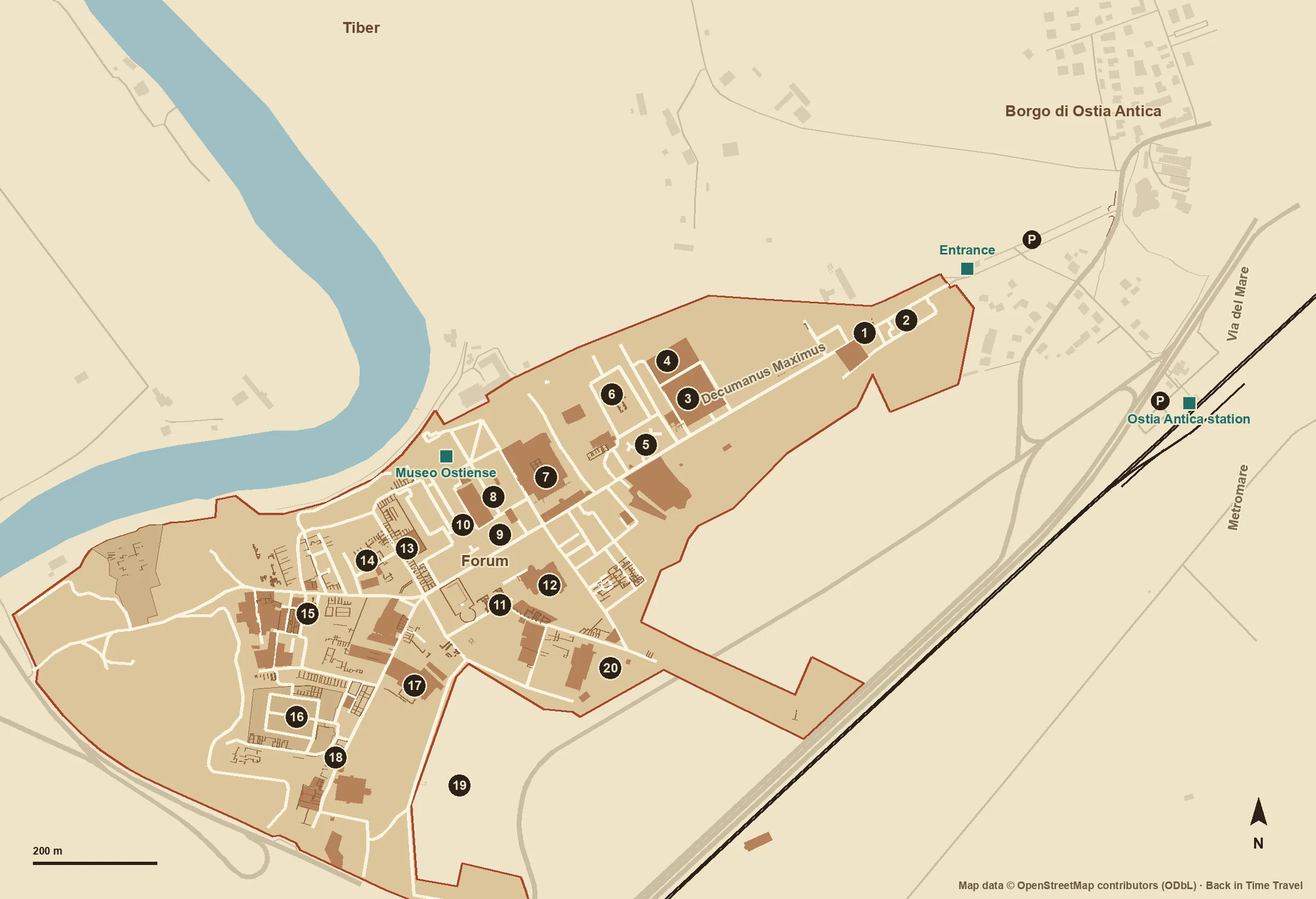
The park is open Tuesday to Sunday from 8.30 am, until 7 pm in summer and 4.30 pm in winter; the ticket costs €18, online from CoopCulture or at the booth on Viale dei Romagnoli. From Rome the Metromare from Porta San Paolo takes half an hour; from the station it is five minutes across the footbridge.

The park is closed on Mondays. The excavation is large and short of shade: water, a hat and sturdy shoes are essential, and the paving of the decumanus is uneven. Some houses with wall paintings open only at set times or with a guide; ask at the booth.

Affiliate link: we may receive a commission when you book through GetYourGuide. The historical interpretation remains independent.

Visiting sources checked on 24 September 2026. Prices and availability are provided by the operator.

Keep exploring

More of
Ostia Antica.

Sources and context

These texts combine published research with editorial explanation. Some dates are approximate. Photographs show documented surviving conditions. Specialist archaeological review is still pending.

  1. Source: Parco archeologico di Ostia antica · Besucherinformation
  2. Source: Ostia-antica.org · Introduction to Ostia
  3. Source: Ostia-antica.org · Topographisches Wörterbuch (Jan Theo Bakker)
  4. Source: Augustinus · Bekenntnisse IX (Übersetzung Pusey, Project Gutenberg)
  5. Source: Europäische Kommission · European Heritage Label, Archaeological Area of Ostia Antica (2019)
Images and usage rights

The Capitolium of Ostia Antica seen from the forum: the flight of steps, the brick core of the Hadrianic temple, on the left a column of the basilica, on the right the remains of the forum porticoes. Photograph taken on 7 September 2019. Nicholas Hartmann / Wikimedia Commons · CC BY-SA 4.0. Resized to 1600 pixels wide and compressed as WebP; no crop or content alterations. Framing varies by screen. Derived photograph under the same licence.

Barlow OFL · Manrope OFL