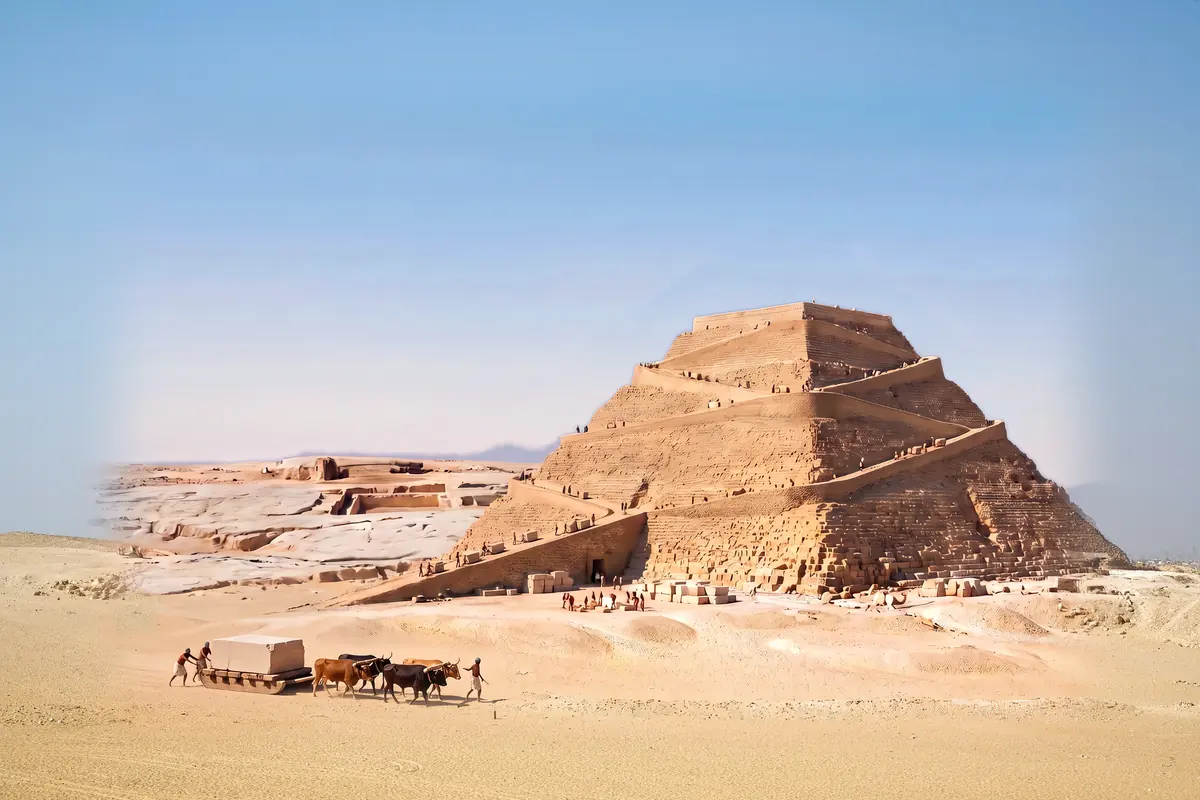
AI vision: the building site of Khufu’s pyramid around 2560 BC, on the right the pyramid two thirds complete with mud-brick ramps, sledges and gangs of workers, the sites of Khafre and Menkaure still bare rock with quarry pits, in front desert with camps, workshops and oxen
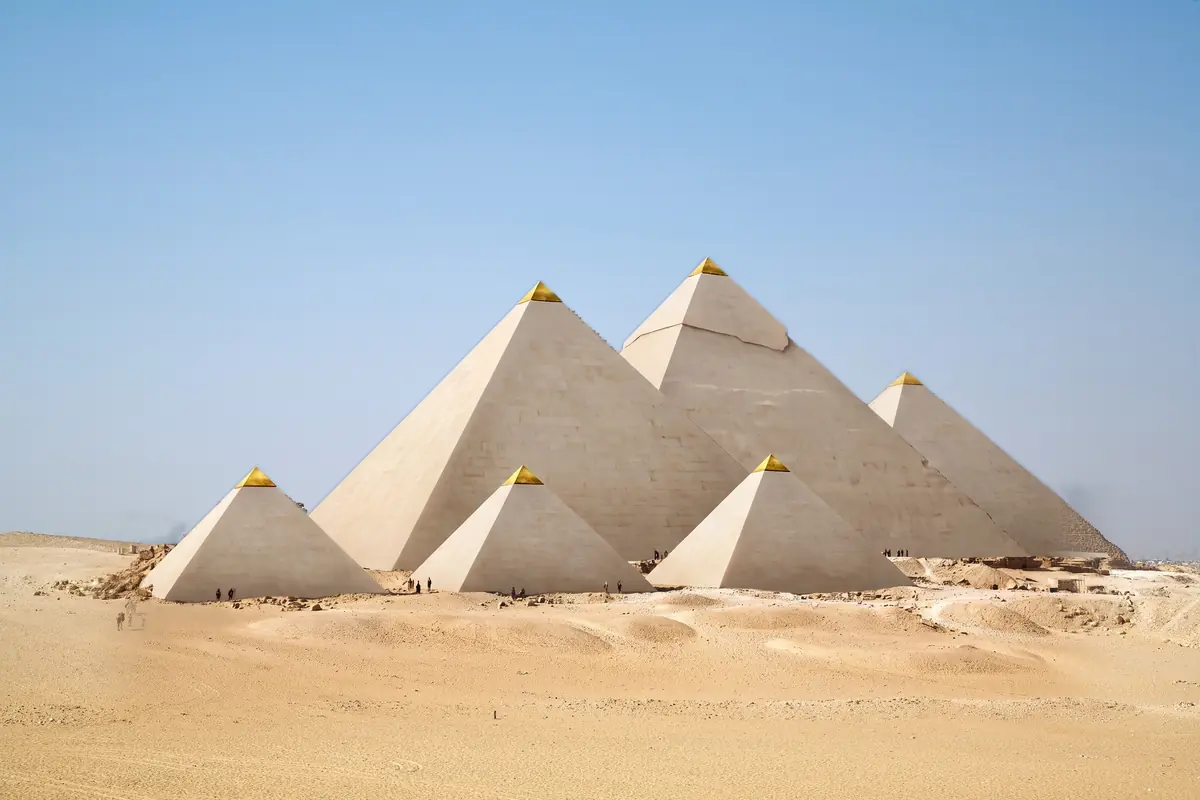
AI vision: the three pyramids of Giza completed around 2500 BC, smooth white limestone casing, gilded tips, the pyramid of Menkaure with red granite on its lower courses, the three queens’ pyramids intact, mortuary temples and enclosure walls, a procession of priests on the causeway
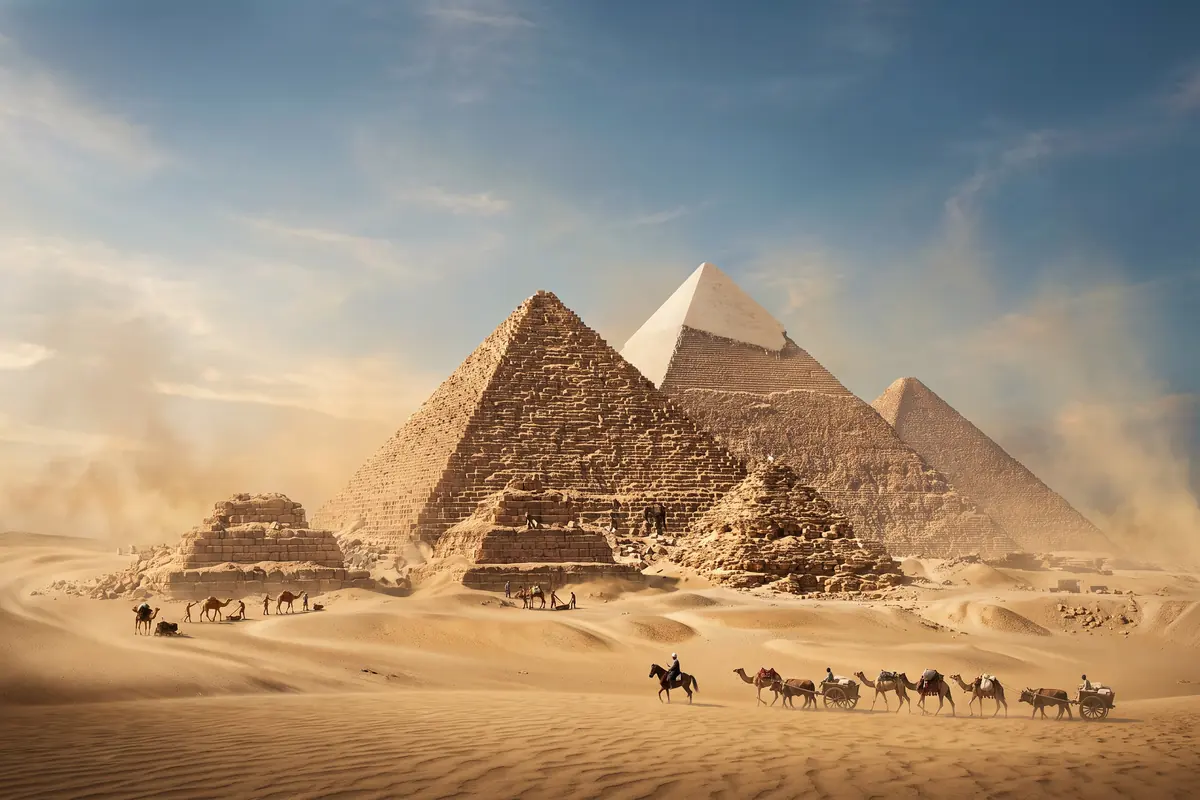
AI vision: the pyramids of Giza in 1356, workers breaking off casing blocks and loading them onto camels and ox carts, Khufu and Menkaure already largely stripped, Khafre keeping its cap, sand dunes at the foot, a Mamluk overseer on horseback
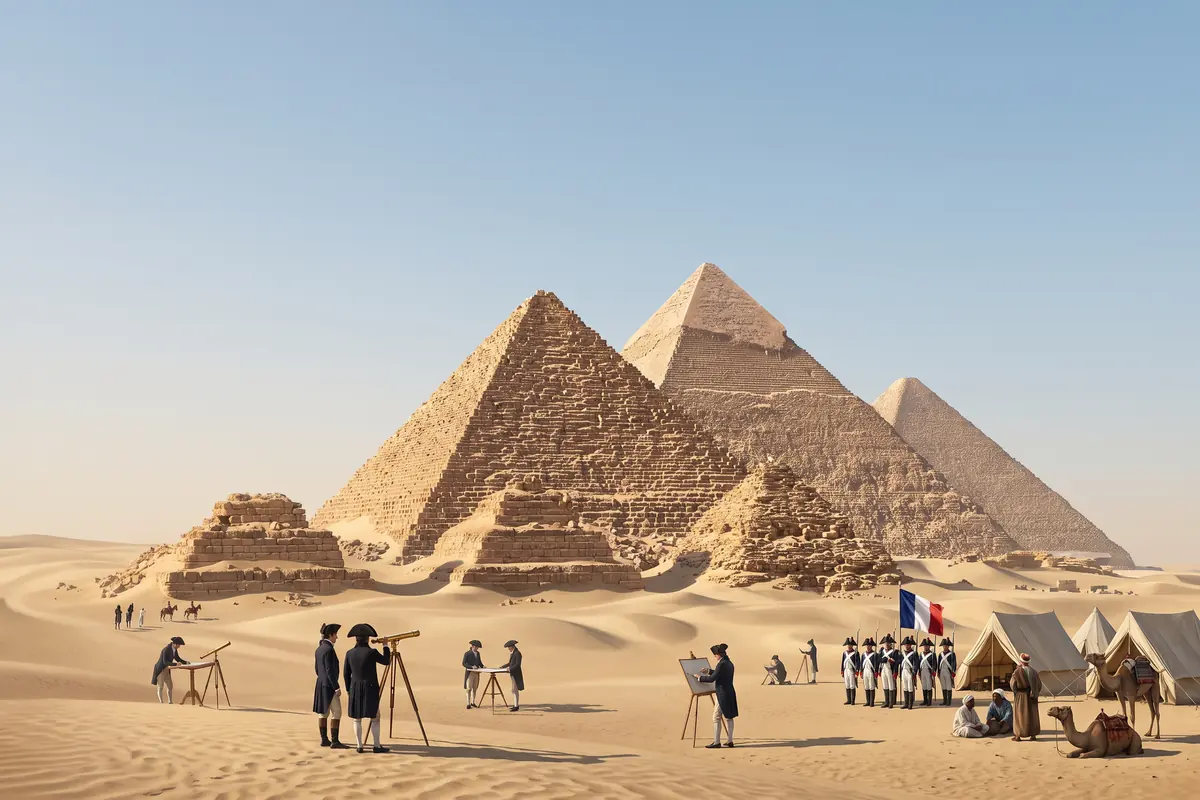
AI vision: the pyramids of Giza in autumn 1798, savants of the French expedition with plane tables, telescopes and drawing boards, French soldiers in uniform and a tricolour, camels and Bedouin, sand reaching high up the base of the pyramids
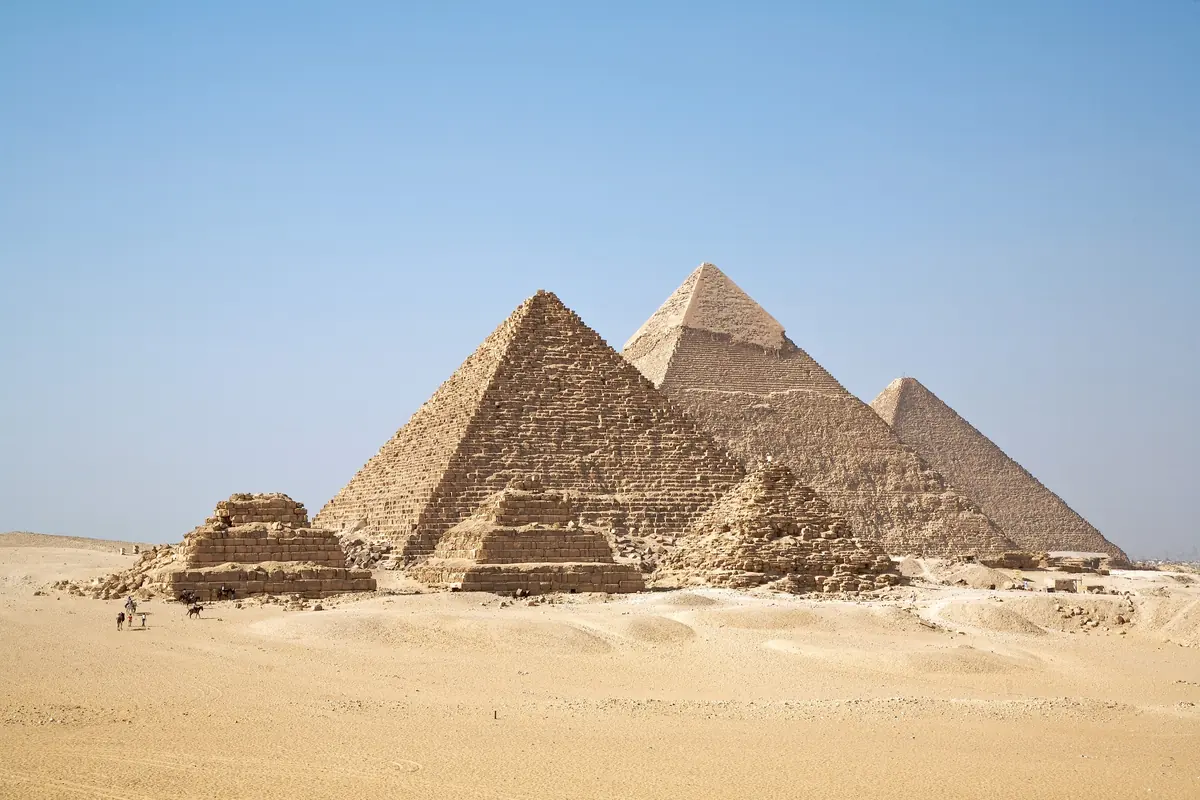
The three pyramids of Giza today from the desert to the south: in front the three queens’ pyramids, behind them the pyramid of Menkaure, the pyramid of Khafre with its pale cap and on the right the pyramid of Khufu, the city at the right edge (photo)
Documented Khufu’s pyramid under construction: casing of Tura limestone, Merer papyri year 27 of KhufuDocumented Bare rock where Khafre’s pyramid will stand: built only under the sonDocumented Camp of the workers: workers’ town Heit el-Ghurab, excavated by Lehner/AERA since 1988Assumed Ramps of mud brick and rubble: ramp remains at Giza and Hatnub, course disputedInvented Oxen, workshops and tents in the desert
Documented Khufu’s pyramid with casing: Tura limestone, joints of 0.5 mm (Petrie 1883)Documented Khafre’s pyramid: 143.5 m, on rock ten metres higherDocumented Menkaure’s pyramid: lower sixteen courses of red granite, unfinished at the king’s deathAssumed Queens’ pyramids intact with casing: remains preserved, state around 2500 reconstructedInvented Procession of priests on the causeway
Documented Khufu’s pyramid without casing: removal under Sultan an-Nasir Hasan in 1356 recordedDocumented Khafre’s pyramid keeps its cap: preserved to this dayDocumented Menkaure’s pyramid with a breach: demolition attempt of 1196 under al-Aziz UthmanAssumed Sand up to the foot of the pyramids: documented for 1798, assumed for 1356Invented Mamluk overseer, camels and ox carts
Documented Khufu’s pyramid without its tip: the state shown in the plates of the Description de l’ÉgypteDocumented Khafre’s pyramid with its cap: drawn by the savants of the commissionDocumented Plane tables and draughtsmen: survey by the Commission des Sciences et des ArtsAssumed Sand up to the base: visible in the plates, height at this spot estimatedInvented Tricolour, Bedouin and camels in the foreground
Documented Khufu’s pyramid: 138.5 m, void above the Grand Gallery (ScanPyramids 2017)Documented Khafre’s pyramid: the only one with casing preserved at the topDocumented Menkaure’s pyramid: 61 m, granite below, breach of 1196 on the north sideDocumented Queens’ pyramids: three subsidiary pyramids of Menkaure, remains of casing

AI vision · artistic licence

The building site of Khufu: one view, 4,600 years

You stand in a single spot, in the sand south of the plateau, looking north at three pyramids. Time runs, you don’t. Scroll from Khufu’s building site around 2560 BC through the three completed white mountains, the stripping of the casing for Cairo in 1356 and the plane tables of Napoleon’s savants to the view that awaits you today.

I’m Ada Falk. I have spent my life digging through dirt in search of other lives. On this plateau men with sledges and ropes built a mountain, and one of them kept a logbook. I’ll show you what they built and who later took it apart again. I’ll guide you.

Ada is an invented narrator. The history is real: every fact and quotation is sourced, and the sources are listed at the end. The images are AI visions, not scientific reconstructions. The button “What is the evidence?” shows what is documented.

AI vision: the building site of Khufu’s pyramid around 2560 BC, on the right the pyramid two thirds complete with mud-brick ramps, sledges and gangs of workers, the sites of Khafre and Menkaure still bare rock with quarry pits, in front desert with camps, workshops and oxen

Diary 1 / 5 · around 2560 BC · a morning in the inundation season

The building site of Khufu’s pyramid around 2560 BC: Khufu’s mountain grows

Stand here, in the sand south of the plateau, and look north. On the right a mountain of stone is growing, two thirds of it are there, the top is still missing, and ramps of mud brick and rubble cling to its flanks, on which gangs of twenty men haul blocks on sledges. To the left of it there is nothing: bare rock plateau, a few quarry pits from which the core of the pyramid comes. Khafre and Menkaure are not yet born, or are children. In front of you, where the desert is empty today, the crews are camped.

We know one of them by name. Merer, inspector of a crew of forty men, kept his logbook in the 27th year of Khufu’s reign: he sails by boat to Tura, loads white limestone, sails to Akhet-Khufu, the “Horizon of Khufu”, and back again, about thirty blocks every ten days. His papyrus lay for 4,500 years in a harbour on the Red Sea and was found in 2013. The ramps, the sledges, the gangs and the empty rock are documented; the oxen, the workshops and the tents in the foreground are my invention.

Merer, inspector, year 27 of Khufu

„Day 26: Inspector Merer casts off with his crew from Tura South, loaded with stone, for Akhet-Khufu; spends the night at She-Khufu. Day 27: sets sail from She-Khufu, sails towards Akhet-Khufu, loaded with stone, spends the night at Akhet-Khufu.“

Papyrus Jarf B, after P. Tallet: Les papyrus de la mer Rouge I. Le journal de Merer. Cairo 2017. Abridged.

Image: AI vision based on a photo by Ricardo Liberato (CC BY-SA 2.0), not a scientific reconstruction.

AI vision: the three pyramids of Giza completed around 2500 BC, smooth white limestone casing, gilded tips, the pyramid of Menkaure with red granite on its lower courses, the three queens’ pyramids intact, mortuary temples and enclosure walls, a procession of priests on the causeway

Diary 2 / 5 · around 2500 BC · noon, the light stands vertical

The three pyramids completed around 2500 BC: Three white mountains

Sixty years later all three stand. Khufu is dead, his son Khafre has built beside him, almost as high and on higher rock, and Menkaure, the grandson, the smallest of the three, its lower sixteen courses in red granite from Aswan. Each pyramid wears a skin of white limestone from Tura, fitted so smoothly that in 1881 Petrie will measure the joints at half a millimetre, and in the noon sun they dazzle. In front of each lies a mortuary temple, from which a causeway leads down to the valley temple on the canal.

The priests you see on the causeway carry the offerings for a god who is buried here. The casing, the temples, the causeways and the three small pyramids of the queens in front of Menkaure are documented, their remains still stand. The gilded tips are assumed: from other pyramids we know capstones of stone, from Giza not a single piece. The procession and the banners are invented.

Herodotus, around 430 BC

„It is built of stone smoothed and fitted together in the most perfect manner, not one of the stones being less than thirty feet in length.“

Herodotus: Histories II 124. Translated by G. C. Macaulay (1890).

Image: AI vision based on a photo by Ricardo Liberato (CC BY-SA 2.0), not a scientific reconstruction.

AI vision: the pyramids of Giza in 1356, workers breaking off casing blocks and loading them onto camels and ox carts, Khufu and Menkaure already largely stripped, Khafre keeping its cap, sand dunes at the foot, a Mamluk overseer on horseback

Diary 3 / 5 · 1356 · a late-summer afternoon

Stripping the casing for Cairo, 1356: The skin of the mountains goes to Cairo

Three thousand eight hundred years later the stripping begins. On 8 August 1303 an earthquake from the sea off Crete loosened the casing of the Great Pyramid, and since then the white blocks have lain at its foot like a quarry that belongs to nobody. Sultan an-Nasir Hasan, master of Egypt, is building in Cairo the greatest mosque of the Mamluks, and the limestone of Tura, smoothed four thousand years ago, crosses the river on camels and ox carts. Khufu’s pyramid already shows its steps, Menkaure’s too; only Khafre keeps its cap, to this day.

The men in the picture levering the blocks with crowbars are day labourers; nobody knows their names. That casing blocks went to Cairo in 1356 is in the chronicles, and in 1881 Petrie found the last blocks under the rubble on the north side. The overseer on horseback, the camel caravan and the edge of the dunes are invented; that the sand stood higher then than today is assumed.

Petrie, 1883

„The mean variation of the cutting of the stone from a straight line and from a true square is but 0.01 inch on a length of 75 inches up the face, an amount of accuracy equal to most modern opticians’ straight-edges of such a length.“

W. M. Flinders Petrie: The Pyramids and Temples of Gizeh. London 1883, on the casing stones of Khufu’s pyramid.

Image: AI vision based on a photo by Ricardo Liberato (CC BY-SA 2.0), not a scientific reconstruction.

AI vision: the pyramids of Giza in autumn 1798, savants of the French expedition with plane tables, telescopes and drawing boards, French soldiers in uniform and a tricolour, camels and Bedouin, sand reaching high up the base of the pyramids

Diary 4 / 5 · autumn 1798 · early morning

Napoleon’s savants survey the pyramids, 1798: Forty centuries on the plane table

On 21 July 1798 Bonaparte defeated the Mamluks at Embabeh, fifteen kilometres from here. He called it the Battle of the Pyramids because they stood on the horizon; out here nothing happened that day. What comes after matters more: a hundred and sixty savants travelled with the army, and in August Bonaparte founds the Institut d’Égypte in Cairo. The men with plane tables and telescopes you see in the picture are engineers and draughtsmen of that commission. They measure the base, count the courses, draw every block.

The sand stands high against the pyramids, the Sphinx lies in it up to the neck. After twenty years the drawings become the Description de l’Égypte, twenty-three volumes, the largest publication of its age, and with it Egyptology begins. The savants, the survey and the sand are documented; the tricolour at this spot, the Bedouin and the camels are invented. The famous line about forty centuries was spoken, if it was spoken, before the battle at Embabeh, not here.

Bonaparte, as handed down

„Soldiers, consider that from the top of these pyramids forty centuries look down upon you.“

Napoleon Bonaparte before the battle at Embabeh on 21 July 1798, as later recorded; the wording is not contemporary.

Image: AI vision based on a photo by Ricardo Liberato (CC BY-SA 2.0), not a scientific reconstruction.

The three pyramids of Giza today from the desert to the south: in front the three queens’ pyramids, behind them the pyramid of Menkaure, the pyramid of Khafre with its pale cap and on the right the pyramid of Khufu, the city at the right edge (photo)

Diary 5 / 5 · Today

The pyramids of Giza today: And now you

This is real. Exactly this view awaits you when you walk west from the panorama point south of the road until the three pyramids stand in a row: in front the three small queens’ pyramids of Menkaure, behind them his pyramid with the granite below, then Khafre with its cap of Tura limestone, on the far right Khufu, 138.5 metres high, eight metres less than on the first day. At the right edge begins the city that has eaten the desert since 1798.

Four millennia are not over here yet: in 2017 physicists using cosmic-ray muons found a void of at least thirty metres above the Grand Gallery of Khufu’s pyramid that nobody has yet entered. The plateau has been World Heritage since 1979. Stand here, half close your eyes, and the casing shines again.

The physicists, 2017

„Here we report the discovery of a large void (with a cross-section similar to that of the Grand Gallery and a minimum length of 30 metres) situated above the Grand Gallery.“

K. Morishima et al.: Discovery of a big void in Khufu’s Pyramid by observation of cosmic-ray muons. Nature 552 (2017).

Real photo: Ricardo Liberato, CC BY-SA 2.0, via Wikimedia Commons.

Your expedition

Visit the pyramids of Giza: Stand exactly here

“The rest you have to see for yourself. And when you stand at the foot of Khufu’s pyramid, put your hand on a block. One like it lay on Merer’s boat.” Ada Falk

  1. To the panorama point in the desert. From the gate on the Mena House side the road leads past Khufu and Khafre south-west to the viewpoint; from there walk a little way west into the sand until the three pyramids stand in a row: that is the view of this time journey.
  2. Back to the queens. Past the three small pyramids of Menkaure to the breach of 1196 on the north side of his pyramid, then to Khafre, where you see the casing at the top and the granite below.
  3. Then the Great Pyramid. On the north side the casing blocks Petrie uncovered in 1881, and if you have a ticket, the Grand Gallery, above which the void has lain since 2017. Finally down to the Sphinx and the workers’ town south of it.
  • Early or late: Right after opening the light comes low from the east and the buses have not yet arrived; in the late afternoon the sun is behind you when you look from the south.
  • Separate tickets: The site, the interior of Khufu’s pyramid and the other pyramids have their own tickets; the interior is cramped and stuffy on hot days. Agree camel and horse prices at the panorama point beforehand.
  • Check first: Admission, gates and how to get there are in our guide to Giza tickets and admission; all highlights are on our map.

At a glance

The pyramids of Giza in facts

Built
around 2560 to 2500 BC for Khufu, Khafre and Menkaure, 4th Dynasty; Khufu reigned about 2589 to 2566 BC
Height
Khufu 146.6 m originally, today 138.5 m, base 230.3 m; Khafre 143.5 m, today 136.4 m; Menkaure 65.5 m, today 61 m
Builders
gangs of free workers supplied from the workers’ town Heit el-Ghurab; estimates 13,000 to 40,000 men
Written source
logbook of the inspector Merer, year 27 of Khufu, found in 2013 at Wadi al-Jarf: limestone from Tura to Akhet-Khufu
Casing
white Tura limestone, joints around 0.5 mm; loosened in the earthquake of 1303, stripped for Cairo from 1356; only Khafre keeps its tip
Napoleon
battle at Embabeh 21 July 1798; Institut d’Égypte 22 August 1798; Description de l’Égypte 1809 to 1829
Research
Petrie surveys 1880 to 1882; ScanPyramids finds a void of at least 30 m above the Grand Gallery in 2017
Today
World Heritage since 1979 (No. 86, Memphis and its Necropolis); entry by the Sphinx gate or on the Mena House side

Frequently asked questions about the pyramids of Giza and how they were built

How were the pyramids of Giza built?

From limestone quarried right beside the building site, with a skin of fine white limestone from Tura on the other side of the Nile. The blocks came by boat along canals to the foot of the plateau and were hauled up on sledges over ramps of mud brick and rubble; remains of such ramps have been found at Giza and in the quarry of Hatnub. How exactly the ramps ran, straight, spiral or internal, is disputed to this day.

Who built the pyramids, slaves?

No. Since 1988 Mark Lehner and his team have been excavating the workers’ town Heit el-Ghurab south of the Sphinx: sleeping galleries, bakeries, grain silos, cattle bones. The gangs were Egyptian workers who served in shifts and were provisioned. The logbook of the inspector Merer from Wadi al-Jarf, found in 2013, names a crew of forty men who brought limestone from Tura to the site, about thirty blocks every ten days.

What is true in Herodotus?

Herodotus visited Egypt around 450 BC, two thousand years after Khufu, and wrote down what the priests told him: a hundred thousand men in three-month shifts, ten years for the causeway, twenty for the pyramid, an inscription about radishes, onions and leeks for the workers. The orders of magnitude are exaggerated; research puts the workforce at 13,000 to 40,000. What he observed correctly are the causeway, the stepped construction of the core and the perfectly fitted casing.

Why are the pyramids no longer smooth and white?

The casing of Tura limestone lasted almost four thousand years. On 8 August 1303 a severe earthquake from the sea off Crete loosened the blocks, and from 1356 Sultan an-Nasir Hasan had the loose blocks carted to Cairo, for his mosque-madrasa and other buildings. Only Khafre’s pyramid kept its cap. In 1881 Petrie found the last casing blocks of Khufu’s pyramid under the rubble on the north side.

Did the Battle of the Pyramids take place at the pyramids?

No. Bonaparte defeated the Mamluks on 21 July 1798 at Embabeh on the west bank of the Nile opposite Cairo, about fifteen kilometres from Giza; the pyramids stood on the horizon, hence the name. The savants of the expedition came to Giza afterwards and, with the Institut d’Égypte founded on 22 August 1798, measured and drew the monuments. Their plates became the Description de l’Égypte, published from 1809 to 1829.

Are there still undiscovered rooms in Khufu’s pyramid?

Yes. In 2017 the ScanPyramids project used cosmic-ray muons, which pass through stone, to detect a void at least thirty metres long above the Grand Gallery, published in the journal Nature. What it is, a relieving space or a passage, nobody knows; nobody has yet entered it.

What did the pyramids look like?

Smooth, white and dazzling: each wore a skin of polished limestone, Menkaure’s pyramid with sixteen lower courses of red granite. In front of each lay a mortuary temple, a causeway led to the valley temple on the canal, and in front of Menkaure stood three small pyramids for queens. The images on this page are AI visions meant to convey a feeling; people, ramps, colours and scenes are interpretation, and the outlines of the pyramids follow today’s photograph.

When is the best time for this view?

Early in the morning after opening, when the light comes low from the east and the buses have not yet arrived, or in the late afternoon. The view from the south is at the panorama point in the desert, which you reach on foot, by car or by camel; from October to April the heat is bearable. Admission, gates and how to get there are in our guide to Giza tickets and admission.

About these images

The images of stages 1 to 4 are AI visions generated with Nano Banana Pro (Google Gemini) via fal.ai; the starting point was a photograph of the three pyramids from the desert to the south (Ricardo Liberato, CC BY-SA 2.0, cropped). As adaptations of that photo the visions are published under the same licence. They are meant to convey a feeling and are not scientific reconstructions: people, clothing, ramps, colours and scenes are invented, and the buildings follow the evidence only in broad strokes. The image files are labelled as AI-generated (IPTC). The last image is the unaltered photograph.

Sources and status

Text: Daniela Pieper, Back in Time Travel editorial team. Updated 25 September 2026. Specialist review is still pending. Translations are our own, abridged.

  1. UNESCO World Heritage: Memphis and its Necropolis, the Pyramid Fields from Giza to Dahshur (No. 86)
  2. Pierre Tallet: Les papyrus de la mer Rouge I. Le journal de Merer (Papyrus Jarf A et B). IFAO, Cairo 2017
  3. IFAO: Wadi el-Jarf excavation, Khufu’s harbour on the Red Sea (Tallet, Laisney)
  4. Wikipedia: Diary of Merer (with references to Tallet 2017 and Tallet/Lehner 2021)
  5. Ancient Egypt Research Associates (Mark Lehner): Lost City of the Pyramids, workers’ town Heit el-Ghurab
  6. Herodotus: Histories II 124–125 (Godley translation, Perseus Digital Library)
  7. Herodotus: An Account of Egypt, translated by G. C. Macaulay (Project Gutenberg 2131)
  8. W. M. Flinders Petrie: The Pyramids and Temples of Gizeh. London 1883 (Internet Archive)
  9. K. Morishima et al.: Discovery of a big void in Khufu’s Pyramid by observation of cosmic-ray muons. Nature 552 (2017)
  10. Wikipedia: 1303 Crete earthquake (earthquake of 8 August 1303, damage to the casing)
  11. Wikipedia: Mosque-Madrasa of Sultan Hassan (built 1356–1363, limestone from the pyramids, citing Behrens-Abouseif 2007)
  12. Wikipedia: Pyramid of Menkaure (granite casing, queens’ pyramids, demolition attempt of 1196)
  13. Wikipedia: Battle of the Pyramids (21 July 1798 at Embabeh)
  14. Wikipedia: Institut d’Égypte (founded 22 August 1798)
  15. Description de l’Égypte (1809–1829), digital edition of the Bibliotheca Alexandrina
  16. Digital Giza, Harvard University: archive of the excavations on the plateau
  17. M. Lehner: The Complete Pyramids. London 1997.
  18. M. Lehner, Z. Hawass: Giza and the Pyramids. London 2017.
  19. P. Tallet, M. Lehner: The Red Sea Scrolls. How Ancient Papyri Reveal the Secrets of the Pyramids. London 2021.
  20. D. Behrens-Abouseif: Cairo of the Mamluks. A History of the Architecture and its Culture. London 2007.
  21. Description de l’Égypte. Antiquités, Planches, vol. V (Pyramides de Memphis). Paris 1822.
Image credits

View today and source image of the AI visions: Ricardo Liberato, Wikimedia Commons, CC BY-SA 2.0. Cropped, resized.

AI visions: Back in Time Travel, generated with Nano Banana Pro via fal.ai, adaptations of the photo by Ricardo Liberato, CC BY-SA 2.0. Not a scientific reconstruction.

Barlow Condensed / Manrope · SIL Open Font License. Barlow OFL · Manrope OFL